

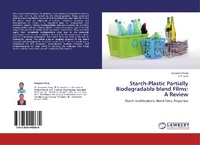
Starch-Plastic Partially Biodegradable blend Films
A Review
Published on 11. October 2013
Book
Paperback/Softback
92 pages
978-3-659-44968-0 (ISBN)
Description
The environmental impact of synthetic plastic wastes is of global concern as these are inert to the attack by the microorganisms. These persistent polymers are a significant source of environmental pollution and harm wild life when these are dispersed in nature. Therefore, recycling and degradations of plastics is an important issue for environment and economic reasons. Partially biodegradable polymers obtained by blending biodegradable and non biodegradable commercial polymers can effectively reduce the volume of plastic waste by partial degradation. They are more useful than completely biodegradable ones due to the economic advantages and superior properties, imparted by the commercial polymer used as a blending component. Pure starch does not form a film due to hydrophilic nature. This article gives an excellent account of the recent research and developments on starch based plastic films. The article is very informative for the researcher, academicians, business strategist, and environmentalist for their effort in reducing the pollution from these wastes and for sustainable growth using natural resources.
More details
Language
English
Product notice
Paperback (trade)
Unsewn / adhesive bound
Dimensions
Height: 220 mm
Width: 150 mm
Thickness: 7 mm
Weight
155 gr
ISBN-13
978-3-659-44968-0 (9783659449680)
Copyright in bibliographic data and cover images is held by Nielsen Book Services Limited or by the publishers or by their respective licensors: all rights reserved.
Schweitzer Classification
Persons
Dr. Sangeeta Garg, Ph D, working in the area of Environmental and Chemical Engineering, Associate Professor, NIT Jalandhar, Punjab, IndiaDr. A K Jana, Ph D, Working in the area of Environmental and Bio Chemical Engineering, Professor, NIT Jalandhar, Punjab, India