

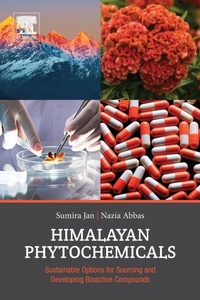
Himalayan Phytochemicals
Sustainable Options for Sourcing and Developing Bioactive Compounds
Published on 12. April 2018
Book
Paperback/Softback
316 pages
978-0-08-102227-6 (ISBN)
Description
Himalayan Phytochemicals: Sustainable Options for Sourcing and Developing Bioactive Compounds provides a detailed review of the important medicinal plants which have already been discovered in the Himalayan region, outlining their discovery, activity and underlying chemistry.
In addition, it supports a global shift towards sustainable sourcing of natural products from delicate ecosystems. Across the world, environmental destruction and overharvesting of medicinal plants are reducing and destroying multiple important sources and potential leads before researchers have the chance to discover, explore or synthesize them effectively. By identifying this problem and discussing its impact on the Himalayan region, Himalayan Phytochemicals: Sustainable Options for Sourcing and Developing Bioactive Compounds frames the ongoing global struggle and highlights the key factors that must be considered and addressed when working with phytochemicals from endemic plant sources.
In addition, it supports a global shift towards sustainable sourcing of natural products from delicate ecosystems. Across the world, environmental destruction and overharvesting of medicinal plants are reducing and destroying multiple important sources and potential leads before researchers have the chance to discover, explore or synthesize them effectively. By identifying this problem and discussing its impact on the Himalayan region, Himalayan Phytochemicals: Sustainable Options for Sourcing and Developing Bioactive Compounds frames the ongoing global struggle and highlights the key factors that must be considered and addressed when working with phytochemicals from endemic plant sources.
More details
Language
English
Place of publication
London
United Kingdom
Publishing group
Elsevier Health Sciences
Target group
Professional and scholarly
Primary audience: Researchers investigating bioactive agents from natural products as medicinal leads (including medicinal chemists and pharmaceutical scientists). Secondary audience: All groups studying the sustainable cultivation, sourcing and development of bioactive agents from flora in threatened ecosystems (including green chemists, botanists, taxonomists and environmental scientists)
Product notice
Paperback (trade)
Dimensions
Height: 229 mm
Width: 152 mm
Thickness: 17 mm
Weight
426 gr
ISBN-13
978-0-08-102227-6 (9780081022276)
Copyright in bibliographic data and cover images is held by Nielsen Book Services Limited or by the publishers or by their respective licensors: all rights reserved.
Schweitzer Classification
Other editions
Additional editions
Sumira Jan | Nazia Abbas
Himalayan Phytochemicals
Sustainable Options for Sourcing and Developing Bioactive Compounds
E-Book
04/2018
Elsevier
€210.00
Available for download
Persons
Dr. Sumira Jan has worked out numerous medicinal plants, focusing on their phyto-geographical distribution, ontogenetic changes, chemical profiling, chemo diversity, and pharmaceutical potential. She received BioCaRe Early Career Scientist Award (2014), prestigious Fast Track Young Scientist Award (2015) and CSIR pool scientist award (2018). She has published over 40 research papers, 16 book chapters and four books (Three with Elsevier and One with Springer). All these books are authored versions focused on the abiotic stress, eco-physiology and metabolomics of various crops. Dr. Nazia Abbas is working as a scientist at the CSIR-Indian Institute of Integrative Medicine. She was selected for the prestigious INSA-Young Scientist Award in 2016 and the DST-INSPIRE Faculty award in 2014. Her current work focuses on the molecular and physiochemical aspects of medicinal plants of the Kashmir Himalayas.
Content
1. Biogeographical distribution of medicinal and aromatic herbs
2. Utilization and botanical significance of Himalayan herbs
3. Conservation and cultivation of herbs: Challenge and policy making
4. Chemistry of Himalayan phytochemicals
5. Biotechnological strategies for improvement of aromatic and medicinal herbs
6. Quality assurance and quality control of medicinal and aromatic herbs
7. Marketing indigenous herbs: Connecting link between international trade and Himalayan livelihood
2. Utilization and botanical significance of Himalayan herbs
3. Conservation and cultivation of herbs: Challenge and policy making
4. Chemistry of Himalayan phytochemicals
5. Biotechnological strategies for improvement of aromatic and medicinal herbs
6. Quality assurance and quality control of medicinal and aromatic herbs
7. Marketing indigenous herbs: Connecting link between international trade and Himalayan livelihood