

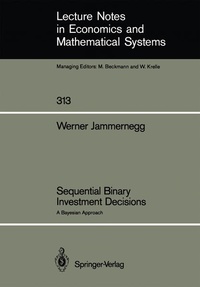
Sequential Binary Investment Decisions
A Bayesian Approach
Published on 27. July 1988
Book
Paperback/Softback
VI, 156 pages
978-3-540-50034-6 (ISBN)
Description
This book describes some models from the theory of investment which are mainly characterized by three features. Firstly, the decision-maker acts in a dynamic environment. Secondly, the distributions of the random variables are only incompletely known at the beginning of the planning process. This is termed as decision-making under conditions of uncer tainty. Thirdly, in large parts of the work we restrict the analysis to binary decision models. In a binary model, the decision-maker must choose one of two actions. For example, one decision means to undertake the invest ·ment project in a planning period, whereas the other decision prescribes to postpone the project for at least one more period. The analysis of dynamic decision models under conditions of uncertainty is not a very common approach in economics. In this framework the op timal decisions are only obtained by the extensive use of methods from operations research and from statistics. It is the intention to narrow some of the existing gaps in the fields of investment and portfolio analysis in this respect. This is done by combining techniques that have been devel oped in investment theory and portfolio selection, in stochastic dynamic programming, and in Bayesian statistics. The latter field indicates the use of Bayes' theorem for the revision of the probability distributions of the random variables over time.
More details
Series
Edition
Softcover reprint of the original 1st ed. 1988
Language
English
Place of publication
Berlin
Germany
Publishing group
Springer Berlin
Target group
Professional and scholarly
Research
Illustrations
VI, 156 p.
Dimensions
Height: 244 mm
Width: 170 mm
Thickness: 10 mm
Weight
302 gr
ISBN-13
978-3-540-50034-6 (9783540500346)
DOI
10.1007/978-3-642-46646-5
Schweitzer Classification
Content
1. Introduction.- 1.1 Uncertainty and Risk Aversion.- 1.2 Methods and Organization.- 2. The Monotonicity of Transition Probabilities.- 2.1 Sufficient Statistics.- 2.2 Posterior Distributions and Transition Probabilities.- 3. Dynamic Portfolio Models under Uncertainty.- 3.1 Classic Dynamic Portfolio Models.- 3.2 Binary Dynamic Portfolio Models under Uncertainty.- 4. The Optimal Timing of Investment.- 4.1 Investment Decisions and the Economic Life of Projects.- 4.2 A Deterministic Model in Continuous Time.- 4.3 Investment Models under Conditions of Risk.- 4.4 Investment Models under Conditions of Uncertainty.- 5. Concluding Remarks.- References.