

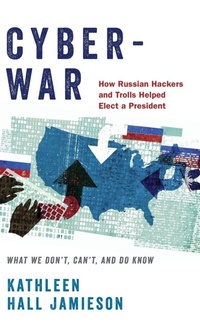
Cyberwar
How Russian Hackers and Trolls Helped Elect a President - What We Don't, Can't, and Do Know
Published on 22. November 2018
Book
Hardback
336 pages
978-0-19-091581-0 (ISBN)
Description
The question of how Donald Trump won the 2016 election looms over his presidency. In particular, were the 78,000 voters who gave him an Electoral College victory affected by the Russian trolls and hackers? Trump has denied it. So too has Vladimir Putin. Others cast the answer as unknowable.
Drawing on path-breaking work in which she and her colleagues isolated significant communication effects in the 2000 and 2008 presidential campaigns, the eminent political communication scholar Kathleen Hall Jamieson marshals the troll posts, unique polling data, analyses of how the press used the hacked content, and a synthesis of half a century of media effects research to argue that, although not certain, it is probable that the Russians helped elect the 45th president of the United States.
In the process, Cyberwar tackles questions that include: How extensive was the troll messaging? What characteristics of the social media platforms did the Russians exploit? Why did the mainstream press rush the hacked content into the citizenrys newsfeeds? Was Clinton telling the truth when she alleged that the debate moderators distorted what she said in the leaked speeches? Did the Russian influence extend beyond social media and news to alter the behavior of FBI director James Comey?
After detailing the ways in which the Russian efforts were abetted by the press, social media platforms, the candidates, party leaders, and a polarized public, Cyberwar closes with a warning: the country is ill-prepared to prevent a sequel.
Drawing on path-breaking work in which she and her colleagues isolated significant communication effects in the 2000 and 2008 presidential campaigns, the eminent political communication scholar Kathleen Hall Jamieson marshals the troll posts, unique polling data, analyses of how the press used the hacked content, and a synthesis of half a century of media effects research to argue that, although not certain, it is probable that the Russians helped elect the 45th president of the United States.
In the process, Cyberwar tackles questions that include: How extensive was the troll messaging? What characteristics of the social media platforms did the Russians exploit? Why did the mainstream press rush the hacked content into the citizenrys newsfeeds? Was Clinton telling the truth when she alleged that the debate moderators distorted what she said in the leaked speeches? Did the Russian influence extend beyond social media and news to alter the behavior of FBI director James Comey?
After detailing the ways in which the Russian efforts were abetted by the press, social media platforms, the candidates, party leaders, and a polarized public, Cyberwar closes with a warning: the country is ill-prepared to prevent a sequel.
Reviews / Votes
I found Jamieson's even-handed approach and detailed evidence both convincing and refreshing. * Terri Apter, Books of the Year 2018, The Times Literary Supplement * Illuminating, timely, Cyberwar is a major step forward in trying to understand the 'new' media order ... Jamieson provides perhaps the first authoritative account and synthesis of the copious amounts of data surrounding the 2016 attack ... the result is perhaps the clearest-cut glimpse of what an information war looks like... Cyberwar is more powerful for what it is not... * Alexander Kimburg, Nature * In her breakthrough new book Cyberwar, Kathleen Hall Jamieson applies her legendary skills to a forensic examination of the Russian hackers, trolls and bots who reshaped American public opinion through social media platforms, using data analytics to achieve maximum impact. Her masterful study provides a compelling answer to the question of whether Russia likely helped elect an American President. * Andrea Mitchell, NBC News Chief Foreign Affairs Correspondent MSNBC Anchor * Kathleen Hall Jamieson has performed a great service not just for politicians, journalists and curious citizens, but most important, for American democracy, by taking a scholar's approach to answering one of the most urgent and gnawing questions of our time: how did Russia try to influence the U.S. elections of 2016 and how much difference did that make? This is a must-read for everyone who cares about the future of the American electoral system. * Judy Woodruff, Anchor and Managing Editor, The PBS NewsHour * Kathleen Hall Jamieson mounts a strong challenge to the conventional wisdom that the Russia interference in the 2016 presidential race did not affect the outcome. Drawing on her expertise in presidential elections and how messages are received, she shows how the hacked emails influenced the media's focus and traces the powerful synergies between what the trolls were saying and what voters were ready to believe. It is hard to imagine a better application of careful scholarship to a central question for our country and deserves a wide readership. * Robert Jervis, Adlai E. Stevenson Professor of International Politics, Columbia University * One hopes [...] that everyone who studies presidential elections, everyone who safeguards their security, and particularly every journalist who covers them will heed this book. * Regina G. Lawrence, Public Opinion Quartlery *More details
Language
English
Place of publication
New York
United States
Target group
Professional and scholarly
Dimensions
Height: 222 mm
Width: 145 mm
Thickness: 21 mm
Weight
550 gr
ISBN-13
978-0-19-091581-0 (9780190915810)
Copyright in bibliographic data and cover images is held by Nielsen Book Services Limited or by the publishers or by their respective licensors: all rights reserved.
Schweitzer Classification
Other editions
Additional editions
Kathleen Hall Jamieson
Cyberwar
How Russian Hackers and Trolls Helped Elect a President: What We Don't, Can't, and Do Know
E-Book
05/2020
1st Edition
Oxford University Press
€31.99
Available for download
Kathleen Hall Jamieson
Cyberwar
How Russian Hackers and Trolls Helped Elect a President: What We Don't, Can't, and Do Know
E-Book
09/2018
1st Edition
OUP eBook
€9.49
Available for download
Kathleen Hall Jamieson
Cyberwar
How Russian Hackers and Trolls Helped Elect a President: What We Don't, Can't, and Do Know
E-Book
09/2018
1st Edition
OUP eBook
€9.49
Available for download
Person
Kathleen Hall Jamieson is the Elizabeth Ware Packard Professor of Communication at the Annenberg School for Communication of the University of Pennsylvania and Director of its Annenberg Public Policy Center. Among her award winning Oxford University Press books are Packaging the Presidency, Eloquence in an Electronic Age, Spiral of Cynicism (with Joseph Cappella), and The Obama Victory (with Kenski and Hardy).
Content
PrologueIntroductionPart One: Who Did It, Why, and How It May Have MatteredChapter One: How Do We Know that the Russians Meddled in the 2016 U.S. Presidential Election?Chapter Two: A Theory of Communication that Posits EffectsPart Two: The Pre-Requisites of InfluenceChapter Three: Pre-Requisite One: Widespread MessagingChapter Four: Pre-Requisite Two: Messages Aligned with Trump's Electoral InterestsChapter Five: Pre-Requisite Three: Messages to Mobilize Veterans and White Christians, Demobilizing Blacks and Sanders' Supporters, Shifting Liberals to SteinChapter Six: Pre-Requisite Four: Well-Targeted ContentChapter Seven: Pre-Requisite Five: Persuasive AppealsPart Three: Exposure: How the Russians Affected the News and Debate Agendas in the Last Month of the Campaign Chapter Eight: The Russian Effect On Press Coverage in OctoberChapter Nine: The Effect of the Stolen Emails on the Last Two Presidential DebatesChapter Ten: The Russian Effect on the Media Agenda in the Last Days of the ElectionPart Four: What We Don't, Can't, and Do Know About How Russian Hackers and Trolls Helped Elect Donald J. TrumpAfterword: LessonsAppendicesAppendix One: Changes in Perceptions of Clinton and Trump in OctoberAppendix Two: Debate 2 and Debate 3 Exposure Effect on Candidate Trait EvaluationsAppendix Three: Association between Perception Changes and Vote IntentionsReferences