

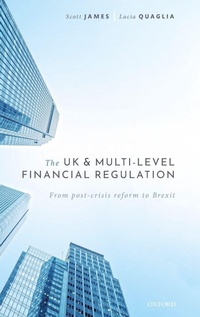
The UK and Multi-level Financial Regulation
From Post-crisis Reform to Brexit
Published on 6. February 2020
Book
Hardback
240 pages
978-0-19-882895-2 (ISBN)
Description
The UK and Multi-level Financial Regulation examines the role of the United Kingdom (UK) in shaping post-crisis financial regulatory reform, and assesses the implications of the UK's withdrawal from the European Union (EU). It develops a domestic political economy approach to examine how the interaction of three domestic groups - elected officials, financial regulators, and the financial industry - shaped UK preferences, strategy, and influence in international and EU-level regulatory negotiations. The framework is applied to five case studies: bank capital and liquidity requirements; bank recovery and resolution rules; bank structural reforms; hedge fund regulation; and the regulation of over-the-counter derivatives. It concludes by reflecting on the future of UK financial regulation after Brexit.
The book argues that UK regulators pursued more stringent regulation when they had strong political support to resist financial industry lobbying. UK regulators promoted international harmonisation of rules when this protected the competitiveness of industry or enabled cross-border externalities to be managed more effectively; but were often more resistant to new EU rules when these threatened UK interests. Consequently, the UK was more successful at shaping international standards by leveraging its market power, regulatory capacity, and alliance building (with the US). But it often met with greater political resistance at the EU level, forcing it to use legal challenges to block reform or secure exemptions. The book concludes that political and regulatory pressure was pivotal in defining the UK's 'hard' Brexit position, and so the future UK-EU relationship in finance will most likely be based on a framework of regulatory equivalence.
The book argues that UK regulators pursued more stringent regulation when they had strong political support to resist financial industry lobbying. UK regulators promoted international harmonisation of rules when this protected the competitiveness of industry or enabled cross-border externalities to be managed more effectively; but were often more resistant to new EU rules when these threatened UK interests. Consequently, the UK was more successful at shaping international standards by leveraging its market power, regulatory capacity, and alliance building (with the US). But it often met with greater political resistance at the EU level, forcing it to use legal challenges to block reform or secure exemptions. The book concludes that political and regulatory pressure was pivotal in defining the UK's 'hard' Brexit position, and so the future UK-EU relationship in finance will most likely be based on a framework of regulatory equivalence.
Reviews / Votes
Scott James and Lucia Quaglia do an outstanding job. * Erik Jones, Survival * An immensely original, significant and timely contribution to our understanding of Brexit, post-crisis financial regulatory reform, and multi-level governance. Unerring - and, indeed, unerringly sophisticated. Its novel 'domestic political economy' perspective deserves to be widely followed. * Colin Hay, Professor of Political Science, Sciences Po, Paris * With the release of The UK and Multi-Level Financial Regulation , finance watchers will no longer need to baffle over the UKs seemingly erratic post-crisis behavior: its frequent departure from light-touch regulation, its inconsistent support of European and international harmonization, and its apparent abandonment of City of London interests in the pursuit of Brexit. James and Quaglias timely and readable book promises to be the guide to the UKs role in shaping recent and future financial regulation. Scholars, analysts, authorities, and market participants will appreciate the meticulously-researched cases, recognition of regulators as political actors, incorporation of complexity and temporality, and theoretical synthesis all of which contribute to a compelling explanation of British goals, strategies and influence within Europe and at the international level. * Elliot Posner, Associate Professor of Political Science, Case Western Reserve University *More details
Language
English
Place of publication
Oxford
United Kingdom
Target group
Professional and scholarly
Dimensions
Height: 240 mm
Width: 161 mm
Thickness: 18 mm
Weight
529 gr
ISBN-13
978-0-19-882895-2 (9780198828952)
Copyright in bibliographic data and cover images is held by Nielsen Book Services Limited or by the publishers or by their respective licensors: all rights reserved.
Schweitzer Classification
Other editions
Additional editions
Scott James | Lucia Quaglia
The UK and Multi-level Financial Regulation
From Post-crisis Reform to Brexit
E-Book
02/2020
1st Edition
OUP eBook
€47.99
Available for download
Scott James | Lucia Quaglia
The UK and Multi-level Financial Regulation
From Post-crisis Reform to Brexit
E-Book
02/2020
1st Edition
OUP eBook
€56.49
Available for download
Persons
Dr Scott James joined King's College London in September 2008, and served as Deputy Head of the Department of Political Economy from 2015-16. From 2012 to 2016, he was Principal Investigator on the ESRC-funded 'Voices in the City' project, and since 2016 has been part of the UK research team for the nine-country Horizon 2020 'EMU Choices' project. In 2017 Dr James held a visiting position at the Blavatnik School of Government, University of Oxford. Dr James has published 14 articles in leading international journals, a monograph with Manchester University Press, and several book chapters with Palgrave Macmillan.
Lucia Quaglia is a Professor of Political Science at the University of Bologna (IT). She was professor of Political Science at the University of York (2012-2017) (UK). She was awarded research fellowships by the Hanse-Wissenschafts Kolleg (DE), the University of Bremen (DE), the Fonds National de la Recherche (Luxembourg), the Max Planck Institute in Cologne (DE), the Scuola Normale Superiore (IT), and the European University Institute (IT). She has published 7 books, 4 of which with Oxford University Press. She has guest co-edited 4 special issues of highly ranked academic journals.
Lucia Quaglia is a Professor of Political Science at the University of Bologna (IT). She was professor of Political Science at the University of York (2012-2017) (UK). She was awarded research fellowships by the Hanse-Wissenschafts Kolleg (DE), the University of Bremen (DE), the Fonds National de la Recherche (Luxembourg), the Max Planck Institute in Cologne (DE), the Scuola Normale Superiore (IT), and the European University Institute (IT). She has published 7 books, 4 of which with Oxford University Press. She has guest co-edited 4 special issues of highly ranked academic journals.
Content
1: INTRODUCTION
2: STATE OF THE ART AND RESEARCH DESIGN
3: SETTING THE MULTI-LEVEL CONTEXT
4: BANK CAPITAL AND LIQUIDITY REQUIREMENTS
5: BANK RECOVERY AND RESOLUTION RULES
6: BANK STRUCTURAL REFORMS
7: REGULATION OF HEDGE FUNDS
8: REGULATION OF OVER-THE-COUNTER DERIVATIVES
9: BREXIT AND THE FUTURE UK-EU RELATIONSHIP
10: CONCLUSION
2: STATE OF THE ART AND RESEARCH DESIGN
3: SETTING THE MULTI-LEVEL CONTEXT
4: BANK CAPITAL AND LIQUIDITY REQUIREMENTS
5: BANK RECOVERY AND RESOLUTION RULES
6: BANK STRUCTURAL REFORMS
7: REGULATION OF HEDGE FUNDS
8: REGULATION OF OVER-THE-COUNTER DERIVATIVES
9: BREXIT AND THE FUTURE UK-EU RELATIONSHIP
10: CONCLUSION