

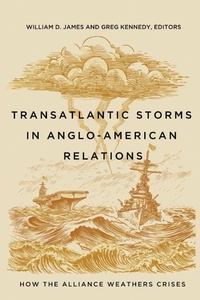
Transatlantic Storms in Anglo-American Relations
How the Alliance Weathers Crises
Published on 3. March 2026
Book
Paperback/Softback
316 pages
978-1-64712-682-7 (ISBN)
Description
An authoritative, in-depth study on the character, legacy, and trajectory of the UK-US alliance
After the chaotic withdrawal from Afghanistan in 2021, many observers declared the UK-US alliance-often dubbed "the special relationship"-dead. Yet this was hardly the first time the partnership was read its last rites. Indeed, one of its defining characteristics is its resilience in the face of political volatility and geopolitical shifts.
Transatlantic Storms in Anglo-American Relations explains how the world's most consequential bilateral alliance endures despite countless crises. The book's contributors trace the roots of the US-UK alliance; analyse the institutionalized pillars of nuclear, military, and intelligence cooperation; and highlight underappreciated aspects of economic and defense-industrial interdependence. Drawing on archival research and interviews, the volume revisits lesser-known strategic flashpoints and reveals how twentieth-century crises tested the alliance without breaking its foundations.
Amid the US rebalance to the Indo-Pacific and Donald Trump's return to the White House, James and Kennedy provide an essential guide for understanding the character, legacy, and trajectory of the UK-US relationship.
After the chaotic withdrawal from Afghanistan in 2021, many observers declared the UK-US alliance-often dubbed "the special relationship"-dead. Yet this was hardly the first time the partnership was read its last rites. Indeed, one of its defining characteristics is its resilience in the face of political volatility and geopolitical shifts.
Transatlantic Storms in Anglo-American Relations explains how the world's most consequential bilateral alliance endures despite countless crises. The book's contributors trace the roots of the US-UK alliance; analyse the institutionalized pillars of nuclear, military, and intelligence cooperation; and highlight underappreciated aspects of economic and defense-industrial interdependence. Drawing on archival research and interviews, the volume revisits lesser-known strategic flashpoints and reveals how twentieth-century crises tested the alliance without breaking its foundations.
Amid the US rebalance to the Indo-Pacific and Donald Trump's return to the White House, James and Kennedy provide an essential guide for understanding the character, legacy, and trajectory of the UK-US relationship.
More details
Language
English
Place of publication
Washington, DC
United States
Target group
Professional and scholarly
US School Grade: College Graduate Student and over
Product notice
Paperback (trade)
Illustrations
Not illustrated
Dimensions
Height: 229 mm
Width: 152 mm
Thickness: 18 mm
Weight
429 gr
ISBN-13
978-1-64712-682-7 (9781647126827)
Copyright in bibliographic data and cover images is held by Nielsen Book Services Limited or by the publishers or by their respective licensors: all rights reserved.
Schweitzer Classification
Other editions
Additional editions
William D. James | Greg Kennedy
Transatlantic Storms in Anglo-American Relations
How the Alliance Weathers Crises
E-Book
03/2026
Georgetown University Press
€49.49
Available for download
Persons
William D. James is assistant professor of strategic studies in the S. Rajaratnam School of International Studies at Nanyang Technological University in Singapore. He is the author of British Grand Strategy in the Age of American Hegemony (2024).
Greg Kennedy is professor of strategic foreign policy in the Defence Studies Department at King's College London, where he leads the Economic Conflict & Competition Research Group. He is the author of Anglo-American Strategic Relations and the Far East, 1933-1939 (2002) and more than ten other edited volumes on defense policy and strategy.
Greg Kennedy is professor of strategic foreign policy in the Defence Studies Department at King's College London, where he leads the Economic Conflict & Competition Research Group. He is the author of Anglo-American Strategic Relations and the Far East, 1933-1939 (2002) and more than ten other edited volumes on defense policy and strategy.
Content
Acknowledgments
Introduction: The Nature and Character of Anglo-American Strategic Relations, Greg Kennedy
Part I: The Roots and Practice of Institutional Cooperation
1. The US-UK Nuclear Relationship in American Politics, Suzanne Doyle
2. Multinational Coalition Warfare and the Anglo-American Experiment in the Mediterranean, 1942-43, Carson Teuscher
3. BRUSA: Antecedents, Foundation, and Formative Conduct, 1940-43, C. J. Jenner
4. Anglo-American Clandestine Cooperation: The Past, Present, and Future of the Special Intelligence Relationship(s), Thomas Maguire and David V. Gioe
5. Anglo-American Military Relations Since the End of the Cold War, Wyn Rees
Part II: Economic and Industrial Cooperation
6. The United States, the United Kingdom, and the International Financial System Since 1945, Michael F. Hopkins
7. Joint Strike Fighter and Transatlantic Defense Procurement, Emma Salisbury
Part III: Crisis Points
8. The First World War and the Anglo-American Crisis of 1916, Andrew Gawthorpe
9. Loyalty, Inertia, and a High-Level Tiff: Anglo-American Relations in 1956, Gill Bennett
10. Jordan and Kuwait: US-UK Relations in the Aftermath of Suez, Louise Kettle
11. The Secret Weapon: Chevaline's Stealthy Legacy, Reja Younis
12. Divergent Decisions, Shared Vision: US-UK Relations and Strategic Choices Following the Soviet Invasion of Afghanistan, Barbara Zanchetta
13. Wagging the Dog? Blair, Clinton, and the "Special Relationship" in the Kosovo Crisis, Jonathan Esty
Conclusion: 1956 and All That: Is the Anglo-American Alliance Immune to Political Crises?, William D. James
List of Contributors
Index
Introduction: The Nature and Character of Anglo-American Strategic Relations, Greg Kennedy
Part I: The Roots and Practice of Institutional Cooperation
1. The US-UK Nuclear Relationship in American Politics, Suzanne Doyle
2. Multinational Coalition Warfare and the Anglo-American Experiment in the Mediterranean, 1942-43, Carson Teuscher
3. BRUSA: Antecedents, Foundation, and Formative Conduct, 1940-43, C. J. Jenner
4. Anglo-American Clandestine Cooperation: The Past, Present, and Future of the Special Intelligence Relationship(s), Thomas Maguire and David V. Gioe
5. Anglo-American Military Relations Since the End of the Cold War, Wyn Rees
Part II: Economic and Industrial Cooperation
6. The United States, the United Kingdom, and the International Financial System Since 1945, Michael F. Hopkins
7. Joint Strike Fighter and Transatlantic Defense Procurement, Emma Salisbury
Part III: Crisis Points
8. The First World War and the Anglo-American Crisis of 1916, Andrew Gawthorpe
9. Loyalty, Inertia, and a High-Level Tiff: Anglo-American Relations in 1956, Gill Bennett
10. Jordan and Kuwait: US-UK Relations in the Aftermath of Suez, Louise Kettle
11. The Secret Weapon: Chevaline's Stealthy Legacy, Reja Younis
12. Divergent Decisions, Shared Vision: US-UK Relations and Strategic Choices Following the Soviet Invasion of Afghanistan, Barbara Zanchetta
13. Wagging the Dog? Blair, Clinton, and the "Special Relationship" in the Kosovo Crisis, Jonathan Esty
Conclusion: 1956 and All That: Is the Anglo-American Alliance Immune to Political Crises?, William D. James
List of Contributors
Index