

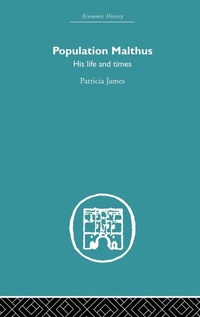
Population Malthus
His Life and Times
1st Edition
Published on 3. November 2005
Book
Hardback
552 pages
978-0-415-38113-0 (ISBN)
Description
This is a fascinating insight into the work of one of our greatest thinkers.
Thomas Robert Malthus (1766-1834) is best remembered today for his theories on the menace of over-population; this first ever full-length biography shows him also in his role as one of the founders of classical political economy, still a controversial figure in the history of economic thought. Based on exhaustive research among contemporary sources, it gives an account of Malthus's two careers, as an economist and as a professor at the East India College.
Patricia James describes how, at the East India College, Malthus was influential in the establishment of an incorruptible Civil Service and the modern system of written examinations, in circumstances which seem almost farcical today. She gives an account of his family and social life, which was full of warmth and variety, with an abundance of 'characters' as well as many famous men.
People nowadays are inclined to argue in a vacuum whether Malthus is 'right' or 'wrong' about population outrunning subsistence, and about the adequacy of aggregate demand in a capitalist society. Patricia James shows him in his historical setting, so that the book is a study both of the man and of the age in which he lived. She believes that, paradoxically, if we view Malthus's works as the period pieces they are, it becomes more and not less easy to see their relevance to our own problems. Although Malthus's search for basic principles in a changing world was confused and erratic, his ideas are still illuminating to those who prefer investigation and reappraisal to the mere reiteration of dogma. This text was first published in 1975.
Thomas Robert Malthus (1766-1834) is best remembered today for his theories on the menace of over-population; this first ever full-length biography shows him also in his role as one of the founders of classical political economy, still a controversial figure in the history of economic thought. Based on exhaustive research among contemporary sources, it gives an account of Malthus's two careers, as an economist and as a professor at the East India College.
Patricia James describes how, at the East India College, Malthus was influential in the establishment of an incorruptible Civil Service and the modern system of written examinations, in circumstances which seem almost farcical today. She gives an account of his family and social life, which was full of warmth and variety, with an abundance of 'characters' as well as many famous men.
People nowadays are inclined to argue in a vacuum whether Malthus is 'right' or 'wrong' about population outrunning subsistence, and about the adequacy of aggregate demand in a capitalist society. Patricia James shows him in his historical setting, so that the book is a study both of the man and of the age in which he lived. She believes that, paradoxically, if we view Malthus's works as the period pieces they are, it becomes more and not less easy to see their relevance to our own problems. Although Malthus's search for basic principles in a changing world was confused and erratic, his ideas are still illuminating to those who prefer investigation and reappraisal to the mere reiteration of dogma. This text was first published in 1975.
More details
Series
Language
English
Place of publication
London
United Kingdom
Publishing group
Taylor & Francis Ltd
Target group
College/higher education
Professional and scholarly
Dimensions
Height: 240 mm
Width: 161 mm
Thickness: 34 mm
Weight
989 gr
ISBN-13
978-0-415-38113-0 (9780415381130)
Copyright in bibliographic data and cover images is held by Nielsen Book Services Limited or by the publishers or by their respective licensors: all rights reserved.
Schweitzer Classification
Other editions
Additional editions
E-Book
11/2013
1st Edition
Routledge
€77.99
Available for download
E-Book
11/2013
1st Edition
Routledge
€77.99
Available for download
Book
03/2013
1st Edition
Routledge
€85.70
Shipment within 15-20 days
Person
Patricia James
Content
Acknowledgments Prologue 1. Background 2. The Principle of Population 3. The Great Quarto of 1803 4. The Population Controversies Begin 5. A Married Professor (1804-10) 6. Paper Money 7. The Haileybury Champion (1811-17) 8. Literary Misfortunes (1812-15) 9. The Principles of Political Economy 10. The Heat of the Day (1817-25) 11. Declining Sun (1825-34) Epilogue Notes and References Index