

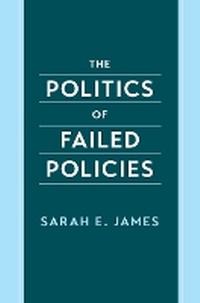
The Politics of Failed Policies
Published on 18. July 2025
Book
Hardback
312 pages
978-0-19-781360-7 (ISBN)
Description
The Politics of Failed Policies examines the darker side of state autonomy and policy experimentation in our federal system: policy failure. While advances in statistics and computing promised the ability to evaluate the outcomes of state policies more precisely and accurately, the path from information to responsive policy remains far from guaranteed, especially given our highly polarized political climate. Most of the existing scholarship focuses on individual characteristics that affect public officials' likelihood of internalizing new information and refining their policy preferences. In stark contrast, author Sarah James takes a historical institutionalist approach and shows that the design, resources, and processes of state-level research institutions can systematically influence when evidence can overcome confirmation bias and partisan preferences among elected state officials evaluating a policy. This work contributes a more precise definition of a state's capacity for research that better explains political responses to policy failure. The detailed case studies support a theory of policy feedback in which policy and institutional landscape can empower diffusely organized and disadvantaged policy opponents to overcome the power of the traditional winners in the American political economy.
The Politics of Failed Policies takes seriously that policy research and learning are not isolated from the caprices of party politics, and yet James shows that state politics and policymaking are not irrevocably beholden to the whims of partisan bickering. While ideological battles, pressure from well-resourced interest groups, and, yes, even elections, remain formidable forces in American politics, strategically designed state policies and institutions can lay a foundation for building a coalition to respond to actual policy outcomes. Choices about policy and institutional design have long-term effects on when, how, and why public officials feel pressured to acknowledge and respond to policy failure.
The Politics of Failed Policies takes seriously that policy research and learning are not isolated from the caprices of party politics, and yet James shows that state politics and policymaking are not irrevocably beholden to the whims of partisan bickering. While ideological battles, pressure from well-resourced interest groups, and, yes, even elections, remain formidable forces in American politics, strategically designed state policies and institutions can lay a foundation for building a coalition to respond to actual policy outcomes. Choices about policy and institutional design have long-term effects on when, how, and why public officials feel pressured to acknowledge and respond to policy failure.
Reviews / Votes
Building on implementation literature, James looks at two factors at the state level that determine whether policies are deemed failures and repealed: first, a state's data collection capacity, and second, its analytical capacity to examine the data. ..What readers learn here is that there is a politics of data or evidence, and the choice of whether to provide good data and analysis of policy is often highly contested. Excellent for collections on American politics, policy, and implementation. * D. Schultz, CHOICE *More details
Series
Language
English
Place of publication
New York
United States
Target group
College/higher education
Dimensions
Height: 19 mm
Width: 156 mm
Thickness: 235 mm
Weight
547 gr
ISBN-13
978-0-19-781360-7 (9780197813607)
Copyright in bibliographic data and cover images is held by Nielsen Book Services Limited or by the publishers or by their respective licensors: all rights reserved.
Schweitzer Classification
Other editions
Additional editions
Sarah James
The Politics of Failed Policies
Book
10/2025
Oxford University Press Inc
€30.50
Shipment within 15-20 days


Person
Sarah James is an assistant professor of political science at Gonzaga University. She has a PhD in Government and Social Policy from Harvard University. She was the Arleen Carlson & Edna Nelson Graduate Fellow at the Radcliffe Institute for Advanced Study and a fellow in the Multidisciplinary Program on Inequality and Social Policy at the Harvard Kennedy School. James has published in State Politics and Policy Quarterly, The Russel Sage Journal for the Social Sciences, and College Teaching. James also has a M.Ed. in curriculum and instruction from Boston University. She has extensive experience in public K-12 education, first as a teacher, then as a high school principal, and she currently serves on the board of trustees for a Boston charter school.
Content
Part I: Theoretical contributions Chapter 1 : The tricky thing about experimenting Chapter 2 : Policy feedback, institutions, and policy learning Chapter 3 : Methodological Approach & Case Selection Chapter 4 : If you aren't counted, your problems don't count: Defining and theorizing collection capacity Chapter 5 : Moving beyond counting: Defining and theorizing analytical capacity Part II: Case Studies Chapter 6 : The Clear Cut Case (Washington taxes) Chapter 7 : The Treasure Trove Case (Texas Truancy) Chapter 8 : The Hollow Case (Washington Truancy) Chapter 9 : The Status-Quo Case (Texas' Tax Incentives) Chapter 10 : Experimentation & failure as opportunities References Appendix A : Building Policy Trajectories