

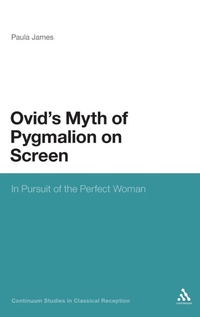
Ovid's Myth of Pygmalion on Screen
In Pursuit of the Perfect Woman
Published on 8. December 2011
Book
Hardback
248 pages
978-1-4411-8466-5 (ISBN)
Description
Exploration of the reception of Ovid's myth thorughout history in fiction, film and television. Why has the myth of Pygmalion and his ivory statue proved so inspirational for writers, artists, philosophers, scientists, and directors and creators of films and television series? The 'authorised' version of the story appears in the epic poem of transformations, "Metamorphoses", by the first-century CE Latin poet Ovid; in which the bard Orpheus narrates the legend of the sculptor king of Cyprus whose beautiful carved woman was brought to life by the goddess Venus. Focusing on screen storylines with a "Pygmalion" subtext, from silent cinema to "Buffy the Vampire Slayer" and "Lars and the Real Girl", this book looks at why and how the made-over or manufactured woman has survived through the centuries and what we can learn about this problematic model of 'perfection' from the perspective of the past and the present. Given the myriad representations of Ovid's myth, can we really make a modern text a tool of interpretation for an ancient poem? This book answers with a resounding 'yes' and explains why it is so important to give antiquity back its future.
"Continuum Studies in Classical Reception" presents scholarly monographs offering new and innovative research and debate to students and scholars in the reception of 'Classical Studies'. Each volume will explore the appropriation, reconceptualization and recontextualization of various aspects of the Graeco-Roman world and its culture, looking at the impact of the ancient world on modernity. Research will also cover reception within antiquity, the theory and practice of translation, and reception theory.
"Continuum Studies in Classical Reception" presents scholarly monographs offering new and innovative research and debate to students and scholars in the reception of 'Classical Studies'. Each volume will explore the appropriation, reconceptualization and recontextualization of various aspects of the Graeco-Roman world and its culture, looking at the impact of the ancient world on modernity. Research will also cover reception within antiquity, the theory and practice of translation, and reception theory.
Reviews / Votes
Paula James has produced a brilliant and engaging study of how and why the modern media of film and television continue to refashion ancient mythological narratives for contemporary audiences, in this case, Ovid's story of Pygmalion and his ivory statue come to life. In a series of provocative and detailed chapters, James expertly examines an array of cinematic and televisual texts - from classic films like Vertigo (1958) to more recent screen productions such as Lars and the Real Girl (2007) and Buffy the Vampire Slayer (1997-2003) - that correspond on both the narrative and figurative levels to Ovid's myth of the "made-over woman." James deftly unravels the myth's infinite and powerful layers as she explores the popular genre of "make-over films," while delving into the question of our eternal fascination with the theme of artfully - or artificially - created life and the problems of "perfection" inherent in the eyes of the beholder. With the analytical skills of a classicist and the ardor of a film fan, James succeeds in assessing both the impact of the classical myth on modern viewers, as well as how each onscreen reception in its current cultural context sheds further interpretive light on the ancient story. Monica S. Cyrino, University of New Mexico, USA The story of Elisa Doolittle, the working class flower girl transformed into the image of a Duchess by Professor Higgins, was made famous by the 1964 musical My Fair Lady. In her excellent book, Paula James positions this story within a more complex and long standing literary and cinematic tradition. Beginning with Ovid's epic poetry and his version of the Pygmalion myth, James explores how the narrative trope of the make-over has been repeatedly reworked and re-imagined on screen. Bringing together an exciting range of literary, cinematic, and televisual texts as diverse as Pygmalion, Vertigo, Pretty Woman, Miss Congeniality and Buffy the Vampire Slayer, James offers an insightful discussion of the perennial cultural need to fashion and re-fashion women into a fantasy ideal. Scholarly and engaging, this book will make you look at these texts, whether classical or pop culture, like never before. Stacey Abbot, Reader in Film and Television Studies, Roehampton University, London, UK Drawing on an impressive range of scholarship, James generously acknowledges the work of others as well as forming her own conclusions surrounding the ultimate inadequacies of the created feminine ideal.. The book explores the ongoing fascination with Ovid's Pygmalion story, explains why it still has powerful resonances today and, furthermore, suggests how its new reworkings can illuminate readings of Ovid's Metamorphoses itself. -- Rosemary Barrow * Bryn Mawr Classical Review * The fortunes of the Pygmalion story in literature and the fine arts have been well canvassed over the years; James provides the most extensive coverage so far for film and television. -- Gordon Braden University of Virginia * Translation and Literature *More details
Series
Language
English
Place of publication
New York
United States
Target group
College/higher education
Dimensions
Height: 240 mm
Width: 161 mm
Thickness: 18 mm
Weight
537 gr
ISBN-13
978-1-4411-8466-5 (9781441184665)
Copyright in bibliographic data and cover images is held by Nielsen Book Services Limited or by the publishers or by their respective licensors: all rights reserved.
Schweitzer Classification
Other editions
Additional editions
E-Book
10/2011
1st Edition
Bloomsbury Continuum
€31.99
Available for download
Person
Paula James is Senior Lecturer in Classical Studies at The Open University, UK, and has published widely in Latin Literature and on the reception of classical motifs in popular culture. She has appeared on 'Womens Hour' on Radio 4 to talk about her previos book The Role of the Parrot in Selected Texts from Ovid to Jean Rhysand has also appeared on Radio 3's Greek and Roman Essay series, speaking on Cicero.
Content
1. Preface - Why Pygmalion?; 2. Introduction - Ovid's Pygmalion Myth and its cultural contexts; 3. My Fair Lady: the make-over movie from Shaw's Pygmalion to Miss Congeniality; 4. Bringing the Gods down to Earth - supernatural statues on film; 5. Lesser mortals, lesser movies and the mannequin factor; 6. Bathos and Pathos - perfect girlfriends who fail to please; 7. Producing Pandoras - screen robots and 'virtual' women as unpredictable partners; 8. Role reversals: Female empowerment and Haraway's 'cyborg manifesto'; 9. Crossing boundaries: returning Pygmalion to the pedestal?; 10. Where do we go from here? Thinking with Myth and Myth-making in the future; Bibliography; Index.