

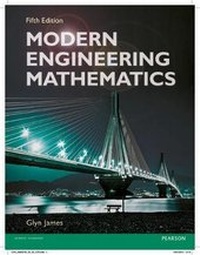
Modern Engineering Mathematics
5th Edition
Published on 30. April 2015
Book
Paperback/Softback
1152 pages
978-1-292-08073-4 (ISBN)
Description
This book provides a complete course for first-year engineering mathematics. Whichever field of engineering you are studying, you will be most likely to require knowledge of the mathematics presented in this textbook. Taking a thorough approach, the authors put the concepts into an engineering context, so you can understand the relevance of mathematical techniques presented and gain a fuller appreciation of how to draw upon them throughout your studies.
More details
Edition
5th edition
Language
English
Place of publication
Harlow
United Kingdom
Target group
College/higher education
Professional and scholarly
Dimensions
Height: 245 mm
Width: 190 mm
Thickness: 40 mm
Weight
1843 gr
ISBN-13
978-1-292-08073-4 (9781292080734)
Copyright in bibliographic data and cover images is held by Nielsen Book Services Limited or by the publishers or by their respective licensors: all rights reserved.
Schweitzer Classification
Other editions
New editions
Glyn James | Phil Dyke
Modern Engineering Mathematics
Book
02/2020
6th Edition
Pearson Education Limited
€76.50
Shipment within 10-20 days
Previous edition
Book
05/2010
4th Edition
Prentice-Hall
€66.84
Article exhausted; check for reprint
Person
Glyn James is currently Emeritus Professor in Mathematics at Coventry University, having previously been Dean of the School of Mathematical and Information Sciences. As in previous editions he has drawn upon the knowledge and experience of his co-authors to provide an excellent revision of the book.
Content
Table of Contents
Chapter 1: Numbers, Algebra and Geometry
1.1 Introduction
1.2 Number and arithmetic
1.3 Algebra
1.4 Geometry
1.5 Numbers and accuracy
1.6 Engineering applications
1.7 Review exercises
Chapter 2: Functions
2.1 Introduction
2.2 Basic definitions
2.3 Linear and quadratic functions
2.4 Polynomial functions
2.5 Rational functions
2.6 Circular functions
2.7 Exponential, logarithmic and hyperbolic functions
2.8 Irrational functions
2.9 Numerical evaluation of functions
2.10 Engineering application: a design problem
2.11 Review exercises
Chapter 3: Complex Numbers
3.1 Introduction
3.2 Properties
3.3 Powers of complex numbers
3.4 Loci in the complex plane
3.5 Functions of a complex variable
3.6 Engineering application: alternating currents in electrical networks
3.7 Review exercises
Chapter 4: Vector Algebra
4.1 Introduction
4.2 Basic definitions and results
4.3 The vector treatment of the geometry of lines and planes
4.4 Engineering application: spin-dryer suspension
4.5 Engineering application: cable stayed bridge
4.6 Review exercises
Chapter 5: Matrix Algebra
5.1 Introduction
5.2 Definitions and properties
5.3 Determinants
5.4 The inverse matrix
5.5 Linear equations
5.6 Rank
5.7 The eigenvalue problem
5.8 Engineering application: spring systems
5.9 Engineering application: steady heat transfer through composite materials
5.10 Review exercises
Chapter 6: An Introduction to Discrete Mathematics
6.1 Introduction
6.2 Set theory
6.3 Switching and logic circuits
6.4 Propositional logic and methods of proof
6.5 Engineering application: expert systems
6.6 Engineering application: control
6.7 Review exercises
Chapter 7: Sequences, Series and Limits
7.1 Introduction
7.2 Sequences and series
7.3 Finite sequences and series
7.4 Recurrence relations
7.5 Limit of a sequence
7.6 Infinite series
7.7 Power series
7.8 Functions of a real variable
7.9 Continuity of functions of a real variable
7.10 Engineering application: insulator chain
7.11 Engineering application: approximating functions and Pade approximants
7.12 Review exercises
Chapter 8: Differentiation and Integration
8.1 Introduction
8.2 Differentiation
8.3 Techniques of differentiation
8.4 Higher derivatives
8.5 Applications of optimization problems
8.6 Numerical differentiation
8.7 Integration
8.8 Techniques of integration
8.9 Applications of integration
8.10 Numerical evaluation of integrals
8.11 Engineering application: design of prismatic channels
Chapter 1: Numbers, Algebra and Geometry
1.1 Introduction
1.2 Number and arithmetic
1.3 Algebra
1.4 Geometry
1.5 Numbers and accuracy
1.6 Engineering applications
1.7 Review exercises
Chapter 2: Functions
2.1 Introduction
2.2 Basic definitions
2.3 Linear and quadratic functions
2.4 Polynomial functions
2.5 Rational functions
2.6 Circular functions
2.7 Exponential, logarithmic and hyperbolic functions
2.8 Irrational functions
2.9 Numerical evaluation of functions
2.10 Engineering application: a design problem
2.11 Review exercises
Chapter 3: Complex Numbers
3.1 Introduction
3.2 Properties
3.3 Powers of complex numbers
3.4 Loci in the complex plane
3.5 Functions of a complex variable
3.6 Engineering application: alternating currents in electrical networks
3.7 Review exercises
Chapter 4: Vector Algebra
4.1 Introduction
4.2 Basic definitions and results
4.3 The vector treatment of the geometry of lines and planes
4.4 Engineering application: spin-dryer suspension
4.5 Engineering application: cable stayed bridge
4.6 Review exercises
Chapter 5: Matrix Algebra
5.1 Introduction
5.2 Definitions and properties
5.3 Determinants
5.4 The inverse matrix
5.5 Linear equations
5.6 Rank
5.7 The eigenvalue problem
5.8 Engineering application: spring systems
5.9 Engineering application: steady heat transfer through composite materials
5.10 Review exercises
Chapter 6: An Introduction to Discrete Mathematics
6.1 Introduction
6.2 Set theory
6.3 Switching and logic circuits
6.4 Propositional logic and methods of proof
6.5 Engineering application: expert systems
6.6 Engineering application: control
6.7 Review exercises
Chapter 7: Sequences, Series and Limits
7.1 Introduction
7.2 Sequences and series
7.3 Finite sequences and series
7.4 Recurrence relations
7.5 Limit of a sequence
7.6 Infinite series
7.7 Power series
7.8 Functions of a real variable
7.9 Continuity of functions of a real variable
7.10 Engineering application: insulator chain
7.11 Engineering application: approximating functions and Pade approximants
7.12 Review exercises
Chapter 8: Differentiation and Integration
8.1 Introduction
8.2 Differentiation
8.3 Techniques of differentiation
8.4 Higher derivatives
8.5 Applications of optimization problems
8.6 Numerical differentiation
8.7 Integration
8.8 Techniques of integration
8.9 Applications of integration
8.10 Numerical evaluation of integrals
8.11 Engineering application: design of prismatic channels