

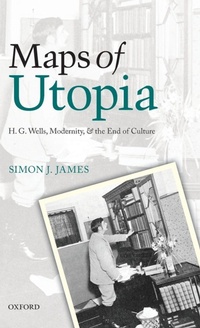
Maps of Utopia
H. G. Wells, Modernity and the End of Culture
1st Edition
Published on 2. February 2012
Book
Hardback
246 pages
978-0-19-960659-7 (ISBN)
Description
H. G. Wells is one of the most widely-read writers of the twentieth century, but until now the aesthetics of his work have not been investigated in detail. Maps of Utopia tells the story of Wells's writing career over six decades, during which he produced popular science, educational theory, history, politics, prophecy, and utopia, as well as realist, experimental, and science fiction. This book asks what Wells thought literature was, and what he thought it was for. H. G. Wells formulated a literary aesthetics based on scientific principles, designed to improve the world both in the present and for future generations. Unlike Henry James, with whom he famously argued, Wells was not content simply to let literary art be, for its own sake: he wanted to make art instrumental in improving the lives of its readers, by bringing about the founding the World State that he predicted was man's only alternative to self-destruction. Such a project differed radically from the aims of Wells's late-Victorian and his Modernist contemporaries - with consequences for the nature both of Wells's writing and for his subsequent critical reception.
Maps of Utopia begins with the late-Victorian debate about the uses of effect of reading, especially reading fiction, that followed the mass literacy of the 1870-71 Education Acts. It considers Wells's best known scientific romances, such as The Time Machine and The War of the Worlds, and important social novels such as Tono-Bungay. It also examines less well-known texts such as The Sea Lady, Boon and Wells's journalism and political writings. This study closes with his cinematic collaboration The Shape of Things to Come, and The Outline of History, Wells's best-selling book in his own lifetime.
Maps of Utopia begins with the late-Victorian debate about the uses of effect of reading, especially reading fiction, that followed the mass literacy of the 1870-71 Education Acts. It considers Wells's best known scientific romances, such as The Time Machine and The War of the Worlds, and important social novels such as Tono-Bungay. It also examines less well-known texts such as The Sea Lady, Boon and Wells's journalism and political writings. This study closes with his cinematic collaboration The Shape of Things to Come, and The Outline of History, Wells's best-selling book in his own lifetime.
Reviews / Votes
The great strength of Maps of Utopia is located in the way it combines an introductory quality with insights that will make the most seasoned devotee of Wells think. Maps of Utopia is undoubtedly one of the very best studies of Wellsas entire oeuvre. Like all strong monographs, it has implications beyond its immediate subject matter. Thus James implies that English as a subject, whose founding coincided with and perpetuated the exclusion of authors outside the modernist canon, needs to put its house of fiction in order. * Steven McLean, Literature & History * One of the strengths of James's book is the depth of research that underlies the detailed contextualisation of Wells's output; it should be added that this output is presented in nearcomprehensive breadth, which again makes the book required reading for any student of Wells. * Ben Carver, Independent Scholar * an insightful reading ... James deftly delineates various narrative devices that Wells deployed to fashion works of "instrumental value" while negotiating the uncomfortable restrictiveness of literary realism and the equally uncomfortable freedom of romance ... a rewarding study of Wells's didactic narrative techniques. * William J Scheick, English Literature in Transition (1880-1920) * Of the numerous critical books that aspire to explain the importance and shape of Wells whole career, this seems to me one of the best: intelligent, lively, and sensitive to the cultural issues at the heart of Wellss urge to be both an artist and an educator. * John Huntington, The Wellsian * James has written one of the best books on Wells in recent memory Including meticulous documentation and informative footnotes but written in an engaging, accessible style, this book will appeal to devotees of Wells, specialists in Victorian and modernist fiction, and those interested in good literary criticism. * C.A. Rydel, Choice * It is a very informative read, offering not only an original study of Wells, but also an overview of late 19th- and 20th-century debates on culture to which we should do well to return. * Laura Scuriatti, Times Higher Education * As Editor of The Wellsian, Simon J. James has considerable experience of editing and writing on the works of H. G. Wells and George Gissing. James's latest book acknowledges the recent interest in Wells the man ... but quietly and assuredly refocuses attention on the scientifically motivated aesthetic programme that governed Wells's writing. * Emelyne Godfrey, Times Literary Supplement * Wells' evolutionary views seem to have a relevance today, and if that is the case then it is well that the books about him should be as clear, as well-argued and as comprehensive as this excellant example by Simon James. * Paul Kincaid, Foundation *More details
Language
English
Place of publication
Oxford
United Kingdom
Target group
College/higher education
Professional and scholarly
Students and scholars of late nineteenth- and early twentieth-century literature
Illustrations
One black-and-white halftone
Dimensions
Height: 222 mm
Width: 145 mm
Thickness: 17 mm
Weight
446 gr
ISBN-13
978-0-19-960659-7 (9780199606597)
Copyright in bibliographic data and cover images is held by Nielsen Book Services Limited or by the publishers or by their respective licensors: all rights reserved.
Schweitzer Classification
Other editions
Additional editions
E-Book
02/2012
1st Edition
Oxford University Press
€170.83
Available for download
Person
Dr Simon J. James is Professor of Victorian Literature at Durham University. He is the author of Unsettled Accounts: Money and Narrative Form in the Novels of George Gissing and of work on Charles Dickens, H. G. Wells, and Edwardian fiction. He has edited four Wells novels for Penguin Classics, and is the current editor of The Wellsian, the scholarly journal of the H. G. Wells Society.
Content
1. Of Art, Of Literature, Of Mr. H. G. Wells ; 2. The History of the Future: The Scientific Romances ; 3. The Uses of Literacy: Reading and Realismin Wells's Novels ; 4. The Idea of a Planned World: H. G. Wells's Utopias ; 5. Education and Catastrophe: The War and the World ; Bibliography