

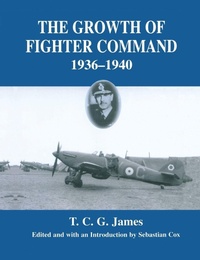
Growth of Fighter Command, 1936-1940
Air Defence of Great Britain, Volume 1
1st Edition
Published on 17. July 2014
Book
Paperback/Softback
168 pages
978-0-415-76127-7 (ISBN)
Description
The first of two volumes of the classified Air Historical Branch study of Fighter Command and the Air Defence of the United Kingdom. It covers pre-war expansion of the Command, the creation of the first integrated air defence system, and an account of Dunkirk and the Battle of Britain.
Reviews / Votes
'Should be mandatory reading for anyone seriously contemplating work on Fighter Command during World War II.' - RAF Air Power ReviewMore details
Series
Language
English
Place of publication
London
United Kingdom
Publishing group
Taylor & Francis Ltd
Target group
College/higher education
Dimensions
Height: 246 mm
Width: 189 mm
Thickness: 10 mm
Weight
346 gr
ISBN-13
978-0-415-76127-7 (9780415761277)
Copyright in bibliographic data and cover images is held by Nielsen Book Services Limited or by the publishers or by their respective licensors: all rights reserved.
Schweitzer Classification
Other editions
Additional editions

T.C.G. James | Sebastian Cox
Growth of Fighter Command, 1936-1940
Air Defence of Great Britain, Volume 1
E-Book
06/2014
1st Edition
Routledge
€72.49
Available for download

T.C.G. James | Sebastian Cox
Growth of Fighter Command, 1936-1940
Air Defence of Great Britain, Volume 1
E-Book
06/2014
1st Edition
Routledge
€72.49
Available for download
T.C.G. James | Sebastian Cox
Growth of Fighter Command, 1936-1940
Air Defence of Great Britain, Volume 1
Book
08/2001
Routledge
€231.20
Shipment within 10-20 days
Persons
Edited by Cox, Sebastian Author T.C.G. James
Content
Part 1: The Growth of the ADGB System Prior to 1935: The Origin of the ADGB System Delays in its Completion. The Organization oftThe Aircraft Fighting Zone. Raid Intelligence. Relationship between the c-in-c and Subsidiary Air Defence Formations. Progress Towards Consolidating the Air Defences. The Growth of the ADGB Command. The Numerical Weakness of the RAF. The Rise of Germany and the First Expansion of the Metropolitan Air Force. The Need for the Reorientation of the ADGB System Part 2: The Reorientation of the Air Defence of Great Britain (1): The Formation of the ADGB Sub-Committee Basic Principles of Air Defence. Alternative Defence Schemes. The Weapons Needed. The Extent of the Threatened Area. Recommendations, April 1935. Implications of the Report. Further Deterioration in the Political Situation. Suggested Acceleration of the Air Defence Scheme. Decision of the Cabinet Part 3: The Expansion of the Air Force and the Formation of Fighter Command: Air Staff View of the German Claim to Air Parity A New Expansion Scheme - The Meaning of Parity. Proposed Fighter Strength. Acceleration of the Expansion Scheme. The Consequent Reorganization of the Metropolitan Air Force. Abolition of the ADGB Command. New Relationship between Air Ministry, Command and Groups. Opposition to the New System. Control of Operations. The Opening of Fighter Command. Auxilliary Squadrons Attached to Fighter Command. Failure to Achieve the Planned Expansion Programme. A Compensating Factor. The New Expansion Scheme of February 1937 Part 4: The Reorientation of the Air Defence of Great Britain (2): The Need for New Techniques of Air Defence - The Formation of Scientific Committees Abolition of the Outer Artillery Zone Due to New Methods of Aircraft Location. New Disposition of the Gun Defences. Unsatisfactory Production Position - Effect on Defence Policy. Further Expansion of the German Air Force. The "Knock-Out" Blow. "Ideal" Air Defence Scheme. The Reception of the "Ideal" Scheme. Temporary Ban on Further Re-Armament Scheme. Expansion of the Observer Corps. Deployment of AA Defences. The Lifting of the Cabinet Ban Part 5: Further Plans for Air Defence 1938-39: Approval Given to Part of the "Ideal" Scheme Changes in Searchlight and Sector Lay-Out. Provision for the Defence of Vital Points. Full "Ideal" Scheme Sanctioned, November 1939. Final Pre-War Provisions for Air Defence Part 6: The Growth of Fighter Command, July 1937-September 1939: Expansion of First-Line Strength Problems of Expansion. Shortage of Reserves. The Position in September 1938. Effect of the Emergency upon Command Organization. Expansion Policy in the Last Year of Peace. State of Fighter Command in March 1939 Part 7: Extension of the Commitments of Fighter Command, 1939 Part 8: Fighter Policy, September 1939-May 1940 Part 9: Fighter Command and the Battles in the Low Countries and France. Appendices