

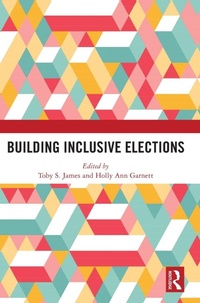
Building Inclusive Elections
1st Edition
Published on 14. July 2020
Book
Hardback
198 pages
978-0-367-50950-7 (ISBN)
Description
Elections around the world are plagued with the problem of unequal levels of participation. This can have profound consequences for election results, representation and policies. This book focuses on the interventions that can be used to redress the turnout gap and other inequalities within the electoral process.
The book defines the concept of inclusive voting practices to refer to policy instruments which can reduce turnout inequality between groups and mitigate other inequalities within the electoral process. Studies from around the world then examine how policies can affect inclusivity on election day. This includes research on enfranchising felons and migrant communities; compulsory voting; voter ID requirements; voter registration practices; investment in electoral management; gendered electoral violence; accessible voting practices; and overseas voting. As a result, this book will be of interest to scholars of democracy, democratic theory and elections, as well as having major policy implications worldwide.
The chapters in this book were originally published as a special issue of the journal Policy Studies.
The book defines the concept of inclusive voting practices to refer to policy instruments which can reduce turnout inequality between groups and mitigate other inequalities within the electoral process. Studies from around the world then examine how policies can affect inclusivity on election day. This includes research on enfranchising felons and migrant communities; compulsory voting; voter ID requirements; voter registration practices; investment in electoral management; gendered electoral violence; accessible voting practices; and overseas voting. As a result, this book will be of interest to scholars of democracy, democratic theory and elections, as well as having major policy implications worldwide.
The chapters in this book were originally published as a special issue of the journal Policy Studies.
More details
Language
English
Place of publication
London
United Kingdom
Publishing group
Taylor & Francis Ltd
Target group
College/higher education
Dimensions
Height: 250 mm
Width: 175 mm
Thickness: 15 mm
Weight
534 gr
ISBN-13
978-0-367-50950-7 (9780367509507)
Copyright in bibliographic data and cover images is held by Nielsen Book Services Limited or by the publishers or by their respective licensors: all rights reserved.
Schweitzer Classification
Other editions
Additional editions
Toby S. James | Holly Ann Garnett
Building Inclusive Elections
Book
01/2024
1st Edition
Routledge
€65.00
Shipment within 15-20 days
Toby S. James | Holly Ann Garnett
Building Inclusive Elections
E-Book
11/2020
1st Edition
Routledge
€59.49
Available for download
Toby S. James | Holly Ann Garnett
Building Inclusive Elections
E-Book
11/2020
1st Edition
Routledge
€59.49
Available for download
Persons
Toby S. James is Professor of Politics and Public Policy at the University of East Anglia, Norwich, UK. He has published widely on electoral integrity, political leadership and the policy process. His books include Elite Statecraft and Election Administration (2012) and Comparative Electoral Management (2020). He is a co-convener of the global Electoral Management Network.
Holly Ann Garnett is Assistant Professor of Political Science at the Royal Military College of Canada and cross-appointed at Queen's University, in Kingston, Ontario, Canada. Her research examines how electoral integrity can be strengthened throughout the electoral cycle, including electoral management, registration and voting procedures, election technology, civic literacy and campaign finance. She is a co-convener of the global Electoral Management Network.
Holly Ann Garnett is Assistant Professor of Political Science at the Royal Military College of Canada and cross-appointed at Queen's University, in Kingston, Ontario, Canada. Her research examines how electoral integrity can be strengthened throughout the electoral cycle, including electoral management, registration and voting procedures, election technology, civic literacy and campaign finance. She is a co-convener of the global Electoral Management Network.
Content
1. Introduction: the case for inclusive voting practices
2. Restoring voting rights: evidence that reversing felony disenfranchisement increases political efficacy
3. Are inequalities in representation lower under compulsory voting?
4. Conceptualizing more inclusive elections: violence against women in elections and gendered electoral violence
5. Electoral integrity, voter fraud and voter ID in polling stations: lessons from English local elections
6. Implementing voter ID: lessons from Missouri, USA
7. Waiting to vote: the effect of administrative irregularities at polling locations and voter confidence
8. Disability and election administration in the United States: barriers and improvements
9. Migrant populations and external voting: the politics of suffrage expansion in Central America
10. Inclusive voting practices: lessons for theory, praxis, and the future research agenda
2. Restoring voting rights: evidence that reversing felony disenfranchisement increases political efficacy
3. Are inequalities in representation lower under compulsory voting?
4. Conceptualizing more inclusive elections: violence against women in elections and gendered electoral violence
5. Electoral integrity, voter fraud and voter ID in polling stations: lessons from English local elections
6. Implementing voter ID: lessons from Missouri, USA
7. Waiting to vote: the effect of administrative irregularities at polling locations and voter confidence
8. Disability and election administration in the United States: barriers and improvements
9. Migrant populations and external voting: the politics of suffrage expansion in Central America
10. Inclusive voting practices: lessons for theory, praxis, and the future research agenda