

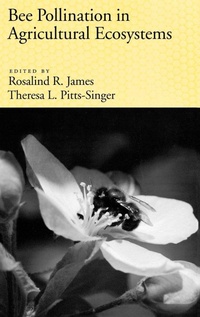
Bee Pollination in Agricultural Eco-systems
Published on 28. August 2008
Book
Hardback
248 pages
978-0-19-531695-7 (ISBN)
Description
For many agricultural crops, bees play a vital role as pollinators, and this book discusses the interplay among bees, agriculture and the environment. Although honey bees are well recognized as pollinators, managed bumble bees and solitary bees are also critical for the successful pollination of certain crops, while wild bees provide a free service. As bees liberally pass pollen from one plant to the next, they also impact the broader ecosystem, and not always to the benefit of humankind. Bees can enhance the unintentional spread of genes from genetically engineered plants, and may increase the spread of invasive weeds. Conversely, genetically engineered plants can impact pollinators, and invasive weeds can supply new sources of food for these insects. Bees' flower-visiting activities also can be exploited to help spread biological control agents that control crop pests, and they are important for native plant reproduction. Managing bees for pollination is complex and factors that must take into consideration are treated here including bee natural history, physiology, pathology, and behavior. Furthermore, transporting bees from native ranges to new areas for pollination services can be controversial, and needs to be done only after assuring that it will not disrupt various ecosystems. Even though bees are small, unobtrusive creatures, they play large roles in the ecosystem. The connection between bees and humankind also is symbolic of a broader interconnection between humans and the natural world.
Reviews / Votes
Listed in Ecology"This book will go a long way toward keeping non-Apis bees in the limelight. It represents a compendium of the latest thinking on the issues surrounding the place of wild bees in sustainable agriculture. I highly recommend it for readers interested in the public conversation on bee decline and pollination."--Keith S. Delaplane, The Quarterly Review of Biology
More details
Language
English
Place of publication
New York
United States
Target group
College/higher education
Illustrations
14 halftones, 11 line illustrations
Dimensions
Height: 240 mm
Width: 161 mm
Thickness: 18 mm
Weight
540 gr
ISBN-13
978-0-19-531695-7 (9780195316957)
Copyright in bibliographic data and cover images is held by Nielsen Book Services Limited or by the publishers or by their respective licensors: all rights reserved.
Schweitzer Classification
Other editions
Additional editions
Rosalind James | Theresa L. Pitts-Singer
Bee Pollination in Agricultural Ecosystems
E-Book
09/2008
1st Edition
OUP eBook
€85.99
Available for download
Rosalind James | Theresa L. Pitts-Singer
Bee Pollination in Agricultural Ecosystems
E-Book
09/2008
1st Edition
OUP eBook
€85.99
Available for download
Persons
Rosalind R. James is Research Leader of the USDA Agricultural Research Services Pollinating Insect Biology, Systematics, and Management Research Unit in Logan, Utah.
Theresa L. Pitts-Singer is a Research Entomologist in the USDA Agricultural Research Services Bee Biology and Systematics Laboratory in Logan, Utah.
Theresa L. Pitts-Singer is a Research Entomologist in the USDA Agricultural Research Services Bee Biology and Systematics Laboratory in Logan, Utah.
Content
Foreword by Chris OToole ; SECTION 1: BEES AS POLLINATORS AND MORE IN AGRICULTURAL ECOSYSTEMS ; Chapter 1 - Introduction: Bees in Nature and on the Farm (Theresa L. Pitts-Singer and Rosalind R. James) ; Chapter 2 - Crop Pollination Services from Wild Bees (Claire Kremen) ; Chapter 3 - Crop Pollination in Greenhouses (Jose M. Guerra-Sanz) ; Chapter 4 - Pollinating-Bees Crucial to Farming Wildflower Seed for U.S. Habitat Restoration (James H. Cane) ; Chapter 5 - Honey Bees, Bumble Bees, and Biocontrol: New Alliances Between Old Friends (Peter G. Kevan, Jean-Pierre Kapongo, Mohammad Al-mazraawi, and Les Shipp) ; SECTION 2: MANAGING SOLITARY BEES ; Chapter 6 - Ecophysiology of the Life Cycle in Osmia Mason Bees Used as Crop Pollinators (Jordi Bosch, Fabio Sgolastra, William P. Kemp) ; Chapter 7 - Past and Present Management of Alfalfa Bees (Theresa L. Pitts-Singer) ; Chapter 8 - The Problem of Disease When Domesticating Bees (Rosalind R. James) ; SECTION 3: ENVIRONMENTAL RISKS ASSOCIATED WITH BEES ; Chapter 9 - Environmental Impact of Exotic Bees Introduced for Crop Pollination (Carlos H. Vergara) ; Chapter 10 - Invasive Exotic Plant-Bee Interactions (Karen Goodell) ; Chapter 11 - Estimating the Potential for Bee-Mediated Gene Flow in Genetically-Modified (GM) Crops (James E. Cresswell) ; Chapter 12 - Genetically Modified Crops: Effects on Bees and Pollination (Lora A. Morandin) ; Chapter 13 - The Future of Agricultural Pollination (Rosalind James and Theresa Pitts-Singer)