

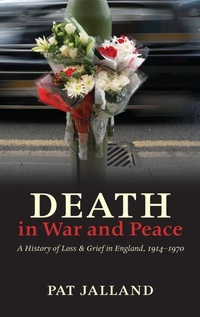
Death in War and Peace
A History of Loss and Grief in England, 1914-1970
1st Edition
Published on 30. September 2010
Book
Hardback
338 pages
978-0-19-926551-0 (ISBN)
Description
Death in War and Peace is the first detailed historical study of experience of death, grief, and mourning in England in the fifty years after 1914. In it Professor Jalland explores the complex shift from a culture where death was accepted and grief was openly expressed before 1914, to one of avoidance and silence by the 1940s and thereafter.
The two world wars had a profound and cumulative impact on the prolonged process of change in attitudes to death in England. The inter-war generation grew up in a bleak atmosphere of mass mourning for the dead soldiers of the Great War, and the Second World War created an even deeper break with the past, as a pervasive model of silence about death and suppressed grieving became entrenched in the nation's psyche.
Stories drawn from letters and diaries show us how death and loss were experienced by individuals and families in England from 1914; and how the attitudes, responses, and rituals of death and grieving varied with gender, religion, class, and region. The growing medicalization and hospitalization of death from the 1950s further reinforced the growing culture of silence about death, as it moved from the care of the family to that of hospitals, doctors, and undertakers.
These silences about death still linger today, despite a further cultural shift since the 1970s towards greater emotional expressiveness. This fascinating study of death and bereavement helps us to understand the present as well as the past.
The two world wars had a profound and cumulative impact on the prolonged process of change in attitudes to death in England. The inter-war generation grew up in a bleak atmosphere of mass mourning for the dead soldiers of the Great War, and the Second World War created an even deeper break with the past, as a pervasive model of silence about death and suppressed grieving became entrenched in the nation's psyche.
Stories drawn from letters and diaries show us how death and loss were experienced by individuals and families in England from 1914; and how the attitudes, responses, and rituals of death and grieving varied with gender, religion, class, and region. The growing medicalization and hospitalization of death from the 1950s further reinforced the growing culture of silence about death, as it moved from the care of the family to that of hospitals, doctors, and undertakers.
These silences about death still linger today, despite a further cultural shift since the 1970s towards greater emotional expressiveness. This fascinating study of death and bereavement helps us to understand the present as well as the past.
Reviews / Votes
An important historical contribution to the study of death and an informative account of how a country has handled far-reaching social challenge and change... Death in War and Peace succeeds in negotiating the gulf between scholarly and non-scholarly terrains, and for this Jalland must be commended. * Kate Woodthorpe, Times Higher Education * Scholarly enterprise and historical flair have enabled Professor Jalland to rise above the limitations of the material... Death in War and Peace provides us with fresh, imaginative perspectives and compelling detail. * Paul Addison, Times Literary Supplement * Jalland writes with the authority of a scholar who has spent many years researching her subject. This is a fine survey of a neglected topic, and it will surely remain as the standard work in the field for many years. * Adrian Bingham, English Historical Review * This book is an important contribution to understanding how attitudes to death changed in the twentieth century. * Julie-Marie Strange, American Historical Review * This is a fascinating and much needed study. * James Munson, Contemporary Review * Jalland judiciously weaves detailed individual case studies with government reports, statistics, newspaper accounts and diaries. The book is a fine contribution to the analysis of death and grief in modern Britain. * Joanna Bourke, Journal of Social History * impressive and highly readable work * Glennys Howarth, Social History of Medicine *More details
Language
English
Place of publication
Oxford
United Kingdom
Target group
College/higher education
Professional and scholarly
Students and scholars of modern British social and cultural history; general readers interested in how attitudes towards death have changed over the twentieth century.
Illustrations
Register
Black and white plate section
Dimensions
Height: 240 mm
Width: 161 mm
Thickness: 23 mm
Weight
672 gr
ISBN-13
978-0-19-926551-0 (9780199265510)
Copyright in bibliographic data and cover images is held by Nielsen Book Services Limited or by the publishers or by their respective licensors: all rights reserved.
Schweitzer Classification
Other editions
Additional editions
Book
09/2012
1st Edition
Oxford University Press
€66.96
Shipment within 15-20 days
Person
Pat Jalland has been a Professor of History at the Australian National University since 1997. She has published in British women's history, Anglo-Irish history, and the history of death and bereavement in Australia and Britain. Her eight books include The Liberals and Ireland (Harvester, 1980); Women, Marriage and Politics (OUP, 1986), winner of the 1987 Western Australian Literary Award for non-fiction; Death in the Victorian Family (OUP, 1996), winner of the New South Wales Premier's Prize for History, and Changing Ways of Death in 20th Century Australia (UNSW Press, 2006).
Content
Introduction ; Part I: War and Peace 1914-1939 ; 1. Death, the Great War and the influenza pandemic ; 2. Violet Cecil and communities in mourning ; 3. The Bickersteths' sacred pilgrimages to the Great War Cemeteries, 1919-1931 ; 4. Death, disasters and rituals among the northern working classes, 1919-39 ; 5. Sir Sydney Cockerell: cremation and the modern way of death in England ; Part II: The Second World War ; 6. The people's war: Death in the blitz ; 7. Missing airmen and families in anguish: 'There could be no mourning' ; 8. Experiences of wartime grief ; Part III: A changing culture of death and loss since 1945 ; 9. Hidden death: Medicine and care of the dying, 1945 to 1970 ; 10. Widowhood, grief and old age 1945-1963 ; 11. Gorer's map of death: Declining rituals and prolonged sorrow, 1963 ; 12. Observing grief: C.S. Lewis and the psychiatrists ; 13. Epilogue: Change and continuity since the 1970s