

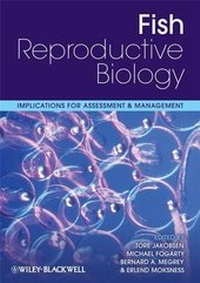
Fish Reproductive Biology
Implications for Assessment and Management
Published on 7. April 2009
Book
Hardback
440 pages
978-1-4051-2126-2 (ISBN)
Description
"The economic importance of fishes and their societal and cultural relevance provide powerful incentives for large-scale, sustained studies of their dynamics" the Editors
The overall goal of this book is to give a picture of the present use of information on fish reproductive biology in assessment and management and its potential for improving management of these resources.
Compiled by an international team of authors, each an expert in their field, this exceptional volume is divided into three major sections:
* Biology, population dynamics, and recruitment
* Information critical to successful assessment and management
* Incorporation of reproductive biology and recruitment considerations into management advice and strategies
Including over 100 diagrams, this book is essential reading for all fisheries scientists. Libraries in universities and research establishments where this subject is studied and taught should have copies on their shelves.
"As one author put it: the goal is to facilitate a 'dialogue between assessment scientists and biologists.' Readers of any specialty should accept this challenge, and this book is an excellent resource to aid them." Fisheries, March 2010
Reviews / Votes
"This book would certainly be an excellent choice for a reading course. ... This is the kind of book that challenges the dogma of introductory courses as well as the methods professionals use to address familiar problems. Each chapter provides personal perspectives, highlights emerging case histories, and illuminates the background conversations that go on at professional conferences and assessment workshops." (Fisheries, March 2010)More details
Edition
1. Auflage
Language
English
Place of publication
Chicester
United Kingdom
Publishing group
John Wiley and Sons Ltd
Target group
Professional and scholarly
Illustrations
ill
Dimensions
Height: 25.4 cm
Width: 19.8 cm
Thickness: 3.1 cm
Weight
1028 gr
ISBN-13
978-1-4051-2126-2 (9781405121262)
Schweitzer Classification
Other editions
New editions
Tore Jakobsen | Michael J. Fogarty | Bernard A. Megrey
Fish Reproductive Biology
Implications for Assessment and Management
Book
03/2016
2nd Edition
Wiley
€201.50
Article not available at the moment
Persons
Tore Jakobsen, Institute of Marine Research, Norway
Michael J Fogarty, University of Maryland, Chesapeake Biological Laboratory, USA
Bernard A. Megrey, Alaska Fisheries Center, Seattle, USA
Erlend Moksness, Ministry of Fisheries, Institute of Marine Research, Norway
Editor
Institute of Marine Research, Norway. Senior scientist and marine biologist with experience from fish stock assessment a
Senior Scientist, Northeast Fisheries Science Center, head of the Ecosystem Assessment Program. Research interests and e
NOAA, National Marine Fisheries Service, Alaska Fisheries Center, Seattle, USA. Research fisheries biologist with NOAA's
Research Director, Institute of Marine Research, Norway. Fisheries biologist with background in recruitment in marine fi
Content
Chapter 1. Introduction (Tore Jakobsen, Michael J. Fogarty, Bernard A. Megrey and Erlend Moksness).
Section 1. Biology, population dynamics, and recruitment.
Chapter 2. Recruitment in Marine Populations (Michael J. Fogarty and Loretta O'Brien).
Chapter 3. Reproductive dynamics (D. Pavlov, N. Emel'yanova and G.G. Novikov).
Chapter 4. Recruitment Variability (Edward D. Houde).
Chapter 5. Effects of fishing on the population (Marie-Joëlle Rochet).
Section 2: Information critical to successful assessment and management.
Chapter 6. Egg, larval and juvenile surveys (Nancy C.H. Lo, Paul E. Smith and Motomitsu Takahashi).
Chapter 7. Stock identification (Gavin A. Begg and Steven X. Cadrin).
Chapter 8. Stock assessment models and predictions of catch and biomass (John G. Pope).
Chapter 9. Applied fish reproductive biology: contribution of individual reproductive.
potential to recruitment and fisheries management (Olav S. Kjesbu).
Section 3: Incorporation of reproductive biology and recruitment considerations into management advice and strategies.
Chapter 10. Current paradigms and forms of advice (K. Cochrane).
Chapter 11. Management: New Approaches to Old Problems (Carl O'Brien).
Chapter 12. Implementing information on stock reproductive potential in fisheries management: the motivation, the challenges and the opportunities (C. Tara Marshall)