

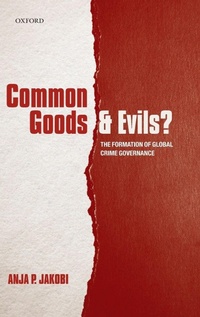
Common Goods and Evils?
The Formation of Global Crime Governance
Published on 4. July 2013
Book
Hardback
330 pages
978-0-19-967460-2 (ISBN)
Description
Global crime governance has emerged as an important component of world politics. It is manifested in national and international agendas, the proliferation of global regulations, growing international budgets, and the enlarged mandates of international organizations. As a result, the definition and prosecution of crime is now increasingly homogenous, but it also shows variance: some crime policies are institutionalized coherently or attached to strong international organizations, while others are weak or dispersed across different forums. Based on sociological institutionalism, this book examines questions of structural variance in the institutional design of global governance. It shows that the interplay of strong actors and rationalization principles lead to more coherent forms of global crime governance, while normative arguments related to crime are more likely to result in fragmented forms. In consequence -- and contrary to many scholars' assumptions -- global crime governance is strongest in those areas that are least attached to moral statements.
The book develops a theory of society and applies this framework to explaining the sources and consequences of institutional design. Drawing on qualitative and quantitative methods, the text analyzes the origins of global regulations, how they are disseminated, and why differences exist. The role of the United States in creating global rules and disseminating them is emphasized. Readers interested in international relations, global governance, globalization studies, world society studies, and criminology will benefit from the theoretical and empirical results of this book.
The book develops a theory of society and applies this framework to explaining the sources and consequences of institutional design. Drawing on qualitative and quantitative methods, the text analyzes the origins of global regulations, how they are disseminated, and why differences exist. The role of the United States in creating global rules and disseminating them is emphasized. Readers interested in international relations, global governance, globalization studies, world society studies, and criminology will benefit from the theoretical and empirical results of this book.
More details
Language
English
Place of publication
Oxford
United Kingdom
Target group
College/higher education
Dimensions
Height: 240 mm
Width: 161 mm
Thickness: 22 mm
Weight
661 gr
ISBN-13
978-0-19-967460-2 (9780199674602)
Copyright in bibliographic data and cover images is held by Nielsen Book Services Limited or by the publishers or by their respective licensors: all rights reserved.
Schweitzer Classification
Other editions
Additional editions

E-Book
07/2013
1st Edition
OUP eBook
€63.49
Available for download
Person
Anja P. Jakobi, PhD, is Senior Research Associate at the Leibniz-Institute Peace Research Institute Frankfurt. She is also adjunct Associate Professor (PD) at the University of Darmstadt, and held many visiting positions for research and teaching at universities worldwide. She holds postgraduate degrees in political science and sociology, and her research analyzes world society at the intersection of international relations research and sociological theorizing. She specializes in global governance, global agenda-setting, and policy diffusion, currently with an emphasis on international organizations and other actors in security, peace, and conflict.
Content
INTRODUCTION ; 1. Global Crime Governance in World Society ; PART I: GOVERNANCE IN WORLD SOCIETY ; 2. Power, Change, and Institutions in World Society ; PART II: ESTABLISHING GLOBAL CRIME GOVERNANCE ; 3. The Historical Development of Global Anti-Crime Procedures ; 4. The Emergence and Diffusion of Global Anti-Crime Regulations ; 5. Global Activities against Money Laundering ; 6. Global Anti-Corruption Norms ; 7. Global Efforts against the Trafficking of Humans ; PART III: COMPARATIVE PERSPECTIVES ON GLOBAL CRIME GOVERNANCE ; 8. The Adoption of Crime Policies: Patterns and Strategies ; 9. Non-State Actors in Global Crime Governance ; CONCLUSIONS ; 10. Global Crime Governance: Conclusions, Implications and Outlook