

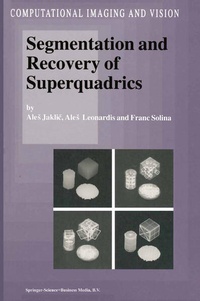
Segmentation and Recovery of Superquadrics
Published on 30. September 2000
Book
Hardback
XXII, 266 pages
978-0-7923-6601-0 (ISBN)
Description
A representation of objects by their parts is the dominant strategy for representing complex 3D objects in many disciplines. In computer vision and robotics, superquadrics are among the most widespread part models. Superquadrics are a family of parametric models that cover a wide variety of smoothly changing 3D symmetric shapes, which are controlled with a small number of parameters and which can be augmented with the addition of global and local deformations. The book covers, in depth, the geometric properties of superquadrics. The main contribution of the book is an original approach to the recovery and segmentation of superquadrics from range images. Several applications of superquadrics in computer vision and robotics are thoroughly discussed and, in particular, the use of superquadrics for range image registration is demonstrated.
Audience: The book is intended for readers of all levels who are familiar with and interested in computer vision issues.
Audience: The book is intended for readers of all levels who are familiar with and interested in computer vision issues.
More details
Series
Edition
2000 ed.
Language
English
Place of publication
Dordrecht
Netherlands
Target group
Professional and scholarly
Research
Product notice
sewn/stitched
Cloth over boards
Illustrations
XXII, 266 p.
Dimensions
Height: 234 mm
Width: 156 mm
Thickness: 18 mm
Weight
585 gr
ISBN-13
978-0-7923-6601-0 (9780792366010)
DOI
10.1007/978-94-015-9456-1
Schweitzer Classification
Other editions
Additional editions
Ales Jaklic | Ales Leonardis | F. Solina
Segmentation and Recovery of Superquadrics
E-Book
04/2013
Springer
€96.29
Available for download
Ales Jaklic | Ales Leonardis | F. Solina
Segmentation and Recovery of Superquadrics
Book
12/2010
Springer
€106.99
Shipment within 15-20 days
Content
1. Introduction.- 2. Superquadrics and Their Geometric Properties.- 3. Extensions of Superquadrics.- 4. Recovery of Individual Superquadrics.- 5. Segmentation with Superquadrics.- 6. Experimental Results.- 7. Applications of Superquadrics.- 8. Conclusions.- Appendices.- B- Superquadric Recovery Code.- C- Range Image Acquisition.- D- Minimum Description Length and Maximum A Posteriori Probability.- E- Object-Oriented Framework for Segmentation (Segmentor).- References.- Author Index.- Topic Index.