

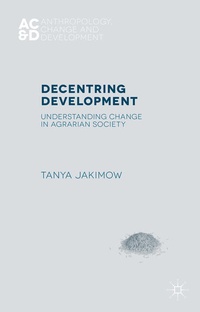
Decentring Development
Understanding Change in Agrarian Societies
Published on 1. September 2015
Book
Hardback
XI, 200 pages
978-1-137-46642-6 (ISBN)
Description
The ways we understand processes of agrarian change are pressing issues for policy makers and development practitioners. Interpreting changes in two agrarian societies in India and Indonesia, the author reveals how transformations to self are critical factors shaping change, as well as under-recognized consequences of development initiatives.
Reviews / Votes
"Decentring Development is an important and interesting theoretical contribution to this pragmatic and oft-repeated question. . This reviewer enjoyed the critical observations and analysis of development in this book. Jakimow makes a strong case for the extension of critical and decentred approaches into donor-funded development research. . I would suggest that development practitioners are surprisingly reflexive about their profession and would welcome Decentring Development . ." (Melissa Johnston, Journal of Contemporary Asia, Vol. 46 (3), 2016)
More details
Series
Edition
1st ed. 2015
Language
English
Place of publication
London
United Kingdom
Target group
Professional and scholarly
Product notice
sewn/stitched
Cloth over boards
With dust jacket
Illustrations
XI, 200 p.
Dimensions
Height: 216 mm
Width: 140 mm
Thickness: 13 mm
Weight
395 gr
ISBN-13
978-1-137-46642-6 (9781137466426)
DOI
10.1057/9781137466433
Schweitzer Classification
Other editions
Additional editions
E-Book
04/2016
Palgrave Macmillan
€96.29
Available for download
Book
01/2014
Palgrave Macmillan
€85.59
The article will not be published
Person
Tanya Jakimow is Senior Lecturer and DECRA Research Fellow at the University of New South Wales, Australia. She has published in the fields of livelihoods, agrarian change, and NGOs in India and Indonesia. Her most recent book
Peddlers of Information: Indian NGOs in the Information Age
was published in 2012.
Content
Introduction PART I: Rethinking social change through the development actor 1. Centring the Self-in-Process 2. The Institutional Landscape PART II: Understanding agrarian societies in research for development 3. Livelihood Pathways 4. Self in Transit PART III: Recognising the unintended consequences of development 5. The State and the Self 6. Moral Spaces of Development Conclusion