

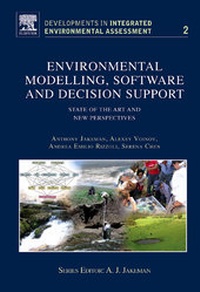
Environmental Modelling, Software and Decision Support: Volume 3
State of the Art and New Perspective
Published on 1. October 2008
Book
Hardback
384 pages
978-0-08-056886-7 (ISBN)
Description
The complex and multidisciplinary nature of environmental problems requires that they are dealt with in an integrated manner. Modeling and software have become key instruments used to promote sustainability and improve environmental decision processes, especially through systematic integration of various knowledge and data and their ability to foster learning and help make predictions. This book presents the current state-of-the-art in environmental modeling and software and identifies the future challenges in the field.
More details
Series
Language
English
Place of publication
Oxford
United Kingdom
Publishing group
Elsevier Science & Technology
Target group
College/higher education
Researchers and postgraduates in environmental modelling, natural resource management, environmental assessment and planning, environmental decision making, atmospheric and air pollution modelling, informatics, decision support systems, global change and earth system modelling, carbon and nitrogen cycling
Dimensions
Height: 240 mm
Width: 165 mm
Weight
880 gr
ISBN-13
978-0-08-056886-7 (9780080568867)
Copyright in bibliographic data and cover images is held by Nielsen Book Services Limited or by the publishers or by their respective licensors: all rights reserved.
Schweitzer Classification
Other editions
Additional editions
Anthony J. Jakeman | Alexey A. Voinov | Andrea E. Rizzoli
Environmental Modelling, Software and Decision Support
State of the Art and New Perspective
E-Book
09/2008
Elsevier
€137.00
Available for download
Persons
Content
1.Modelling and Software as Instruments for Advancing Sustainability
2.Good Modelling Practice
3.Bridging the Gaps between Design and Use: Developing Tools to Support Environmental Management and Policy
4.Complexity and Uncertainty: Rethinking the Modelling Activity
5.Uncertainty in Environmental Decision Making: Issues, Challenges and Future Directions
6.Environmental Policy Aid under Uncertainty
7.Integrated Modelling Frameworks for Environmental Assessment and Decision Support
8.Intelligent Environmental Decision Support Systems
9.Formal Scenario Development for Environmental Impact Assessment Studies
10.Free and Open Source Geospatial Tools for Environmental Modelling and Management
11.Modelling and Monitoring Environmental Outcomes in Adaptive Management
12.Data Mining for Environmental Systems
13.Generic Simulation Models for Facilitating Stakeholder Involvement in Water Resources Planning and Management: a Comparison, Evaluation, and Identification of Future Needs
14.Computational Air Quality Modelling
15. State of the Art in Methods and Software for the Identification, Resolution and Apportionment of Contamination Sources
16.Regional Models of Intermediate Complexity (Remics) - A New Direction in Integrated Landscape Modelling
17.Challenges in Earth System Modelling: Approaches and Applications
18.Uncertainty and Sensitivity Issues in Process-Based Models of Carbon and Nitrogen Cycles in Terrestrial Ecosystems
19.Model-Data Fusion in the Studies of Terrestrial Carbon Sink
20.Building a Community Modelling and Information Sharing Culture
2.Good Modelling Practice
3.Bridging the Gaps between Design and Use: Developing Tools to Support Environmental Management and Policy
4.Complexity and Uncertainty: Rethinking the Modelling Activity
5.Uncertainty in Environmental Decision Making: Issues, Challenges and Future Directions
6.Environmental Policy Aid under Uncertainty
7.Integrated Modelling Frameworks for Environmental Assessment and Decision Support
8.Intelligent Environmental Decision Support Systems
9.Formal Scenario Development for Environmental Impact Assessment Studies
10.Free and Open Source Geospatial Tools for Environmental Modelling and Management
11.Modelling and Monitoring Environmental Outcomes in Adaptive Management
12.Data Mining for Environmental Systems
13.Generic Simulation Models for Facilitating Stakeholder Involvement in Water Resources Planning and Management: a Comparison, Evaluation, and Identification of Future Needs
14.Computational Air Quality Modelling
15. State of the Art in Methods and Software for the Identification, Resolution and Apportionment of Contamination Sources
16.Regional Models of Intermediate Complexity (Remics) - A New Direction in Integrated Landscape Modelling
17.Challenges in Earth System Modelling: Approaches and Applications
18.Uncertainty and Sensitivity Issues in Process-Based Models of Carbon and Nitrogen Cycles in Terrestrial Ecosystems
19.Model-Data Fusion in the Studies of Terrestrial Carbon Sink
20.Building a Community Modelling and Information Sharing Culture