

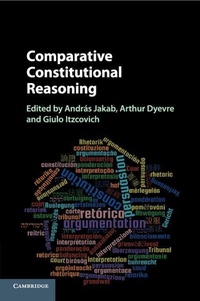
Comparative Constitutional Reasoning
Published on 6. December 2018
Book
Paperback/Softback
868 pages
978-1-107-44976-3 (ISBN)
Description
To what extent is the language of judicial opinions responsive to the political and social context in which constitutional courts operate? Courts are reason-giving institutions, with argumentation playing a central role in constitutional adjudication. However, a cursory look at just a handful of constitutional systems suggests important differences in the practices of constitutional judges, whether in matters of form, style, or language. Focusing on independently-verified leading cases globally, a combination of qualitative and quantitative analysis offers the most comprehensive and systematic account of constitutional reasoning to date. This analysis is supported by the examination of eighteen legal systems around the world including the European Court of Human Rights and the European Court of Justice. Universally common aspects of constitutional reasoning are identified in this book, and contributors also examine whether common law countries differ to civil law countries in this respect.
Reviews / Votes
'Despite substantial academic attention to the rise of judicial power, we know fairly little about how newly empowered courts interpret their constitutions and justify their decisions. This timely and impressive edited collection fills this gap by presenting qualitative and quantitative data from 18 courts and over 700 cases. The volume is a must-read for those interested in comparative constitutional interpretation.' Mila Versteeg, University of Virginia School of Law 'This volume is the mature product of a very thorough, innovative, and reasonably large research project. It is impossible to do justice to the richness of its findings ...' Katalin Capannini-Kelemen, I-CONnect (www.iconnectblog.com)More details
Language
English
Place of publication
Cambridge
United Kingdom
Target group
Professional and scholarly
Product notice
Paperback (trade)
Illustrations
6 Tables, black and white; 19 Line drawings, black and white
Dimensions
Height: 229 mm
Width: 152 mm
Thickness: 47 mm
Weight
1231 gr
ISBN-13
978-1-107-44976-3 (9781107449763)
Copyright in bibliographic data and cover images is held by Nielsen Book Services Limited or by the publishers or by their respective licensors: all rights reserved.
Schweitzer Classification
Other editions
Additional editions
Andras Jakab | Arthur Dyevre | Giulio Itzcovich
Comparative Constitutional Reasoning
Book
04/2017
Cambridge University Press
€164.50
Shipment within 15-20 days
Persons
Andras Jakab is the Director of the Institute for Legal Studies at the Centre for Social Sciences, Hungarian Academy of Sciences. He is also Professor of Constitutional and European Law at Pazmany Peter Catholic University, Budapest. Arthur Dyevre is Associate Professor of Empirical Jurisprudence at the Faculty of Law, Katholieke Universiteit Leuven, Belgium. He works in the fields of legal theory, judicial behaviour, European integration, comparative law and comparative politics. Giulio Itzcovich is Associate Professor of Philosophy of Law in the Department of Legal Science, Universit... degli Studi di Brescia, Italy. He is also a permanent fellow of the Tarello Institute for Legal Philosophy at Universit... degli Studi di Genova.
Content
1. Introduction: comparing constitutional reasoning with quantitative and qualitative methods Andras Jakab, Arthur Dyevre and Giulio Itzcovic; 2. The High Court of Australia Cheryl Saunders and Adrienne Stone; 3. The Austrian Constitutional Court Konrad Lachmayer; 4. The Supreme Federal Court of Brazil Conrado Huebner Mendes; 5. The Supreme Court of Canada Hugo Cyr and Monica Popescu; 6. The Constitutional Court of the Czech Republic Zdenek Kuehn; 7. The European Court of Human Rights Janneke Gerards; 8. The European Court of Justice Giulio Itzcovich; 9. The French Constitutional Council Arthur Dyevre; 10. German Federal Constitutional Court Michaela Hailbronner and Stefan Martini; 11. The Constitutional Court of Hungary Andras Jakab and Johanna Froehlich; 12. The Supreme Court of Ireland Eoin Carolan; 13. The Israeli Supreme Court Suzie Navot; 14. The Constitutional Court of Italy Tania Groppi and Irene Spigno; 15. The Constitutional Court of South Africa Christa Rautenbach and Lorens du Plessis; 16. The Spanish Constitutional Court Marian Ahumada Ruiz; 17. The Constitutional Court of Taiwan Wen-Chen Chang; 18. The Supreme Court (House of Lords) of the United Kingdom Tamas Gyorfi; 19. The Supreme Court of the United States Howard Schweber and Jennifer L. Brookhart; 20. Conclusion Andras Jakab, Arthur Dyevre and Giulio Itzcovich.