

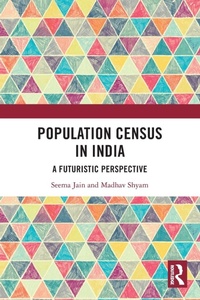
Population Census in India
A Futuristic Perspective
1st Edition
Published on 21. May 2026
Book
Paperback/Softback
182 pages
978-1-032-95778-4 (ISBN)
Description
The population census is the primary data source for any demographic analysis, the execution of social and economic development programmes, administrative activity, as well as for policy decisions, special surveys and scientific research. This book critically analyses key facets of pre-census activity, including its timing, duration and method of enumeration. It traces concepts and definitions adopted by the census of India back to its beginning in 1872. The authors also study themes such as census legislation, census organisation, administrative setups, training strategies, the instruction manual and the impact of COVID-19 on the census.
The volume will be indispensable for students and researchers of population studies, history, development studies, human geography, anthropology, public policy and governance, migration studies and South Asian studies. It will also be useful for planners and policymakers.
The volume will be indispensable for students and researchers of population studies, history, development studies, human geography, anthropology, public policy and governance, migration studies and South Asian studies. It will also be useful for planners and policymakers.
More details
Language
English
Place of publication
London
United Kingdom
Publishing group
Taylor & Francis Ltd
Target group
College/higher education
Postgraduate
Illustrations
13 s/w Tabellen
13 Tables, black and white
Dimensions
Height: 234 mm
Width: 156 mm
Weight
360 gr
ISBN-13
978-1-032-95778-4 (9781032957784)
Copyright in bibliographic data and cover images is held by Nielsen Book Services Limited or by the publishers or by their respective licensors: all rights reserved.
Schweitzer Classification
Other editions
Additional editions
E-Book
12/2024
1st Edition
CRC Press
€60.49
Available for download
Book
12/2024
1st Edition
Routledge India
€195.90
Shipment within 10-20 days
E-Book
12/2024
1st Edition
CRC Press
€60.49
Available for download
Persons
Seema Jain, Secretary, the Government of India, did her Masters in Sustainable Energy Policy (2016-18) in the School of Public Policy and Administration, Carleton University, Ottawa, Canada, and MBA (Public Policy) 2007-08 in the University of Birmingham, UK. She conducted the Census of India 2011 as Director Census Operations, Punjab, from 2009 to 2014 for which she was awarded the President of India Silver Medal. Her areas of expertise include rural development, information technology, housing and urban planning, agricultural marketing, horticulture, food processing, forests and environment, and population census taking in India.
Madhav Shyam, Deputy Director, Directorate of Census, Punjab (now superannuated), has been associated with the census organisation for five decadal censuses. He was nominated by the office of Registrar Government of India (ORGI) for a ten-week Course on 'Population Census Geography' at the University of East Anglia, UK; a six-week Workshop on 'GIS' at US Bureau of Census, Washington; and a one-week Training Workshop on 'Population and Poverty in South Asia' organised jointly by the IIPS, Mumbai and UNESCAP. He is actively engaged in the census domain and is frequently invited to deliver lectures and talks at universities, training organisations and at other stakeholder forums.
Madhav Shyam, Deputy Director, Directorate of Census, Punjab (now superannuated), has been associated with the census organisation for five decadal censuses. He was nominated by the office of Registrar Government of India (ORGI) for a ten-week Course on 'Population Census Geography' at the University of East Anglia, UK; a six-week Workshop on 'GIS' at US Bureau of Census, Washington; and a one-week Training Workshop on 'Population and Poverty in South Asia' organised jointly by the IIPS, Mumbai and UNESCAP. He is actively engaged in the census domain and is frequently invited to deliver lectures and talks at universities, training organisations and at other stakeholder forums.
Content
List of tables vi Foreword vii Preface x List of abbreviations xii 1 Introduction 1 2 Planning for population census 14 3 Population and housing census 31 4 Census questionnaires 44 5 Segments difficult to enumerate 57 6 Slum demography 62 7 Urban-rural classification 66 8 Permanent house numbering 75 9 Census mapping 84 10 Concepts and definitions 93 11 Issuses for deliberations 127 12 Epilogue 141 Annexure: Census questionnaires: population and housing census 1872-2011 145 Index 178