

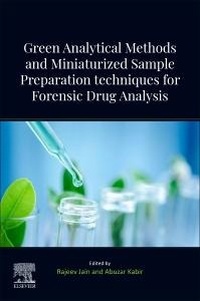
Green Analytical Methods and Miniaturized Sample Preparation techniques for Forensic Drug Analysis
Published on 22. October 2024
Book
Paperback/Softback
556 pages
978-0-443-13907-9 (ISBN)
Description
Green Analytical Methods and Miniaturized Sample Preparation techniques for Forensic Drug Analysis provides a comprehensive overview of GAMs in forensic drug analysis, including green sample preparation techniques, in-situ analytical platforms (such as DIC and ?PADs), and on-site sample preparation. The book discusses not only eco-friendly GAM's, but also methods which provide high sample throughput and cost-effective analysis, and are therefore of immense use in resource limited laboratories of developing countries. This is a comprehensive source of literature for analytical scientists in this developing area of sustainable and affordable analytical methods.
More details
Language
English
Place of publication
Philadelphia
United States
Target group
Professional and scholarly
Product notice
Paperback (trade)
Unsewn / adhesive bound
Dimensions
Height: 229 mm
Width: 152 mm
Thickness: 25 mm
Weight
880 gr
ISBN-13
978-0-443-13907-9 (9780443139079)
Copyright in bibliographic data and cover images is held by Nielsen Book Services Limited or by the publishers or by their respective licensors: all rights reserved.
Schweitzer Classification
Other editions
Additional editions
Rajeev Jain | Abuzar Kabir
Green Analytical Methods and Miniaturized Sample Preparation techniques for Forensic Drug Analysis
E-Book
10/2024
Elsevier
€230.00
Available for download
Persons
Dr. Rajeev Jain is Senior Scientist (Forensic Toxicology) at Central Forensic Science Laboratory, Ministry of Home Affairs, Govt. of India. He has more than 15 years of research experience in the field of analytical toxicology. During his tenure as Forensic Toxicologist, he has examined post-mortem samples of more than 1000 medico-legal cases pertaining to drug overdose and poisoning. He has obtained his Ph.D. degree in Analytical Toxicology from CSIR-Indian Institute of Toxicology Research (India). His research work is focused on Development of sustainable, affordable, and green analytical methods based on microextraction techniques for the determination of chemical analytes for forensic toxicological, clinical, and environmental importance in various complex samples.
Dr. Abuzar Kabir is a Research Associate Professor in the Department of Chemistry and Biochemistry at Florida International University, Miami, Florida, USA. His research focusses on the synthesis, characterization and applications of novel sol-gel derived advanced material systems to be used as chromatographic stationary phases, surface coatings of high-efficiency microextraction sorbents, nanoparticles, microporous and mesoporous functionalized sorbents, molecularly imprinted polymers for analysing trace and ultra-trace level concentration of polar, medium polar, nonpolar, ionic analytes, heavy metals, and organometallic pollutants from complex sample matrices.
Dr. Abuzar Kabir is a Research Associate Professor in the Department of Chemistry and Biochemistry at Florida International University, Miami, Florida, USA. His research focusses on the synthesis, characterization and applications of novel sol-gel derived advanced material systems to be used as chromatographic stationary phases, surface coatings of high-efficiency microextraction sorbents, nanoparticles, microporous and mesoporous functionalized sorbents, molecularly imprinted polymers for analysing trace and ultra-trace level concentration of polar, medium polar, nonpolar, ionic analytes, heavy metals, and organometallic pollutants from complex sample matrices.
Content
1. Green Analytical Methods (GAMs) and principles of Green Analytical Chemistry (GAC)
2. Green Analytical Chemistry Metrics
3. Fabric-Phase Sorbent Extraction (FPSE)
4. Solid-Phase Microextraction
5. Microextraction by packed sorbents (MEPS)
6. Matrix solid-phase dispersion (MSPD)
7. Stir-Bar Sorptive Extraction (SBSE)
8. Disposable Pipette Extraction (DPE)
9. Natural material as sorbent for green extraction
10. Metal organic framework (MOF) based microextraction
11. Single-Drop Microextraction (SDME)
12. Dispersive liquid-liquid microextraction (DLLME)
13. Green solvent based microextraction
14. Deep Eutectic Solvents in Forensic Drug Analysis
15. Sustainable Approaches to Green Derivatization in Chemical Analysis
16. Automatic methods of microextraction and application in forensic drug analysis
17. Microfluidic paper based analytical devices (?PAD)
18. The Role of Digital Image Colorimetry (DIC) in Drug
19. On-site analytical techniques for forensic chemistry
2. Green Analytical Chemistry Metrics
3. Fabric-Phase Sorbent Extraction (FPSE)
4. Solid-Phase Microextraction
5. Microextraction by packed sorbents (MEPS)
6. Matrix solid-phase dispersion (MSPD)
7. Stir-Bar Sorptive Extraction (SBSE)
8. Disposable Pipette Extraction (DPE)
9. Natural material as sorbent for green extraction
10. Metal organic framework (MOF) based microextraction
11. Single-Drop Microextraction (SDME)
12. Dispersive liquid-liquid microextraction (DLLME)
13. Green solvent based microextraction
14. Deep Eutectic Solvents in Forensic Drug Analysis
15. Sustainable Approaches to Green Derivatization in Chemical Analysis
16. Automatic methods of microextraction and application in forensic drug analysis
17. Microfluidic paper based analytical devices (?PAD)
18. The Role of Digital Image Colorimetry (DIC) in Drug
19. On-site analytical techniques for forensic chemistry