

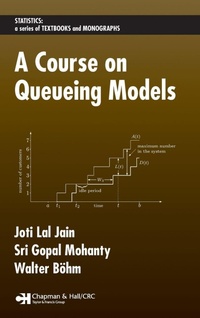
A Course on Queueing Models
1st Edition
Published on 20. July 2006
Book
Hardback
480 pages
978-1-58488-646-4 (ISBN)
Description
The application of engineering principles in divergent fields such as management science and communications as well as the advancement of several approaches in theory and computation have led to growing interest in queueing models, creating the need for a comprehensive text. Emphasizing Markovian structures and the techniques that occur in different models, A Course on Queueing Models discusses recent developments in the field, different methodological tools - some of which are not available elsewhere - and computational techniques.
While most books essentially address the classical methods of queueing theory, this text covers a broad range of methods both in theory and in computation. The first part of the textbook exposes you to many fundamental concepts at an introductory level and provides tools for practitioners. It discusses the basics in queueing theory for Markovian and regenerative non-Markovian models, statistical inference, simulation and some computational procedures, network and discrete-time queues, algebraic and combinatorial methods, and optimization. The second part delves deeper into the topics examined in the first part by presenting more advanced methods. This part also includes general queues, duality in queues, and recent advancements on computational methods and discrete-time queues. Each chapter contains a discussion section that summarizes material and highlights special features.
Incorporating different queueing models, A Course on Queueing Models achieves an ideal balance between theory and practice, making it compatible for advanced undergraduate and graduate students, applied statisticians, and engineers.
While most books essentially address the classical methods of queueing theory, this text covers a broad range of methods both in theory and in computation. The first part of the textbook exposes you to many fundamental concepts at an introductory level and provides tools for practitioners. It discusses the basics in queueing theory for Markovian and regenerative non-Markovian models, statistical inference, simulation and some computational procedures, network and discrete-time queues, algebraic and combinatorial methods, and optimization. The second part delves deeper into the topics examined in the first part by presenting more advanced methods. This part also includes general queues, duality in queues, and recent advancements on computational methods and discrete-time queues. Each chapter contains a discussion section that summarizes material and highlights special features.
Incorporating different queueing models, A Course on Queueing Models achieves an ideal balance between theory and practice, making it compatible for advanced undergraduate and graduate students, applied statisticians, and engineers.
More details
Language
English
Place of publication
Oxford
United States
Publishing group
Taylor & Francis Inc
Target group
Professional and scholarly
Professional Practice & Development
Illustrations
35 b/w images and 8 tables
Dimensions
Height: 235 mm
Width: 157 mm
Thickness: 30 mm
Weight
837 gr
ISBN-13
978-1-58488-646-4 (9781584886464)
Copyright in bibliographic data and cover images is held by Nielsen Book Services Limited or by the publishers or by their respective licensors: all rights reserved.
Schweitzer Classification
Other editions
Additional editions
Joti Lal Jain | Sri Gopal Mohanty | Walter Boehm
A Course on Queueing Models
Book
09/2019
1st Edition
Chapman & Hall/CRC
€97.30
Shipment within 15-20 days
Joti Lal Jain | Sri Gopal Mohanty | Walter Boehm
A Course on Queueing Models
E-Book
04/2016
Chapman & Hall/CRC
€89.99
Available for download
Joti Lal Jain | Sri Gopal Mohanty | Walter Boehm
A Course on Queueing Models
E-Book
04/2016
Chapman and Hall
€89.99
Available for download
Persons
Jain, Joti Lal; Mohanty, Sri Gopal; Boehm, Walter
Content
Queues: Basic Concepts. Markovian Queues. Regenerative Non-Markovian Queues-I. Computational Methods-I. Statistical Inference and Simulation. Regenerative Non-Markovian Queues-II. General Queues. Computational Methods-II. Discrete Time Queues: Transient Solutions. Miscellaneous Topics. Appendices. Index.