

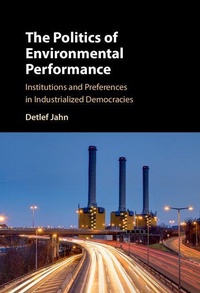
The Politics of Environmental Performance
Institutions and Preferences in Industrialized Democracies
Published on 27. October 2016
Book
Hardback
394 pages
978-1-107-11804-1 (ISBN)
Description
As the world faces the prospect of climate change, nuclear disasters, and water scarcity, it is clear that environmental degradation is an increasingly serious challenge with economic and social consequences. In this book, Detlef Jahn analyzes political processes in a macro-comparative study in order to estimate the role of politics in the field of environmental performance in twenty-one OECD countries. His model demonstrates various styles of politics used to combat environmental degradation. He finds that economic and environmental performance are still closely linked, and that moving towards a service society does not by itself solve the environmental challenge. The close relationship of these areas was made strikingly clear in the economic crisis of the new millennium. He argues that economic globalization fosters environmental deterioration, and undermines efforts in domestic politics and international coordination to improve the environmental record.
Reviews / Votes
'This excellent study shows how various styles of politics exist simultaneously in modern democracies. In environmental politics there are clashes between prioritizing the environment over growth and vice versa. However, there is also a consensus style in some areas of environmental politics, which may be more efficient in the end. A major contribution of this study is the agenda setting power model which illustrates how these two strategies work in democracies. The conclusions build on a rigorous data analysis which underlines the argument compellingly. This approach provides a very attractive model for other studies in the field of macro-comparative politics.' Arend Lijphart, Research Professor Emeritus of Political Science, University of California, San Diego 'Jahn's work is bound to become the go-to book for anyone interested in understanding why industrialized democracies differ so much in how well, or poorly, they treat the natural environment. This book provides a sophisticated and carefully articulated argument that reflects Jahn's unique depth and breadth of knowledge regarding political and policy processes, on the one hand, and environmental degradation, on the other. The book brings together an impressively broad range of theoretical insights, methodological tools, and empirical evidence in an analysis that provides a compelling examination of why countries sometimes succeed but too often fail in their efforts to protect the natural environment. This book has set a new standard of excellence for those seeking to understand comparative environmental politics.' Ronald Mitchell, University of Oregon 'Detlef Jahn studies environmental politics in advanced industrialized countries in a global environment. To achieve this goal, he faces multiple challenges: the interaction between agenda setters and veto players at the national as well as the international level; the multiple dimensions of political competition (left-right and growth-environment); the multiple issues of environmental policies; and the complicating effects of factors like climate. He has produced a thorough and impressive synthesis of theoretical arguments and empirical evidence which will contribute to our understanding of the most important problem of the planet before it is too late.' George Tsebelis, Anatol Rapoport Collegiate Professor of Political Science, University of Michigan 'Professor Jahn has produced an impressive, nuanced study of the determinants of environmental performance among advanced industrial democracies, a neglected topic of increasing importance in comparative politics. It includes many important innovations on the conceptualization of environmental performance and policy-making at various levels, and its focus on political factors is an important contribution to this debate. The book should be read by students and scholars of comparative environmental politics and policy.' Lyle Scruggs, University of ConnecticutMore details
Language
English
Place of publication
Cambridge
United Kingdom
Target group
Professional and scholarly
Illustrations
31 Tables, black and white; 12 Halftones, black and white; 16 Line drawings, black and white
Dimensions
Height: 235 mm
Width: 157 mm
Thickness: 26 mm
Weight
720 gr
ISBN-13
978-1-107-11804-1 (9781107118041)
Copyright in bibliographic data and cover images is held by Nielsen Book Services Limited or by the publishers or by their respective licensors: all rights reserved.
Schweitzer Classification
Other editions
Additional editions
Detlef Jahn
The Politics of Environmental Performance
Institutions and Preferences in Industrialized Democracies
E-Book
03/2017
Cambridge University Press
€30.99
Available for download
Detlef Jahn
Politics of Environmental Performance
Institutions and Preferences in Industrialized Democracies
E-Book
10/2016
Cambridge University Press
€25.49
Available for download
Person
Detlef Jahn is a professor of comparative politics at the University of Greifswald, Germany, and a permanent fellow of the Kolleg-Forschergruppe 'The Transformative Power of Europe' of the Free University Berlin. He is a board member of the Institute for Climate Protection, Energy and Mobility (IKEM) and for the Sustainable Government Index (SGI) of the Bertelsmann Foundation. He has published in International Organization, the Socio-Economic Review, the European Journal of Political Research, and Weather, Climate and Society (WCAS) of the American Meteorological Society. He is also the author of New Politics in Trade Unions (1993).
Content
1. Introduction; Part I. Approach, Method, and Concepts: 2. Explaining environmental performance; 3. Preferences in environmental politics; 4. The institutional settings in twenty-one OECD countries; Part II. Environmental Performance in twenty-one OECD Countries: 5. Measuring environmental performance; 6. Aggregating environmental performance data; Part III. Analysis: 7. Domestic politics; 8. International politics; 9. The nexus of domestic and international politics; 10. Conclusion.