

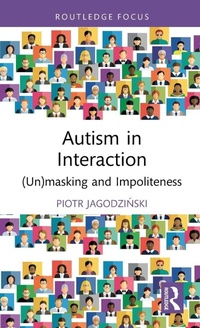
Autism in Interaction
(Un)masking and Impoliteness
1st Edition
Will be published approx. on 8. December 2025
Book
Hardback
120 pages
978-1-032-75351-5 (ISBN)
Description
This book seeks to build further links between (im)politeness research and autism by countering prevailing notions in pragmatics around autism and media portrayals of autistic characters through the lens of neurodiversity.
The volume explores the social, cognitive, and emotional impact of perceptions of rudeness and autistic masking on autistic individuals and the need for pragmatics research to move away from existing theorizations and instead put neurodiversity at the fore. Jagodzinski locates the book's theoretical foundations in the work of Goffman, reconceptualizing notions of face, facework, and line around interpersonal dynamics from a neurodivergent perspective. Jagodzinski uses Polish television series Herkules, which stars an autistic character, as a springboard for showcasing a new pragmatic model for neurodivergent facework rooted in autistic unmasking, best understood as being motivated by the need to bid for interactional freedom that is then co-constructed with a neurotypical interlocutor. The book makes the case for introducing new language and perspectives in the way we describe autistic communication toward capturing pragmatic differences specific to the autistic community in an inclusive way.
This book will be appeal to scholars in pragmatics, politeness studies, and language and communication, as well as those interested in interdisciplinary perspectives in autism research.
The volume explores the social, cognitive, and emotional impact of perceptions of rudeness and autistic masking on autistic individuals and the need for pragmatics research to move away from existing theorizations and instead put neurodiversity at the fore. Jagodzinski locates the book's theoretical foundations in the work of Goffman, reconceptualizing notions of face, facework, and line around interpersonal dynamics from a neurodivergent perspective. Jagodzinski uses Polish television series Herkules, which stars an autistic character, as a springboard for showcasing a new pragmatic model for neurodivergent facework rooted in autistic unmasking, best understood as being motivated by the need to bid for interactional freedom that is then co-constructed with a neurotypical interlocutor. The book makes the case for introducing new language and perspectives in the way we describe autistic communication toward capturing pragmatic differences specific to the autistic community in an inclusive way.
This book will be appeal to scholars in pragmatics, politeness studies, and language and communication, as well as those interested in interdisciplinary perspectives in autism research.
More details
Series
Language
English
Place of publication
London
United Kingdom
Publishing group
Taylor & Francis Ltd
Target group
College/higher education
Postgraduate
Illustrations
2 s/w Tabellen, 3 s/w Zeichnungen, 3 s/w Abbildungen
2 Tables, black and white; 3 Line drawings, black and white; 3 Illustrations, black and white
Dimensions
Height: 222 mm
Width: 145 mm
Thickness: 9 mm
Weight
273 gr
ISBN-13
978-1-032-75351-5 (9781032753515)
Copyright in bibliographic data and cover images is held by Nielsen Book Services Limited or by the publishers or by their respective licensors: all rights reserved.
Schweitzer Classification
Other editions
Additional editions
E-Book
12/2025
1st Edition
Routledge
€31.49
Available for download
E-Book
12/2025
1st Edition
Routledge
€31.49
Available for download
Person
Dr Piotr Jagodzinski is a Senior Lecturer in Applied Linguistics at Manchester Metropolitan University. He has published extensively on (im)politeness in institutional settings. His recent research interests focus on the pragmatics of autistic communication and its links with (im)politeness.
Content
1. Introduction 2. Autism and (im)politeness: from pragmatic failure to neurolect 3. Autism as a stigmatised identity on and off the screen 4. Autistic line, face and (un)masking 5. Setting the stage: data and analytical procedure 6. Unmasking Herkules 7. Conclusion, References, Index