

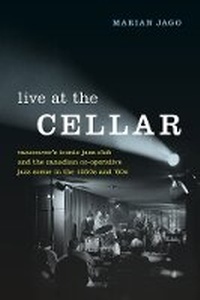
Live at the Cellar
Vancouver's Iconic Jazz Club and the Canadian Co-operative Jazz Scene in the 1950s and '60s
Published on 15. October 2018
Book
Paperback/Softback
364 pages
978-0-7748-3769-9 (ISBN)
Description
In the 1950s and '60s, co-operative jazz clubs such as Vancouver's Cellar, Edmonton's Yardbird Suite, and Halifax's 777 Barrington Street opened their doors in response to new forms of jazz expression emerging after the war and a lack of available performance spaces outside major urban centres. Operated on a not-for-profit basis by the musicians themselves, these hip new clubs created spaces where young jazz musicians could practise their art close to home.
Live at the Cellar looks at this unique period in the development of jazz in Canada. Centered on Vancouver's legendary Cellar club, and including co-ops in four other cities, it explores the ways in which these clubs functioned as sites for the performance and exploration of jazz as well as magnets for countercultural expression in other arts, such as literature, theatre, and film. Marian Jago's deft combination of new, original research with archival evidence, interviews, and photographs allows us to witness the beginnings of a pan-Canadian jazz scene as well as the emergence of key Canadian jazz figures, such as P.J. Perry, Don Thompson, and Terry Clarke, and the rise of jazz icons such as Paul Bley and Ornette Coleman. Although the Cellar and other jazz co-ops are long shuttered, in their day they created a new and infectious energy that still reverberates in Canada's jazz scene today.
Live at the Cellar looks at this unique period in the development of jazz in Canada. Centered on Vancouver's legendary Cellar club, and including co-ops in four other cities, it explores the ways in which these clubs functioned as sites for the performance and exploration of jazz as well as magnets for countercultural expression in other arts, such as literature, theatre, and film. Marian Jago's deft combination of new, original research with archival evidence, interviews, and photographs allows us to witness the beginnings of a pan-Canadian jazz scene as well as the emergence of key Canadian jazz figures, such as P.J. Perry, Don Thompson, and Terry Clarke, and the rise of jazz icons such as Paul Bley and Ornette Coleman. Although the Cellar and other jazz co-ops are long shuttered, in their day they created a new and infectious energy that still reverberates in Canada's jazz scene today.
Reviews / Votes
Good books on jazz are filled with intriguing stories about the relationships that generate such an energizing art form. This book is that, and more. The more is a carefully considered framework for making sense of the social dynamics that create a jazz scene. Put the stories into the framework and you've got a must-read book. - Brian Fraser, historian and minister (BC Lookbook/The Ormsby Review) Live at the Cellar deserves an audience beyond jazz aficionados: in a town that tends to endlessly reinvent the wheel, it tells how the first wheel was forged.- Alexander Varty (The Georgia Straight) With verve and insight, Veronica Strong-Boag's account of Laura Jamieson challenges many widely held myths. The book shows how a seemingly conformist, middle-class matron became an unstinting champion of social change - including women's enfranchisement, birth control, and social democracy. The Last Suffragist Standing is a stunning accomplishment, notably for its fresh and compelling twist on Canadian political history. - Stuart Derdeyn, art and entertainment reporter (Vancouver Sun) Jago's book is a sparkler. It shows how a small group of believers can make real change and quietly kick ass to boot. Bless 'em all! ... This is Vancouver's book of the year, hands down.
- Trevor Carolan (Subterrain, Issue 81) Good books on jazz are filled with intriguing stories about the relationships that generate such an energizing art form. This book is that, and more. The more is a carefully considered framework for making sense of the social dynamics that create a jazz scene. Put the stories into the framework and you've got a must-read book. - Brian Fraser (The Ormsby Review) Live at the Cellar does important work helping to tell the story of the music in Vancouver at this foundational moment in the city's history as well as drawing connections with other major Canadian scenes during the same period. - Joe Sorbara (CAML Review) Marian Jago has performed a genuine service in capturing one of the places that did exist [in the early jazz scene], with a diligently researched and amiably written study of a unique time and place in Vancouver's musical past.
- George Fetherling (Literary Review of Canada) [...]The way Jago sets the stage to explain how and why a musician-run, co-operative jazz venue emerged at this specific time in Vancouver, as in several other places, provides a fascinating window into Canadian history. - Jill Wilson (Canada's History)
More details
Language
English
Place of publication
Vancouver
Canada
Target group
Professional and scholarly
Product notice
Paperback (trade)
Illustrations
50 b&w photos, 2 maps
Dimensions
Height: 229 mm
Width: 152 mm
Weight
540 gr
ISBN-13
978-0-7748-3769-9 (9780774837699)
Copyright in bibliographic data and cover images is held by Nielsen Book Services Limited or by the publishers or by their respective licensors: all rights reserved.
Schweitzer Classification
Persons
Marian Jago, originally from Canada's west coast, is now a lecturer in popular music and jazz studies at the University of Edinburgh. She has published frequently on a wide variety of jazz topics for the Journal of Jazz Studies, Jazz Perspectives, Jazz Research Journal, Routledge, Bloomsbury, and others. Some of her recent work looks at the relationship of jazz to the writing of Jack Kerouac, the jazz economy of New York in the 1960s, and extended studio techniques versus "liveness" in jazz recordings. She also maintains an active interest in the Canadian jazz scene as well as the music and pedagogical practices of Lee Konitz and Lennie Tristano.
Content
Foreword by Don Thompson
Preface
Introduction
Part 1 Setting the Scene
1 Are You In or Out? The Nature of the "Scene"
2 Laying the Groundwork: The Early History of Jazz in Canada
Part 2 The Vancouver Scene
3 The Making of a Jazz Scene: Vancouver's Cellar Club
4 No Room for Squares: The Cellar as Artistic Hub
5 In the Swing of Things: Growth, Maturation, and Mingus
6 Altered Chords: New Blood and the End of an Era
Part 3 Other Canadian Scenes
7 Co-ops from Coast to Coast: Edmonton, Calgary, Halifax
Conclusion
Appendices: Gigography for the Cellar, 1956-63; Canadian Jazz Sources
Notes; Selected Bibliography; Interviews; Index
Preface
Introduction
Part 1 Setting the Scene
1 Are You In or Out? The Nature of the "Scene"
2 Laying the Groundwork: The Early History of Jazz in Canada
Part 2 The Vancouver Scene
3 The Making of a Jazz Scene: Vancouver's Cellar Club
4 No Room for Squares: The Cellar as Artistic Hub
5 In the Swing of Things: Growth, Maturation, and Mingus
6 Altered Chords: New Blood and the End of an Era
Part 3 Other Canadian Scenes
7 Co-ops from Coast to Coast: Edmonton, Calgary, Halifax
Conclusion
Appendices: Gigography for the Cellar, 1956-63; Canadian Jazz Sources
Notes; Selected Bibliography; Interviews; Index