

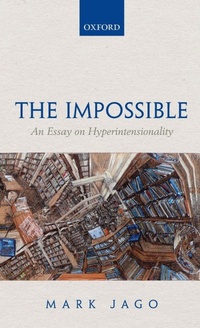
The Impossible
An Essay on Hyperintensionality
Published on 24. April 2014
Book
Hardback
306 pages
978-0-19-870900-8 (ISBN)
Description
Mark Jago presents an original philosophical account of meaningful thought: in particular, how it is meaningful to think about things that are impossible. We think about impossible things all the time. We can think about alchemists trying to turn base metal to gold, and about unfortunate mathematicians trying to square the circle. We may ponder whether god exists; and philosophers frequently debate whether properties, numbers, sets, moral and aesthetic qualities, and qualia exist. In many philosophical or mathematical debates, when one side of the argument gets things wrong, it necessarily gets them wrong. As we consider both sides of one of these philosophical arguments, we will at some point think about something that's impossible. Yet most philosophical accounts of meaning and content hold that we can't meaningfully think or reason about the impossible.
In The Impossible, Jago argues that we often gain new information, new beliefs and, sometimes, fresh knowledge through logic, mathematics and philosophy. That is why logic, mathematics, and philosophy are useful. We therefore require accounts of knowledge and belief, of information and content, and of meaning which allow space for the impossible. Jago's aim in this book is to provide such accounts. He gives a detailed analysis of the concept of hyperintensionality, whereby logically equivalent contents may be distinct, and develops a theory in terms of possible and impossible worlds. Along the way, he provides a theory of what those worlds are and how they feature in our analysis of normative epistemic concepts: knowledge, belief, information, and content.
In The Impossible, Jago argues that we often gain new information, new beliefs and, sometimes, fresh knowledge through logic, mathematics and philosophy. That is why logic, mathematics, and philosophy are useful. We therefore require accounts of knowledge and belief, of information and content, and of meaning which allow space for the impossible. Jago's aim in this book is to provide such accounts. He gives a detailed analysis of the concept of hyperintensionality, whereby logically equivalent contents may be distinct, and develops a theory in terms of possible and impossible worlds. Along the way, he provides a theory of what those worlds are and how they feature in our analysis of normative epistemic concepts: knowledge, belief, information, and content.
Reviews / Votes
Jago's book will be a pleasure to read for a wide range of philosophers interested in mind, language, epistemology, and metaphysics. This book usefully contributes to both the philosophical and technical tasks of incorporating impossible worlds into our theorising about representation. It also lays important initial groundwork for employing impossible worlds in epistemology: not just to model what people do believe and how those beliefs change, but the rational constraints on doing so, even when the beliefs represent impossibilities. * Daniel Nolan, Mind *More details
Language
English
Place of publication
Oxford
United Kingdom
Target group
College/higher education
Dimensions
Height: 222 mm
Width: 145 mm
Thickness: 20 mm
Weight
519 gr
ISBN-13
978-0-19-870900-8 (9780198709008)
Copyright in bibliographic data and cover images is held by Nielsen Book Services Limited or by the publishers or by their respective licensors: all rights reserved.
Schweitzer Classification
Other editions
Additional editions
E-Book
04/2014
1st Edition
OUP eBook
€42.99
Available for download
E-Book
04/2014
1st Edition
OUP Oxford
€57.89
Available for download
Person
Mark Jago is Lecturer in Philosophy at the University of Nottingham. Before that, he was a postdoctoral fellow at Macquarie University in Sydney, Australia. He mainly writes on metaphysics, logic, epistemology, and philosophy of language.
Content
Introduction ; 1. The Possible Worlds Approach ; 2. Hyperintensionality ; 3. Hyperintensionality and Structure ; 4. Impossible Worlds ; 5. Constructing Worlds ; 6. The Problem of Bounded Rationality ; 7. Epistemic Space ; 8. Epistemic Content