

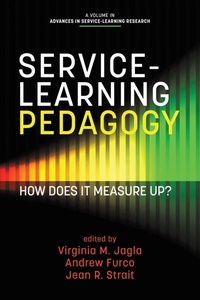
Service-Learning Pedagogy
How Does It Measure Up?
Published on 5. February 2015
Book
Paperback/Softback
406 pages
978-1-62396-955-4 (ISBN)
Description
Service-learning is a powerful method of teaching and learning that has been used effectively for more than two decades. Its efficacy has been researched in a variety of ways and this volume continues to expand that research base. In particular, in this volume, Service-Learning Pedagogy: How Does It Measure Up?, we explore three broad areas of service-learning research and practice that reflect broader discussions of the role of pedagogy in today's educational reform efforts: Teacher Education, Crossing Boundaries: Deepening Relationships in Service-Learning and New Paradigms/Conceptual Frameworks.
Many have called for more rigorous methods when researching service-learning pedagogy. That has been the major impetus for this volume. We seek to generate knowledge regarding service-learning pedagogy, while developing theories about it. We surface some elusive affective characteristics of the pedagogy, which we know has the power to produce transformational learning. To this end, the authors who have contributed to this volume effectively add to the growing body of knowledge in the field and help us get closer to understanding the extent to which service-learning does and does not measure up.
Many have called for more rigorous methods when researching service-learning pedagogy. That has been the major impetus for this volume. We seek to generate knowledge regarding service-learning pedagogy, while developing theories about it. We surface some elusive affective characteristics of the pedagogy, which we know has the power to produce transformational learning. To this end, the authors who have contributed to this volume effectively add to the growing body of knowledge in the field and help us get closer to understanding the extent to which service-learning does and does not measure up.
More details
Series
Language
English
Place of publication
Charlotte
United States
Publishing group
Emerald Publishing Inc
Target group
Professional and scholarly
Dimensions
Height: 234 mm
Width: 156 mm
Thickness: 22 mm
Weight
614 gr
ISBN-13
978-1-62396-955-4 (9781623969554)
Copyright in bibliographic data and cover images is held by Nielsen Book Services Limited or by the publishers or by their respective licensors: all rights reserved.
Schweitzer Classification
Other editions
Additional editions
E-Book
01/2015
1st Edition
Information Age Publishing
from
€62.33
Available for download
Persons
Virginia M. Jagla, National Louis University, USA.
Andrew Furco, University of Minnesota, USA.
Jean R. Strait, Hamline University, USA.
Andrew Furco, University of Minnesota, USA.
Jean R. Strait, Hamline University, USA.
Content
Preface.
Part I: Teacher Education, Jean R. Strait.
Chapter 1. Intersecting Lives and Identities: Shaping Service-Learning Spaces for Preservice Teachers to Experience and Learn About Diversity, Claire Desrochers.
Chapter 2. Examining the Process of Civic Learning Through a Systematic Service-Learning Experience in Teacher Education, Margaret M. Ferrara and Marlene Rebori.
Chapter 3. A Heuristic Phenomenology on the Experience of Building a High School Service-Learning Program, Monica Kowal.
Chapter 4. Promises and Pitfalls of Service-Learning in Teacher Preparation: Lessons From Longitudinal Research, Kathleen C. Tice and Larry P. Nelson.
Part II: Crossing Boundaries: Deepening Relationships in Service-Learning, Andrew Furco.
Chapter 5. Service-Learning Projects in College Introductory Statistics: Effects on Students' Attitudes, Rachel Chaphalkar and Ke Wu.
Chapter 6. Community Engagement: Implementation and Success of Service-Learning Programs With Heritage and Foreign Language Students of Spanish, Gregory Thompson.
Chapter 7. Service-Learning Community: A Win for Students, Community, Institution, and Faculty, Mary Lo Re.
Chapter 8. Service-Learning Pedagogy: Understanding the Impact of Student Breadth and Depth of Engagement in Student Organizations, Julianne Gassman.
Chapter 9. Reflections on Service-Learning Situated in Challenging Contexts: Lessons Learned, Cynthia Bourne, Susan Crichton, and Deborah Carter.
Chapter 10. Community Partners Critique, Eric Hartman.
Part III: New Paradigms/Conceptual Frameworks, Virginia M. Jagla.
Chapter 11. Twenty-First Century Literacies and Service-Learning: An Opportunity to Revolutionize Disciplinary Writing Instruction, George Boggs.
Chapter 12. Kaleidoscopic Learning: Spiritual and Social Conscience Development Through Narrative Reflection in Service-Learning, Matthew Maruggi.
Chapter 13. Across Boundaries of Privilege: Service-Learning for Social Justice, Deborah Rintels Weiner.
Chapter 14. Community-Engaged Learning and Supplemental Instruction: An Exploratory Study of Intersecting Pedagogies, Colleen Packer and Brenda Marsteller Kowalewski.
Chapter 15. Invited Retrospective: The Future of Service-Learning and Community Engagement Research Is Mixed [Methods], Robert Shumer.
About the Editors.
About the Contributors.
Part I: Teacher Education, Jean R. Strait.
Chapter 1. Intersecting Lives and Identities: Shaping Service-Learning Spaces for Preservice Teachers to Experience and Learn About Diversity, Claire Desrochers.
Chapter 2. Examining the Process of Civic Learning Through a Systematic Service-Learning Experience in Teacher Education, Margaret M. Ferrara and Marlene Rebori.
Chapter 3. A Heuristic Phenomenology on the Experience of Building a High School Service-Learning Program, Monica Kowal.
Chapter 4. Promises and Pitfalls of Service-Learning in Teacher Preparation: Lessons From Longitudinal Research, Kathleen C. Tice and Larry P. Nelson.
Part II: Crossing Boundaries: Deepening Relationships in Service-Learning, Andrew Furco.
Chapter 5. Service-Learning Projects in College Introductory Statistics: Effects on Students' Attitudes, Rachel Chaphalkar and Ke Wu.
Chapter 6. Community Engagement: Implementation and Success of Service-Learning Programs With Heritage and Foreign Language Students of Spanish, Gregory Thompson.
Chapter 7. Service-Learning Community: A Win for Students, Community, Institution, and Faculty, Mary Lo Re.
Chapter 8. Service-Learning Pedagogy: Understanding the Impact of Student Breadth and Depth of Engagement in Student Organizations, Julianne Gassman.
Chapter 9. Reflections on Service-Learning Situated in Challenging Contexts: Lessons Learned, Cynthia Bourne, Susan Crichton, and Deborah Carter.
Chapter 10. Community Partners Critique, Eric Hartman.
Part III: New Paradigms/Conceptual Frameworks, Virginia M. Jagla.
Chapter 11. Twenty-First Century Literacies and Service-Learning: An Opportunity to Revolutionize Disciplinary Writing Instruction, George Boggs.
Chapter 12. Kaleidoscopic Learning: Spiritual and Social Conscience Development Through Narrative Reflection in Service-Learning, Matthew Maruggi.
Chapter 13. Across Boundaries of Privilege: Service-Learning for Social Justice, Deborah Rintels Weiner.
Chapter 14. Community-Engaged Learning and Supplemental Instruction: An Exploratory Study of Intersecting Pedagogies, Colleen Packer and Brenda Marsteller Kowalewski.
Chapter 15. Invited Retrospective: The Future of Service-Learning and Community Engagement Research Is Mixed [Methods], Robert Shumer.
About the Editors.
About the Contributors.