

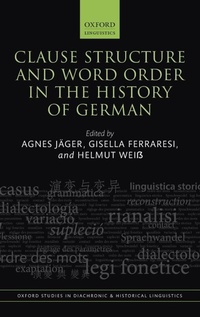
Clause Structure and Word Order in the History of German
Published on 22. March 2018
Book
Hardback
424 pages
978-0-19-881354-5 (ISBN)
Description
This volume presents the first comprehensive generative account of the historical syntax of German. Leading scholars in the field survey a range of topics and offer new insights into central aspects of clause structure and word order, outlining the different stages of their historical development. Each chapter combines a solid empirical basis with descriptive generalizations, supported by a detailed discussion of theoretical analyses couched in the generative framework. Reference is also made throughout to the more traditional descriptive model of the German clause.
The volume is divided into three parts that correspond to the main parts of the clause. Part I explores the left periphery, looking at verb placement (verb second and competing orders), the prefield, and adverbial connectives, while Part II discusses the middle field, including pronominal syntax, the order of full NPs, and the history of negation. The final part examines the right periphery with chapters covering basic word order (OV/VO), prosodic and information-structural factors, and the verbal complex. The book will be a valuable resource for researchers and students in historical syntax and the Germanic languages, and for both descriptive and theoretical linguists alike.
The volume is divided into three parts that correspond to the main parts of the clause. Part I explores the left periphery, looking at verb placement (verb second and competing orders), the prefield, and adverbial connectives, while Part II discusses the middle field, including pronominal syntax, the order of full NPs, and the history of negation. The final part examines the right periphery with chapters covering basic word order (OV/VO), prosodic and information-structural factors, and the verbal complex. The book will be a valuable resource for researchers and students in historical syntax and the Germanic languages, and for both descriptive and theoretical linguists alike.
More details
Series
Language
English
Place of publication
Oxford
United Kingdom
Target group
Professional and scholarly
Dimensions
Height: 240 mm
Width: 161 mm
Thickness: 27 mm
Weight
798 gr
ISBN-13
978-0-19-881354-5 (9780198813545)
Copyright in bibliographic data and cover images is held by Nielsen Book Services Limited or by the publishers or by their respective licensors: all rights reserved.
Schweitzer Classification
Other editions
Additional editions
Agnes Jäger | Gisella Ferraresi | Helmut Weiß
Clause Structure and Word Order in the History of German
E-Book
03/2018
1st Edition
OUP eBook
€73.99
Available for download
Persons
Agnes Jaeger is Professor of Historical German Linguistics at the University of Cologne. Her research interests include diachronic syntax and its interfaces with semantics and morphology, dialectal variation, and theories of language change. She is the author of History of German Negation (Benjamins, 2008) and of Vergleichskonstruktionen im Deutschen: Diachroner Wandel und synchrone Variation (de Gruyter, 2018), as well as numerous journal articles and book chapters on the topics of negation, indefinites, and comparatives, among others. She is the co-editor, with Chiara Gianollo and Doris Penka, of Language Change at the Syntax-Semantics Interface (de Gruyter, 2015).
Gisella Ferraresi is Professor of German Linguistics and German as a Foreign Language at the University of Bamberg. After receiving her Ph.D in 1997 from the University of Stuttgart, she
held positions at the Universities of Hamburg, Hannover, and Frankfurt am Main. She has (co-)edited several volumes on language change and language contact and is the author of three monographs and many articles on language change, grammaticalization, Gothic syntax, language contact, and second language acquisition. Her current research explores topics such as connectives, particles and clause structure, and aspectuality from a diachronic and acquisitional perspective.
Helmut Weiss is Full Professor of Historical German Linguistics at the University of Frankfurt. He is one of the leading experts in the syntax of German dialects, and is co-editor, with Juerg Fleischer and Alexandra Lenz, of The Syntactic Atlas of Hessian Dialects and, with Guenther Grewendorf, of Bavarian Syntax (Benjamins 2014). He is the author of Syntax des Bairischen (Niemeyer 1998) and of multiple journal articles and book chapters on subjects including complementizer agreement, negative concord, possessive constructions, and pronominal syntax.
Gisella Ferraresi is Professor of German Linguistics and German as a Foreign Language at the University of Bamberg. After receiving her Ph.D in 1997 from the University of Stuttgart, she
held positions at the Universities of Hamburg, Hannover, and Frankfurt am Main. She has (co-)edited several volumes on language change and language contact and is the author of three monographs and many articles on language change, grammaticalization, Gothic syntax, language contact, and second language acquisition. Her current research explores topics such as connectives, particles and clause structure, and aspectuality from a diachronic and acquisitional perspective.
Helmut Weiss is Full Professor of Historical German Linguistics at the University of Frankfurt. He is one of the leading experts in the syntax of German dialects, and is co-editor, with Juerg Fleischer and Alexandra Lenz, of The Syntactic Atlas of Hessian Dialects and, with Guenther Grewendorf, of Bavarian Syntax (Benjamins 2014). He is the author of Syntax des Bairischen (Niemeyer 1998) and of multiple journal articles and book chapters on subjects including complementizer agreement, negative concord, possessive constructions, and pronominal syntax.
Editor
Professor of Historical German LinguisticsProfessor of Historical German Linguistics, University of Cologne
Professor for German Linguistics and German as a Foreign LanguageProfessor for German Linguistics and German as a Foreign Language, University of Bamberg
Professor of Historical German LinguisticsProfessor of Historical German Linguistics, University of Frankfurt
Content
1: Agnes Jaeger, Gisella Ferraresi, and Helmut Weiss: Introduction
PART I: The Left Periphery
2: Svetlana Petrova: Introduction to Part I
3: Katrin Axel-Tober: Origins of verb-second in Old High German
4: Svetlana Petrova: Verb-initial declaratives in Old High German and in later German
5: Augustin Speyer and Helmut Weiss: The prefield after the Old High German period
6: Gisella Ferraresi: Adverbial connectives
PART II: The Middle Field
7: Gisella Ferraresi and Agnes Jaeger: Introduction to Part II
8: Helmut Weiss: The Wackernagel complex and pronoun raising
9: Augustin Speyer: Serialization of full noun phrases in the history of German
10: Anne Breitbarth and Agnes Jaeger: History of negation in High and Low German
Part III: The Right Periphery
11: Eric Fuss: Introduction to Part III
12: Eric Fuss: The OV-VO alternation in Early German: Diagnostics for basic word order
13: Svetlana Petrova and Helmut Weiss: OV vs VO in Old High German: The case of thaz-clauses
14: Roland Hinterhoelzl and Svetlana Petrova: Prosodic and information-structural factors in word order variation
15: Augustin Speyer: Periphrastic verb forms
16: Agnes Jaeger: On the history of the IPP construction in German
17: Augustin Speyer: The ACI construction in the history of German
PART I: The Left Periphery
2: Svetlana Petrova: Introduction to Part I
3: Katrin Axel-Tober: Origins of verb-second in Old High German
4: Svetlana Petrova: Verb-initial declaratives in Old High German and in later German
5: Augustin Speyer and Helmut Weiss: The prefield after the Old High German period
6: Gisella Ferraresi: Adverbial connectives
PART II: The Middle Field
7: Gisella Ferraresi and Agnes Jaeger: Introduction to Part II
8: Helmut Weiss: The Wackernagel complex and pronoun raising
9: Augustin Speyer: Serialization of full noun phrases in the history of German
10: Anne Breitbarth and Agnes Jaeger: History of negation in High and Low German
Part III: The Right Periphery
11: Eric Fuss: Introduction to Part III
12: Eric Fuss: The OV-VO alternation in Early German: Diagnostics for basic word order
13: Svetlana Petrova and Helmut Weiss: OV vs VO in Old High German: The case of thaz-clauses
14: Roland Hinterhoelzl and Svetlana Petrova: Prosodic and information-structural factors in word order variation
15: Augustin Speyer: Periphrastic verb forms
16: Agnes Jaeger: On the history of the IPP construction in German
17: Augustin Speyer: The ACI construction in the history of German