

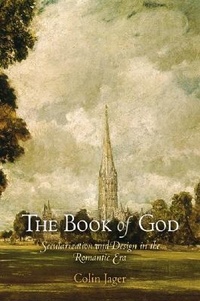
The Book of God
Secularization and Design in the Romantic Era
Published on 26. December 2006
Book
Hardback
288 pages
978-0-8122-3979-9 (ISBN)
Description
The Book of God is a penetrating study of the argument from design as it emerged and circulated in the romantic era. This argument holds that the intricacy and complexity of the natural world points to a divine designer and that nature is to be read as God's book. A literary and philosophical study of this idea, The Book of God revisits the familiar equation of romanticism, modernity, and secularization. Colin Jager eschews classic formulations of the thesis that societies secularize as they modernize, arguing instead that secularization is complexly interwoven with modernity rather than simply opposed to it. This revised concept of secularization reveals how arguments about God's designing intentions structure a romantic modernity that is neither progressive nor entirely secular.
Tracing this understanding through diverse texts, ranging from philosophy and theology to poetry and fiction, Jager argues that the idea of design functions as both source and interlocutor for many of romanticism's most famous topics. The book concludes with current controversies over intelligent design and evolution, arguing for a historically informed approach to modernity's attempts to divide the religious from the secular.
The book's chronological and thematic range will make it of interest to students of religion and of intellectual and cultural history, as well as literary scholars.
Tracing this understanding through diverse texts, ranging from philosophy and theology to poetry and fiction, Jager argues that the idea of design functions as both source and interlocutor for many of romanticism's most famous topics. The book concludes with current controversies over intelligent design and evolution, arguing for a historically informed approach to modernity's attempts to divide the religious from the secular.
The book's chronological and thematic range will make it of interest to students of religion and of intellectual and cultural history, as well as literary scholars.
Reviews / Votes
"An erudite, refreshing study of the eighteenth- and nineteenth-century concept of intentional design that rethinks the equation of romanticism, modernity, and secularization underwriting romantic studies for the last fifty years. The Book of God manages to be at once ambitious, deliberate, and nuanced in its interconnecting conceptions of philosophy and literary criticism." (Orrin Wang, University of Maryland) "The claim that God's existence can be inferred from the order and intricacy of the world has an ancient lineage. The Book of God explores the literary, philosophical, and theological inflection of this avowal in the context of encroaching secularism in the eighteenth and nineteenth centuries. . . . It is a timely work, for the historical survey bears also on contemporary discussion. Some recent commentators have made much of the alleged incompatibly between science and religion. Colin Jager's sensitivity to the complexity of 'secularization' serves to subvert this binary thinking." (Times Literary Supplement)More details
Language
English
Place of publication
Pennsylvania
United States
Target group
College/higher education
Product notice
Paper over boards
Dimensions
Height: 231 mm
Width: 157 mm
Thickness: 30 mm
Weight
590 gr
ISBN-13
978-0-8122-3979-9 (9780812239799)
Copyright in bibliographic data and cover images is held by Nielsen Book Services Limited or by the publishers or by their respective licensors: all rights reserved.
Schweitzer Classification
Person
Colin Jager teaches English at Rutgers University.
Content
Preface
Introduction. Nature is the Book of God
Chapter 1. The Argument Against Design from Deism to Blake
Chapter Two. Arbitrary Acts of Mind: Natural Theology in Hume's Dialogues Concerning Natural Religion
Chapter Three. Theory, Practice, and Anna Barbauld
Chapter Four. Natural Designs: William Paley, Immanuel Kant, and the Power of Analogy
Chapter Five. Mansfield Park and the End of Natural Theology
Chapter Six. Wordsworth: The Shape of Analogy
Chapter Seven. Reading With a Worthy Eye: Secularization and Evil
Chapter Eight. Religion Three Ways
Afterword. Intelligent Design and Religious Ignoramuses; or, the Difference between Theory and Literature
Endnotes
Bibliography
Index
Acknowledgments
Introduction. Nature is the Book of God
Chapter 1. The Argument Against Design from Deism to Blake
Chapter Two. Arbitrary Acts of Mind: Natural Theology in Hume's Dialogues Concerning Natural Religion
Chapter Three. Theory, Practice, and Anna Barbauld
Chapter Four. Natural Designs: William Paley, Immanuel Kant, and the Power of Analogy
Chapter Five. Mansfield Park and the End of Natural Theology
Chapter Six. Wordsworth: The Shape of Analogy
Chapter Seven. Reading With a Worthy Eye: Secularization and Evil
Chapter Eight. Religion Three Ways
Afterword. Intelligent Design and Religious Ignoramuses; or, the Difference between Theory and Literature
Endnotes
Bibliography
Index
Acknowledgments