

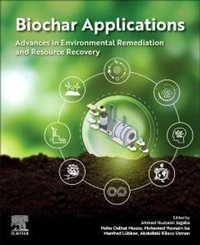
Biochar Applications
Advances in Environmental Remediation and Resource Recovery
Published on 28. May 2026
Book
Paperback/Softback
820 pages
978-0-443-44581-1 (ISBN)
Description
Biochar Applications: Advances in Environmental Remediation and Resource Recovery provides a combined approach between environmental science and environmental engineering that involves the improvement of the natural environment, or the remediation, of polluted sites. In addition, it discusses bioprocess engineering, including the synthesis, modification, characterization, and management of biochar from biomass waste materials. The book includes coverage on sources, impacts, and applications of biochar that could potentially be used as catalysts to enhance environmental remediation and resource recovery processes. Examples of applied research that demonstrate the relationship between wastewater, soil, contaminated environments, remediation, resource recovery, sustainability, and circular bioeconomy are also included.
The book bridges the gap between biochar applications in wastewater treatment, soil improvement, gas mitigation, and resource recovery.
The book bridges the gap between biochar applications in wastewater treatment, soil improvement, gas mitigation, and resource recovery.
More details
Language
English
Place of publication
Philadelphia
United States
Target group
Professional and scholarly
Product notice
Paperback (trade)
Unsewn / adhesive bound
Dimensions
Height: 235 mm
Width: 191 mm
Weight
449 gr
ISBN-13
978-0-443-44581-1 (9780443445811)
Copyright in bibliographic data and cover images is held by Nielsen Book Services Limited or by the publishers or by their respective licensors: all rights reserved.
Schweitzer Classification
Other editions
Additional editions
Ahmad Hussaini Jagaba | Nuhu Dalhat Mu'azu | Mohamed Hasnain Isa
Biochar Applications
Advances in Environmental Remediation and Resource Recovery
E-Book
06/2026
Elsevier
€176.99
Available for download
Persons
Ahmad Hussaini Jagaba is an assistant professor in the Department of Civil Engineering, Faculty of Engineering, University of Tabuk, Saudi Arabia. He obtained his B.Eng. from Abubakar Tafawa Balewa University, Bauchi; M. Eng. Civil Engineering from Universiti Tun Hussein Onn Malaysia (UTHM) and PhD in Civil Engineering (Environmental) from Universiti Teknologi PETRONAS, Bandar Seri Iskandar, Perak Darul Ridzuan, Malaysia. He has authored and co-authored several articles that include research articles, review papers, conference papers, and book chapters in environmental engineering with special emphasis in physical/chemical and biological wastewater treatment, biomass conversion, sewage and industrial sludge and solid waste management. He is an Editor in the "International Journal of Sustainable Engineering (IJSE)?, Taylor & Francis. He is also a reviewer for reputable journals in: Elsevier, Springer, MDPI, Wiley online etc.
Nuhu Dalhat Mu'azu is a professor at the Department of Environmental Engineering, College of Engineering, Imam Bin Abdulrahman Faisal University, Saudi Arabia. He obtained his bachelor's degree (B.Eng. Civil Engineering) from Ahmadu Bello University, Zaria Nigeria and his MSc and PhD in Civil (Water Resources and Environmental) both from King Fahd University of Petroleum and Minerals, Saudi Arabia. He has been engaged in research and teaching in the areas of Environmental Engineering and related engineering and science disciplines. His research focuses on advanced technologies for water and wastewater treatment, wastes management, geoenvironmental engineering, wastewater treatment plant modelling and simulation, process optimization and life cycle assessment for achieving sustainable environmental management. He has published several articles in high ranked journals of international repute. He has been actively involved in consultation services and serves as a principal investigator in execution of several budgeted scientific research projects in collaboration with local and international partners in areas covering technologies for water, wastewater and soil/ground remediation and environmental sustainability in management of solid waste, water, wastewater infrastructures.
Dr. Mohamed Hasnain Isa obtained his BSc Eng (Civil) and MSc Eng (Environmental & Water Resources) degrees from the Aligarh Muslim University, India. He completed PhD (Environmental Eng) from the University of Newcastle upon Tyne, England. Dr. Hasnain has held various academic positions in India and Malaysia. He is currently the Assistant Vice Chancellor (Research and Innovation) and a Professor at the Universiti Teknologi Brunei, Brunei Darussalam. Prof. Hasnain's research emphasis is on the treatment of wastewater with the aim of achieving resource efficiency and advance sustainability. His research focusses on energy recovery through removal of organic matter and degradation of recalcitrant compounds.
Dr. Manfred Luebken has obtained his Diploma degree in Civil Engineering in 2002 from the Leibniz University Hanover, Germany. He completed PhD (Environmental Engineering) in 2009 from the Technical University Munich, Germany. He is currently a senior researcher at the Institute of Urban Water Management and Environmental Engineering of the Ruhr University Bochum, Germany. His research focuses on optimization of (waste)water treatment processes, and mathematical modeling. He has authored and co-authored several articles from fundamental to application-oriented research in the environmental engineering field. In addition, Dr. Manfred Luebken is involved in the development and revising of regulations as well as of technical standards within the context of wastewater treatment and water reuse at national and international level.
Abdullahi Kilaco Usman is a lecturer at the Department of Civil Engineering, University of Hafr Al Batin, Kingdom of Saudi Arabia. He obtained his bachelor's degree (B.Eng. Water and Environmental) from Ahmadu Bello University, Zaria Nigeria, and his MSc (Environmental Engineering) from King Fahd University of Petroleum and Minerals, Saudi Arabia, and PhD in Civil Engineering from Universiti Technologi Malaysia. His research interests include electrokinetic remediation of contaminated soils, photocatalysis/adsorption processes for water and wastewater treatment. He has published several articles that include research articles, review papers, conference papers, and book chapters in environmental engineering with special emphasis in physical/chemical and biological wastewater treatment. He has been involved in several scientific research funded projects in soil and groundwater remediation. He is also a reviewer for reputable journals including Elsevier amongst others.
Nuhu Dalhat Mu'azu is a professor at the Department of Environmental Engineering, College of Engineering, Imam Bin Abdulrahman Faisal University, Saudi Arabia. He obtained his bachelor's degree (B.Eng. Civil Engineering) from Ahmadu Bello University, Zaria Nigeria and his MSc and PhD in Civil (Water Resources and Environmental) both from King Fahd University of Petroleum and Minerals, Saudi Arabia. He has been engaged in research and teaching in the areas of Environmental Engineering and related engineering and science disciplines. His research focuses on advanced technologies for water and wastewater treatment, wastes management, geoenvironmental engineering, wastewater treatment plant modelling and simulation, process optimization and life cycle assessment for achieving sustainable environmental management. He has published several articles in high ranked journals of international repute. He has been actively involved in consultation services and serves as a principal investigator in execution of several budgeted scientific research projects in collaboration with local and international partners in areas covering technologies for water, wastewater and soil/ground remediation and environmental sustainability in management of solid waste, water, wastewater infrastructures.
Dr. Mohamed Hasnain Isa obtained his BSc Eng (Civil) and MSc Eng (Environmental & Water Resources) degrees from the Aligarh Muslim University, India. He completed PhD (Environmental Eng) from the University of Newcastle upon Tyne, England. Dr. Hasnain has held various academic positions in India and Malaysia. He is currently the Assistant Vice Chancellor (Research and Innovation) and a Professor at the Universiti Teknologi Brunei, Brunei Darussalam. Prof. Hasnain's research emphasis is on the treatment of wastewater with the aim of achieving resource efficiency and advance sustainability. His research focusses on energy recovery through removal of organic matter and degradation of recalcitrant compounds.
Dr. Manfred Luebken has obtained his Diploma degree in Civil Engineering in 2002 from the Leibniz University Hanover, Germany. He completed PhD (Environmental Engineering) in 2009 from the Technical University Munich, Germany. He is currently a senior researcher at the Institute of Urban Water Management and Environmental Engineering of the Ruhr University Bochum, Germany. His research focuses on optimization of (waste)water treatment processes, and mathematical modeling. He has authored and co-authored several articles from fundamental to application-oriented research in the environmental engineering field. In addition, Dr. Manfred Luebken is involved in the development and revising of regulations as well as of technical standards within the context of wastewater treatment and water reuse at national and international level.
Abdullahi Kilaco Usman is a lecturer at the Department of Civil Engineering, University of Hafr Al Batin, Kingdom of Saudi Arabia. He obtained his bachelor's degree (B.Eng. Water and Environmental) from Ahmadu Bello University, Zaria Nigeria, and his MSc (Environmental Engineering) from King Fahd University of Petroleum and Minerals, Saudi Arabia, and PhD in Civil Engineering from Universiti Technologi Malaysia. His research interests include electrokinetic remediation of contaminated soils, photocatalysis/adsorption processes for water and wastewater treatment. He has published several articles that include research articles, review papers, conference papers, and book chapters in environmental engineering with special emphasis in physical/chemical and biological wastewater treatment. He has been involved in several scientific research funded projects in soil and groundwater remediation. He is also a reviewer for reputable journals including Elsevier amongst others.
Editor
Department of Civil Engineering, Faculty of Engineering, University of Tabuk, P.O. Box 741, Tabuk 71491, Saudi Arabia
Department of Environmental Engineering College of Engineering, Imam Bin Abdulrahman Faisal University Box 1982, Dammam 31441 Saudi Arabia
Civil Engineering Programme, Faculty of Engineering, Universiti Teknologi Brunei, Tungku Highway, Gadong, BE1410, Brunei Darussalam
Department of Civil and Environmental Engineering, Institute of Urban Water Management and Environmental Engineering, Ruhr-Universitaet Bochum, Universitaetsstrasse 150, Bochum, 44801, North Rhine-Westphalia, Germany
Department of Civil Engineering, College of Engineering, University of Hafr Al Batin, P.O. Box 1803, Hafr Al Batin, 39524, Saudi Arabia
Content
1. Introduction to Biochar for Environmental Applications
2. Biochar for Environmental Sustainability and Resource Recovery: An Overview
3. Biochar and its derivative composites for industrial applications
4. Synthesis, modification, characterization, and properties of biochar for environmental applications
5. Cleaner and circular bioeconomy approaches for biochar production
6. Biochar production yield: effect of leaves, seeds, fronds, straws, trunks, bagasse, and surface fibers as feedstock
7. Artificial intelligence in biochar development and application process optimization
8. Environmental impacts and management of biochar
9. Biochar-based materials for corrosion mitigation in environmental and industrial systems
10. Remediation of contaminated sites by biochar and its derivative composites
11. Biochar and microplastics: Co-existence, mechanisms, transformations, and challenges in contaminated environment
12. Impact of biochar on the composition, population and diversity of microbial community in soil matrices
13. Application of biochar in crop production
14. Biochar as a nutrient and microbial carrier in agricultural production
15. Advanced oxidation and photocatalytic processes utilizing biochar for wastewater treatment
16. Membrane separation processes utilizing biochar for wastewater treatment
17. Adsorption and filtration processes utilizing biochar for wastewater treatment
18. Biochar and its derivatives for environmental remediation and resource recovery through bioelectrochemical techniques
19. Constructed wetlands utilizing biochar for wastewater treatment
20. Anaerobic digestion processes utilizing biochar for resource recovery
21. Dark fermentation processes utilizing biochar for resource recovery
22. Microbial electrolysis and microbial fuel cells utilizing biochar for resource recovery
23. Biochar as a Hybrid Material for Enhancing CO{sub|2} Sequestration and Geothermal Energy Recovery in Carbonate Reservoirs
24. Biochar and its derivative composites for electronics applications
25. Applications of biochar in energy sources, development, storage and conversion efficiency
26. From the Laboratory to the Industrial-Scale: Case Studies of Biochar Production
27. Techno-economic and life-cycle assessment of biochar applications for wastewater treatment
28. Life Cycle Assessment of Biochar: Significance of Production Process-based Greenhouse Gas Emissions Estimates
29. Biochar as a tool for green solution: Chemical interactions, health, environmental benefits, and agricultural developments
2. Biochar for Environmental Sustainability and Resource Recovery: An Overview
3. Biochar and its derivative composites for industrial applications
4. Synthesis, modification, characterization, and properties of biochar for environmental applications
5. Cleaner and circular bioeconomy approaches for biochar production
6. Biochar production yield: effect of leaves, seeds, fronds, straws, trunks, bagasse, and surface fibers as feedstock
7. Artificial intelligence in biochar development and application process optimization
8. Environmental impacts and management of biochar
9. Biochar-based materials for corrosion mitigation in environmental and industrial systems
10. Remediation of contaminated sites by biochar and its derivative composites
11. Biochar and microplastics: Co-existence, mechanisms, transformations, and challenges in contaminated environment
12. Impact of biochar on the composition, population and diversity of microbial community in soil matrices
13. Application of biochar in crop production
14. Biochar as a nutrient and microbial carrier in agricultural production
15. Advanced oxidation and photocatalytic processes utilizing biochar for wastewater treatment
16. Membrane separation processes utilizing biochar for wastewater treatment
17. Adsorption and filtration processes utilizing biochar for wastewater treatment
18. Biochar and its derivatives for environmental remediation and resource recovery through bioelectrochemical techniques
19. Constructed wetlands utilizing biochar for wastewater treatment
20. Anaerobic digestion processes utilizing biochar for resource recovery
21. Dark fermentation processes utilizing biochar for resource recovery
22. Microbial electrolysis and microbial fuel cells utilizing biochar for resource recovery
23. Biochar as a Hybrid Material for Enhancing CO{sub|2} Sequestration and Geothermal Energy Recovery in Carbonate Reservoirs
24. Biochar and its derivative composites for electronics applications
25. Applications of biochar in energy sources, development, storage and conversion efficiency
26. From the Laboratory to the Industrial-Scale: Case Studies of Biochar Production
27. Techno-economic and life-cycle assessment of biochar applications for wastewater treatment
28. Life Cycle Assessment of Biochar: Significance of Production Process-based Greenhouse Gas Emissions Estimates
29. Biochar as a tool for green solution: Chemical interactions, health, environmental benefits, and agricultural developments