

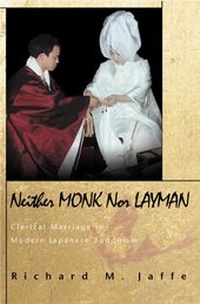
Neither Monk nor Layman
Clerical Marriage in Modern Japanese Buddhism
Published on 24. February 2002
Book
Hardback
320 pages
978-0-691-07495-5 (ISBN)
Description
Buddhism comes in many forms, but in Japan it stands apart from all the rest in one most striking way--the monks get married. In Neither Monk nor Layman, the most comprehensive study of this topic in any language, Richard Jaffe addresses the emergence of an openly married clergy as a momentous change in the history of modern Japanese Buddhism. He demonstrates, in clear and engaging prose, that this shift was not an easy one for Japanese Buddhists. Yet the transformation that began in the early Meiji period (1868-1912)--when monks were ordered by government authorities to adopt common surnames and allowed to marry, to have children, and to eat meat--today extends to all the country's Buddhist denominations. Jaffe traces the gradual acceptance of clerical marriage by Japanese Buddhists from the premodern emergence of the "clerical marriage problem" in the Edo period to its widespread practice by the start of the Second World War. In doing so he considers related issues such as the dissolution of clerical status and the growing domestication of Japanese temple life.
This book reveals the deep contradictions between sectarian teachings that continue to idealize renunciation and a clergy whose lives closely resemble those of their parishioners in modern Japanese society. It will attract not only scholars of religion and of Japanese history, but all those interested in the encounter-conflict between regimes of modernization and religious institutions and the fate of celibate religious practices in the twentieth century.
This book reveals the deep contradictions between sectarian teachings that continue to idealize renunciation and a clergy whose lives closely resemble those of their parishioners in modern Japanese society. It will attract not only scholars of religion and of Japanese history, but all those interested in the encounter-conflict between regimes of modernization and religious institutions and the fate of celibate religious practices in the twentieth century.
Reviews / Votes
"Jaffe does a masterful job of weaving together into a compelling narrative his extensive and well-documented historical sources... This is an important contribution to modern Japanese religious history."--Choice "[A] richly detailed and clearly written work... Jaffe provides abundant material for anyone interested in state-religion issues... A must read for anyone interested in Japanese religious history, Buddhism, or Japanese history."--Stephen G. Covell, Japanese Journal of Religious Studies "This work carefully integrates a deep understanding of Buddhist doctrine with historical detail and ethnographic description. On the issue of clerical marriage in Japanese Buddhism, not only is Jaffe's book the only show in town, but it is a show that no one interested in Japanese Buddhism, Meiji history, church-state relations, religious celibacy, modernization, or secularization would want to miss."--John S. LoBreglio, Journal of Asian Studies "One of the most commonly misunderstood aspects of Japanese Buddhism involves the marriage of clerics. Buddhists from most other countries consider this a sign of the overall decline of Buddhism in Japan and think that Japanese clerics are simply incapable of controlling their desires... Both sides of this complex issue are presented clearly, and the idea of over-all decline is thoroughly debunked. This cross-disciplinary book is important not only to studies of religion but also to those of anthropology and history."--Sarah Horton, Religious Studies Review "Jaffe's work is beautifully referenced and composed, full of illuminating sidelights and contextual explorations, and displaying powerful detail and tireless pursuit of textual evidence... Jaffe's research performs a quite groundbreaking synthesis in any language."--Galen Amstutz, Journal of Japanese StudiesMore details
Series
Language
English
Place of publication
New Jersey
United States
Target group
Professional and scholarly
College/higher education
Product notice
Trade binding
Illustrations
7 b/w illus.
Dimensions
Height: 229 mm
Width: 152 mm
Weight
595 gr
ISBN-13
978-0-691-07495-5 (9780691074955)
Copyright in bibliographic data and cover images is held by Nielsen Book Services Limited or by the publishers or by their respective licensors: all rights reserved.
Schweitzer Classification
Other editions
Additional editions
E-Book
06/2021
1st Edition
Princeton University Press
€109.99
Available for download
Person
Richard Jaffe, a specialist in Japanese Buddhism, is Assistant Professor of Religion at North Carolina State University.
Content
Figures and Table xi Preface xiii Acknowledgments xix Reference Abbreviations xxi Ministries and Other Government Institutions xxiii Chapter 1 Introduction 1 Chapter 2 Pre-Meiji Precedents 9 Chapter 3 Jodo Shin Buddhism and the Edo Period Debate over Nikujiki Saitai 36 Chapter 4 The Household Registration System and the Buddhist Clergy 58 Chapter 5 Passage of the Nikujiki Saitai Law: The Clergy and the Formation of Meiji Buddhist Policy 95 Chapter 6 Horses with Horns: The Attack on Nikujiki Saitai 114 Chapter 7 Denominational Resistance and the Modification of Government Policy 148 Chapter 8 Tanaka Chigaku and the Buddhist Clerical Marriage: Toward a Positive Appraisal of Family Life 165 Chapter 9 The Aftermath: From Doctrinal Concern to Practical Problem 189 Chapter 10 Almost Home 228 Glossary 243 Bibliography 254 Index 275