

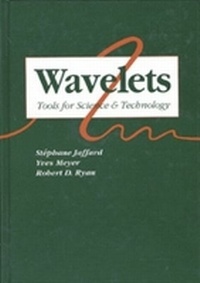
Wavelets
Tools for Science & Technology
Will be published approx. on 30. April 2001
Book
Hardback
269 pages
978-0-89871-448-7 (ISBN)
Description
This long-awaited update of Meyer's Wavelets: Algorithms & Applications includes completely new chapters on four topics: wavelets and the study of turbulence, wavelets and fractals (which includes an analysis of Riemann's nondifferentiable function), data compression, and wavelets in astronomy. The chapter on data compression was the original motivation for this revised edition, and it contains up-to-date information on the interplay between wavelets and nonlinear approximation. The other chapters have been rewritten with comments, references, historical notes, and new material. Four appendices have been added: a primer on filters, key results (with proofs) about the wavelet transform, a complete discussion of a counterexample to the Marr-Mallat conjecture on zero-crossings, and a brief introduction to Hoelder and Besov spaces. In addition, all of the figures have been redrawn, and the references have been expanded to a comprehensive list of over 260 entries. The book includes several new results that have not appeared elsewhere.
Wavelet analysis-an exciting theory at the intersection of the frontiers of mathematics, science, and technology-is a unifying concept that interprets a large body of scientific research. In addition to its intrinsic mathematical interest, its applications have serious economic implications in the areas of signal and image compression. For these expanding fields, this book provides a clear set of concepts, methods, and algorithms adapted to a variety of applications ranging from the transmission of images on the Internet to theoretical studies in physics. The use of wavelet-based algorithms adopted by the FBI for fingerprint compression and by the Joint Photographic Experts Group for the new JPEG-2000 compression standard confirms the success of this theory.
The authors present with equal skill and clarity the mathematical background and major wavelet applications, including the study of turbulence, fractal objects, and the structure of the universe. Never before have the historic origins, the algorithms, and the applications of wavelets been discussed in such scope, providing a unifying presentation accessible to scientists and engineers across all disciplines and levels of training.
Written specifically for scientists and engineers with diverse backgrounds, the material is presented in a manner that will appeal to both experts and nonexperts alike. This book is a valuable tool for anyone (from graduate student to expert) faced with signal or image processing problems. It also answers the question, "What are wavelets?"
The first seven chapters trace the historical origins of wavelet theory and describe the different time-scale and time-frequency algorithms used today under the term ""wavelets."" Specific examples include the application of wavelet techniques to FBI fingerprint compression problems and the use of wavelets in the new JPEG standard for still image compression. Applying wavelet analysis methods to signal and image processing, fractals, turbulence, and astronomy is covered in the balance.
Wavelet analysis-an exciting theory at the intersection of the frontiers of mathematics, science, and technology-is a unifying concept that interprets a large body of scientific research. In addition to its intrinsic mathematical interest, its applications have serious economic implications in the areas of signal and image compression. For these expanding fields, this book provides a clear set of concepts, methods, and algorithms adapted to a variety of applications ranging from the transmission of images on the Internet to theoretical studies in physics. The use of wavelet-based algorithms adopted by the FBI for fingerprint compression and by the Joint Photographic Experts Group for the new JPEG-2000 compression standard confirms the success of this theory.
The authors present with equal skill and clarity the mathematical background and major wavelet applications, including the study of turbulence, fractal objects, and the structure of the universe. Never before have the historic origins, the algorithms, and the applications of wavelets been discussed in such scope, providing a unifying presentation accessible to scientists and engineers across all disciplines and levels of training.
Written specifically for scientists and engineers with diverse backgrounds, the material is presented in a manner that will appeal to both experts and nonexperts alike. This book is a valuable tool for anyone (from graduate student to expert) faced with signal or image processing problems. It also answers the question, "What are wavelets?"
The first seven chapters trace the historical origins of wavelet theory and describe the different time-scale and time-frequency algorithms used today under the term ""wavelets."" Specific examples include the application of wavelet techniques to FBI fingerprint compression problems and the use of wavelets in the new JPEG standard for still image compression. Applying wavelet analysis methods to signal and image processing, fractals, turbulence, and astronomy is covered in the balance.
Reviews / Votes
"In many respects the book is a personal view of the field, and others would no doubt have tackled the undertaking quite differently; this actually adds to the book's interest.. I believe it is accessible to any scientifically minded reader with rudimentary knowledge of Fourier analysis; furthermore, the seasoned mathematician will find discussions of many interesting nonmathematical topics.. I recommend the book as a delightful introduction to wavelets." --Ingrid Daubechies, AT&T Bell Laboratories, Science, Vol. 262, December 3, 1993."More details
Language
English
Place of publication
New York
United States
Target group
Professional and scholarly
Dimensions
Height: 260 mm
Width: 183 mm
Thickness: 17 mm
Weight
633 gr
ISBN-13
978-0-89871-448-7 (9780898714487)
Copyright in bibliographic data and cover images is held by Nielsen Book Services Limited or by the publishers or by their respective licensors: all rights reserved.
Schweitzer Classification
Content
Preface to Revised Edition
Preface from the First Edition
Chapter 1: Signals and Wavelets
Chapter 2: Wavelets from a Historical Perspective
Chapter 3: Quadrature Mirror Filters
Chapter 4: Pyramid Algorithms for Numerical Image Processing
Chapter 5: Time-Frequency Analysis for Signal Processing
Chapter 6: Time-Frequency Algorithms Using Malvar?Wilson Wavelets
Chapter 7: Time-Frequency Analysis and Wavelet Packets
Chapter 8: Computer Vision and Human Vision
Chapter 9: Wavelets and Turbulence
Chapter 10: Wavelets and Multifractal Functions
Chapter 11: Data Compression and Restoration of Noisy Images
Chapter 12: Wavelets and Astronomy
Appendix A: Filter Fundamentals
Appendix B: Wavelet Transforms
Appendix C: A Counterexample
Appendix D: Hoelder Spaces and Besov Spaces
Bibliography
Author Index
Subject Index.
Preface from the First Edition
Chapter 1: Signals and Wavelets
Chapter 2: Wavelets from a Historical Perspective
Chapter 3: Quadrature Mirror Filters
Chapter 4: Pyramid Algorithms for Numerical Image Processing
Chapter 5: Time-Frequency Analysis for Signal Processing
Chapter 6: Time-Frequency Algorithms Using Malvar?Wilson Wavelets
Chapter 7: Time-Frequency Analysis and Wavelet Packets
Chapter 8: Computer Vision and Human Vision
Chapter 9: Wavelets and Turbulence
Chapter 10: Wavelets and Multifractal Functions
Chapter 11: Data Compression and Restoration of Noisy Images
Chapter 12: Wavelets and Astronomy
Appendix A: Filter Fundamentals
Appendix B: Wavelet Transforms
Appendix C: A Counterexample
Appendix D: Hoelder Spaces and Besov Spaces
Bibliography
Author Index
Subject Index.