

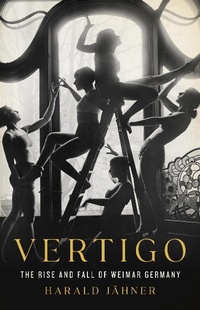
Vertigo
The Rise and Fall of Weimar Germany
Published on 3. September 2024
Book
Hardback
480 pages
978-1-5416-0620-3 (ISBN)
Description
The dramatic and consequential history of Germany’s short-lived experiment with democracy between the world wars, when vibrant cultural experimentation collided with political and economic turmoil
Out of the ashes of the First World War, Germany launched an unprecedented political project: its first democratic government. The Weimar Republic, named for the city where it was established, endured for only fifteen years before it was toppled by the insurgent Nazi Party in 1933. In Vertigo, prizewinning historian Harald Jähner tells the Republic’s full story, capturing a nation caught in a whirlwind of uncertainty and struggling toward a better future.
In the aftermath of World War I, Germany was buffeted by political partisanship, economic upheaval, and the constant threat of revolutionary violence. At the same time, many Germans embraced newly liberated lifestyles. They flouted gender norms, flooded racetracks and dance halls, and fostered a vibrant avant-garde that encompassed groundbreaking artists like filmmaker Fritz Lang, painter Wassily Kandinsky, and architect Walter Gropius. But this new Germany sparked a reactionary backlash that led to the Republic’s fall to the Nazis and, ultimately, the conflagration of World War II.
Blending deeply researched political history with the firsthand experiences of everyday people, Vertigo is a vital, kaleidoscopic portrait of a pivotal moment in German history.
Out of the ashes of the First World War, Germany launched an unprecedented political project: its first democratic government. The Weimar Republic, named for the city where it was established, endured for only fifteen years before it was toppled by the insurgent Nazi Party in 1933. In Vertigo, prizewinning historian Harald Jähner tells the Republic’s full story, capturing a nation caught in a whirlwind of uncertainty and struggling toward a better future.
In the aftermath of World War I, Germany was buffeted by political partisanship, economic upheaval, and the constant threat of revolutionary violence. At the same time, many Germans embraced newly liberated lifestyles. They flouted gender norms, flooded racetracks and dance halls, and fostered a vibrant avant-garde that encompassed groundbreaking artists like filmmaker Fritz Lang, painter Wassily Kandinsky, and architect Walter Gropius. But this new Germany sparked a reactionary backlash that led to the Republic’s fall to the Nazis and, ultimately, the conflagration of World War II.
Blending deeply researched political history with the firsthand experiences of everyday people, Vertigo is a vital, kaleidoscopic portrait of a pivotal moment in German history.
More details
Language
English
Product notice
sewn/stitched
Cloth over boards
Dimensions
Height: 241 mm
Width: 158 mm
Thickness: 41 mm
Weight
710 gr
ISBN-13
978-1-5416-0620-3 (9781541606203)
Copyright in bibliographic data and cover images is held by Nielsen Book Services Limited or by the publishers or by their respective licensors: all rights reserved.
Schweitzer Classification