

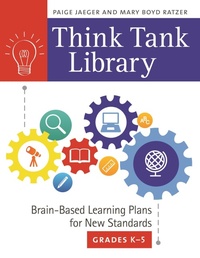
Think Tank Library
Brain-Based Learning Plans for New Standards, Grades K-5
Published on 4. December 2014
Book
Paperback/Softback
150 pages
978-1-61069-990-7 (ISBN)
Description
Transform your library into a "think tank" by helping teachers create an active learning environment in which students question, investigate, synthesize, conclude, and present information based on Common Core standards.
The rigors of today's mandated academic standards can repurpose your library's role as a steward of the Common Core State Standards (CCSS) at your school. This guide will help you help teachers present exciting, field-tested lessons for elementary grades K through 5, addressing developmental steps and individual differences in key competencies in the CCSS. Authors and educators Mary Ratzer and Paige Jaeger illustrate how brain-based learning helps students become deep, critical thinkers and provide the lesson plans to coax the best thinking out of each child.
This tool book presents strategies to help learners progress from novice to expert thinker; challenge younger students with questions that lead to inquiry; incorporate "rigor" into lessons; and use model lesson plans to change instruction. Beginning chapters introduce the basics of instruction and provide ideas for expert cognitive growth of the brain. Sample lessons are aligned with key curriculum areas, including science, social studies, music, art, and physical education.
The rigors of today's mandated academic standards can repurpose your library's role as a steward of the Common Core State Standards (CCSS) at your school. This guide will help you help teachers present exciting, field-tested lessons for elementary grades K through 5, addressing developmental steps and individual differences in key competencies in the CCSS. Authors and educators Mary Ratzer and Paige Jaeger illustrate how brain-based learning helps students become deep, critical thinkers and provide the lesson plans to coax the best thinking out of each child.
This tool book presents strategies to help learners progress from novice to expert thinker; challenge younger students with questions that lead to inquiry; incorporate "rigor" into lessons; and use model lesson plans to change instruction. Beginning chapters introduce the basics of instruction and provide ideas for expert cognitive growth of the brain. Sample lessons are aligned with key curriculum areas, including science, social studies, music, art, and physical education.
Reviews / Votes
What Jaeger and Ratzer offer is timely and strives to bridge the gap between theory and practice in a unique way. * VOYA *More details
Language
English
Place of publication
United States
Publishing group
Bloomsbury Publishing Plc
Target group
Professional and scholarly
Dimensions
Height: 280 mm
Width: 216 mm
Thickness: 8 mm
Weight
397 gr
ISBN-13
978-1-61069-990-7 (9781610699907)
Copyright in bibliographic data and cover images is held by Nielsen Book Services Limited or by the publishers or by their respective licensors: all rights reserved.
Schweitzer Classification
Other editions
Additional editions
Paige Jaeger | Mary Boyd Ratzer
Think Tank Library
Brain-Based Learning Plans for New Standards, Grades K-5
E-Book
12/2014
1st Edition
Libraries Unlimited Inc
€42.49
Available for download
Paige Jaeger | Mary Boyd Ratzer
Think Tank Library
Brain-Based Learning Plans for New Standards, Grades K-5
E-Book
12/2014
1st Edition
Libraries Unlimited Inc
€42.49
Available for download
Persons
Paige Jaeger delivers professional development at the local, state and national levels and is currently serving on the AASL Task Force for the Common Core.
Mary Boyd Ratzer is a professional development consultant who fosters inquiry-based learning and real-world strategies for the Common Core.
Mary Boyd Ratzer is a professional development consultant who fosters inquiry-based learning and real-world strategies for the Common Core.
Content
Contents
Introduction: Why Thinking?
Chapter 1: Thinking and the Culture of Your School
Chapter 2: 22 Ideas for Turning Your Library Into a Think Tank
Chapter 3: Think Tank Libraries and Inquiry
Chapter 4: Thinking and the Common Core
Chapter 5: Wanted: Expert Thinkers
Chapter 6: If the Brain Could Talk
Chapter 7: Thinking and Information Literacy
Chapter 8: Thinking in ELA
Chapter 9: Thinking and Text Dependent Questions
Chapter 10: Thinking in Social Studies
Chapter 11: Thinking in Math
Chapter 12: Thinking in Science
Chapter 13: Think Tank Lessons
Chapter 14: The Primary Learning Years
Chapter 15: Primary K-2 Library and Classroom Lessons
Chapter 16: The Elementary Discovery Grades (3-5) Library and Classroom Lessons
Chapter 17: Think Tank Starter Kits: Lesson Building Block Ideas
Appendix
Bibliography
Index
Introduction: Why Thinking?
Chapter 1: Thinking and the Culture of Your School
Chapter 2: 22 Ideas for Turning Your Library Into a Think Tank
Chapter 3: Think Tank Libraries and Inquiry
Chapter 4: Thinking and the Common Core
Chapter 5: Wanted: Expert Thinkers
Chapter 6: If the Brain Could Talk
Chapter 7: Thinking and Information Literacy
Chapter 8: Thinking in ELA
Chapter 9: Thinking and Text Dependent Questions
Chapter 10: Thinking in Social Studies
Chapter 11: Thinking in Math
Chapter 12: Thinking in Science
Chapter 13: Think Tank Lessons
Chapter 14: The Primary Learning Years
Chapter 15: Primary K-2 Library and Classroom Lessons
Chapter 16: The Elementary Discovery Grades (3-5) Library and Classroom Lessons
Chapter 17: Think Tank Starter Kits: Lesson Building Block Ideas
Appendix
Bibliography
Index