

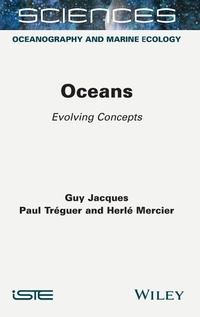
Oceans: Evolving Concepts
Evolving Concepts
1st Edition
Will be published approx. on 5. July 2021
Book
Hardback
308 pages
978-1-78945-003-3 (ISBN)
Description
Since the HMS Challenger expedition of 1872?1876, our vision of the ocean has changed completely. We now understand that it plays a key role in biodiversity, climate regulation, and mineral and biological resources, and as such, the ocean is a major service provider for humanity.
Oceans draws on data from new oceanographic and satellite tools, acquired through international interdisciplinary programs. It describes the processes that control how the ocean functions, on different spatial and temporal scales. After considering the evolution of concepts in physical, chemical and biological oceanography, the book outlines the future of a warmer, acidified, less oxygenated ocean. It shows how a view of the ocean at different scales changes how we understand it. Finally, the book presents the challenges facing the ocean in terms of the exploitation of biological and mineral resources, in the context of sustainable development and the regulation of climate change.
More details
Other editions
Persons
Guy Jacques, a planktologist, launched the French program to study the pelagic environment of the Southern Ocean. He has chaired scientific committees at Ifremer and Orstom.
Paul Treguer, a marine biogeochemist, led international and European programs on the impacts of global change on the ocean. He is the founder of the European Institute for Marine Studies (IUEM) and of Europole Mer.
Herle Mercier, a marine physicist, is interested in observing the variability of water masses in the North Atlantic from a forecasting perspective. He has chaired the MISTRALS Evaluation Committee and the scientific council of the IPEV.
Content
Introduction - Look from space: the planet "Ocean" rather than planet Earth - Brief history of the ocean planet, from its origins to the present day - The Challenger expedition: the birth of oceanography Part 1 - Evolution of concepts since the Challenger expedition
1- The ocean acquires a third dimension
2- From ocean physics to ocean-atmosphere interactions
3- From marine chemistry to marine biogeochemistry
4- From marine biology to biological oceanography
5- From the azo abysses to hydrothermal ecosystems
Part Two - Concepts for the 21st Century Ocean
1- From large to small scale: importance in physics, biogeochemistry, and biology
2- Ecosystem approach to the exploited biological resources
3- Integrated approach to a warm, acidified, deoxygenated ocean Outlook
- Comparative evolution of concepts in oceanography and other natural sciences
- The challenges of oceanography beyond the sciences sensu stricto.