

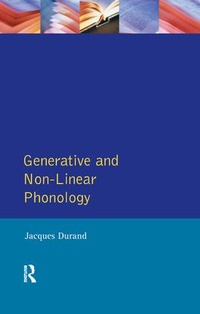
Generative and Non-Linear Phonology
1st Edition
Published on 28. July 2017
Book
Hardback
352 pages
978-1-138-45778-2 (ISBN)
Description
Generative phonology is a developing field of linguistics, and is producing both rival interpretations and models. This book provides a clear and accessible evaluation of the debate. It provides a detailed overview of the main models, revealing that they are often complimentary rather than contradictory, and how these can be interconnect and be used together to explore the subject.
More details
Series
Language
English
Place of publication
London
United Kingdom
Publishing group
Taylor & Francis Ltd
Target group
College/higher education
Dimensions
Height: 216 mm
Width: 138 mm
Weight
810 gr
ISBN-13
978-1-138-45778-2 (9781138457782)
Copyright in bibliographic data and cover images is held by Nielsen Book Services Limited or by the publishers or by their respective licensors: all rights reserved.
Schweitzer Classification
Other editions
Additional editions
Durand Jacques
Generative and Non-Linear Phonology
E-Book
09/2014
1st Edition
Routledge
€88.49
Available for download
Durand Jacques
Generative and Non-Linear Phonology
E-Book
09/2014
1st Edition
Routledge
€88.49
Available for download
Durand Jacques
Generative and Non-Linear Phonology
Book
02/1990
1st Edition
Routledge
€95.50
Shipment within 10-20 days
Person
Durand Jacques
Content
1 Introduction I. l Scope of this book 1.2 From classical phonemics to generative phonology 1.3 Phonemes or features? 1.4 Levels of representation 1.5 Aspects of a standard generative analysis of Midi French 1.6 Phonology within the model of grammar 2 The theory of Distinctive Features 2. 1 Preliminaries 2.2 Some general assumptions 2.3 The phonetic features and their articulatory correlates 2.4 Universalism revisited 2.5 The acoustic/auditory basis of distinctive features 2.6 Invariance and distinctive features 3 Binarism, full and partial specification, markedness and gestures 3-4 Markedness Theory 3.5 Gestures 4 The derivational issue: aspects of the abstractness-concreteness debate abstractness-concreteness debate 4. I Preliminaries 4.2 Aspects of the segmental phonology of English 4.3 Objections to the Vowel Shift and Velar Softening 4.4 Natural Generative Phonology 4.5 In defence of the Vowel Shift 5 Underspecification Theory and Lexical Phonology 5. I Underspecification Theory 5.2 Lexical Phonology 6 Metrical structures 6. l The syllable 6.2 Stress and prominence 7 Autosegmental and Multidimensional Phonology 1 Preliminary remarks 7.2 Tones and the autosegmental framework 7.3 The skeleton 7 .4 Further geometrical extensions 7.5 Universal Phonology and the 'no rule' approach 8 An outline of Dependency Phonology 8.1 Introduction 8.2 Suprasegmental representations 8.3 Infrasegmental representations 8.4 Back unrounded vowels: epilogue and prologue