

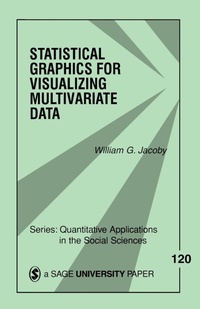
Statistical Graphics for Visualizing Multivariate Data
1st Edition
Published on 19. March 1998
Book
Paperback/Softback
112 pages
978-0-7619-0899-9 (ISBN)
Description
Author William G. Jacoby explores a variety of graphical displays that are useful for visualizing multivariate data. The basic problem involves representing information that varies along several dimensions when the display medium (a computer screen or printed page) is inherently two-dimensional. In order to address this problem, Jacoby introduces the concepts of a "data space." He then explains several methods for coding information directly into the plotting symbols used to represent the observations. He next describes pictorial representations of three-dimensional space followed by a discussion of the scatterplot matrix as a way of "flattening out" the multiple dimensions of a multivariate data space. In addition, he examines conditioning plots (which are strategies for "looking into subregions" of the multidimensional data space), and presents the biplot as a technique for showing observations and variables together in a single display. He concludes with a discussion of some general ideas about data visualization. Statistical Graphics for Visualizing Multivariate Data will enable researchers to better explore the contents of a dataset, find the structure in their data, check the underlying assumptions of the statistical model they used, and better communicate the results of their analysis.
More details
Series
Language
English
Place of publication
Thousand Oaks
United States
Target group
Professional and scholarly
Dimensions
Height: 216 mm
Width: 140 mm
Thickness: 6 mm
Weight
152 gr
ISBN-13
978-0-7619-0899-9 (9780761908999)
Copyright in bibliographic data and cover images is held by Nielsen Book Services Limited or by the publishers or by their respective licensors: all rights reserved.
Schweitzer Classification
Person
William G. Jacoby is a Professor in the Department of Political Science at Michigan State University. He is also a Research Scientist at the University of Michigan, where he serves as Director of the Inter-University Consortium for Political and Social Research (ICPSR) Summer Training Program in Quantitative Methods of Social Research.
Professor Jacoby joined the MSU faculty in 2003. Previously, he held positions at the University of South Carolina, Ohio State University, and the University of Missouri. He received his Ph.D. from the University of North Carolina, Chapel Hill in 1983.
Professor Jacoby's main professional interests are mass political behavior (public opinion, political attitudes, voting behavior) and quantitative methodology (measurement theory, scaling methods, statistical graphics, modern regression). His current research focuses on citizen ideology and belief system organization, value choices and their implications for subsequent political orientations, measuring policy priorities in the American states, the implications of measurement assumptions for statistical models, and graphical strategies for data analysis.
Recently, Professor Jacoby has taught courses on public opinion, regression analysis, scaling methods, and statistical graphics.
Professor Jacoby joined the MSU faculty in 2003. Previously, he held positions at the University of South Carolina, Ohio State University, and the University of Missouri. He received his Ph.D. from the University of North Carolina, Chapel Hill in 1983.
Professor Jacoby's main professional interests are mass political behavior (public opinion, political attitudes, voting behavior) and quantitative methodology (measurement theory, scaling methods, statistical graphics, modern regression). His current research focuses on citizen ideology and belief system organization, value choices and their implications for subsequent political orientations, measuring policy priorities in the American states, the implications of measurement assumptions for statistical models, and graphical strategies for data analysis.
Recently, Professor Jacoby has taught courses on public opinion, regression analysis, scaling methods, and statistical graphics.
Content
Introduction
Multiple-Code Plotting Symbols in Scatterplots
Profile Plots
Three-Dimensional Plots for Trivariate Data
The Scatterplot Matrix
Conditioning Plots
The Biplot
Conclusions
Multiple-Code Plotting Symbols in Scatterplots
Profile Plots
Three-Dimensional Plots for Trivariate Data
The Scatterplot Matrix
Conditioning Plots
The Biplot
Conclusions