

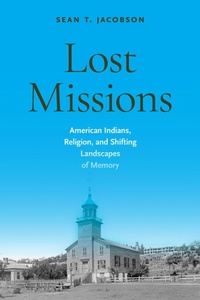
Lost Missions
American Indians, Religion, and Shifting Landscapes of Memory
Will be published approx. on 24. November 2026
Book
Hardback
264 pages
978-1-62534-972-9 (ISBN)
Description
Tracing how shuttered mission schools became contested commemorative landscapes
During the Early Republic and Jacksonian eras, Euro-American colonists and Native nations in the South and Old Northwest established mission schools intended to Christianize Indigenous peoples. In Lost Missions, Sean T. Jacobson recovers the histories and afterlives of these institutions, arguing that they played a far more consequential role in Native-settler relations than scholars have previously acknowledged. Mission schools advanced a spiritual vision of a multiethnic Christian America-one that ultimately collapsed amid the federally sponsored Indian Removal campaigns of the 1830s and 1840s.
Following the closure of these schools, their physical and symbolic landscapes became powerful sites of memory. Euro-American Christians later transformed former missions into commemorative spaces that celebrated "frontier" piety and national expansion. Through monuments, pageantry, and local histories, Protestant and Catholic Americans alike recast missionary labor as a foundational component of American nation-building. In doing so, these narratives framed the Christianization of Native peoples as a benevolent civilizing project, one that implicitly-and sometimes explicitly-sanitized the coercion, dispossession, and violence that accompanied westward expansion and the forced removal of Indigenous nations.
By the late twentieth century, however, these commemorative narratives faded. Suburban development, commercialization, and shifting cultural priorities rendered many mission sites once again "lost," stripped of the civic meaning they once held. Yet Jacobson shows that these landscapes still speak, especially when viewed from Indigenous perspectives. Reinterpreted through Native histories of endurance and survival, former missions reveal counternarratives of persistence amid profound loss. As tribal nations increasingly engage with these sites today, Lost Missions probes their contested status as places of memory and conscience, illuminating how public history continues to shape and challenge understandings of America's colonial past.
During the Early Republic and Jacksonian eras, Euro-American colonists and Native nations in the South and Old Northwest established mission schools intended to Christianize Indigenous peoples. In Lost Missions, Sean T. Jacobson recovers the histories and afterlives of these institutions, arguing that they played a far more consequential role in Native-settler relations than scholars have previously acknowledged. Mission schools advanced a spiritual vision of a multiethnic Christian America-one that ultimately collapsed amid the federally sponsored Indian Removal campaigns of the 1830s and 1840s.
Following the closure of these schools, their physical and symbolic landscapes became powerful sites of memory. Euro-American Christians later transformed former missions into commemorative spaces that celebrated "frontier" piety and national expansion. Through monuments, pageantry, and local histories, Protestant and Catholic Americans alike recast missionary labor as a foundational component of American nation-building. In doing so, these narratives framed the Christianization of Native peoples as a benevolent civilizing project, one that implicitly-and sometimes explicitly-sanitized the coercion, dispossession, and violence that accompanied westward expansion and the forced removal of Indigenous nations.
By the late twentieth century, however, these commemorative narratives faded. Suburban development, commercialization, and shifting cultural priorities rendered many mission sites once again "lost," stripped of the civic meaning they once held. Yet Jacobson shows that these landscapes still speak, especially when viewed from Indigenous perspectives. Reinterpreted through Native histories of endurance and survival, former missions reveal counternarratives of persistence amid profound loss. As tribal nations increasingly engage with these sites today, Lost Missions probes their contested status as places of memory and conscience, illuminating how public history continues to shape and challenge understandings of America's colonial past.
Reviews / Votes
"Lost Missions combines deep historical research with public history methods and theory to create an impressive study of missions and how they have been used and remembered. The book will be of interest to students of public history as well as Native American Studies."-Philip Levy, editor (with Leah Glaser) of Branching Out: The Public History of Trees and author of the James Deetz Book Prize winning The Permanent Resident: Excavations and Explorations of George Washington's Life"Part history, part historiography, and part critique of current local interpretation, Lost Missions is a true achievement of historical research."-Lisa Blee, author (with Jean M. O'Brien) of Monumental Mobility: The Memory Work of Massasoit and Framing Chief Leschi: Narratives and the Politics of Historical Justice
More details
Series
Language
English
Place of publication
Massachusetts
United States
Target group
Professional and scholarly
Product notice
sewn/stitched
Cloth over boards
Illustrations
15 illus.
Dimensions
Height: 229 mm
Width: 152 mm
Weight
454 gr
ISBN-13
978-1-62534-972-9 (9781625349729)
Copyright in bibliographic data and cover images is held by Nielsen Book Services Limited or by the publishers or by their respective licensors: all rights reserved.
Schweitzer Classification
Person
Sean T. Jacobson is an assistant professor of history at the University of North Alabama.