

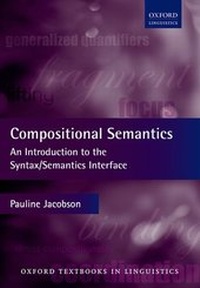
Compositional Semantics
An Introduction to the Syntax/Semantics Interface
Published on 28. August 2014
Book
Hardback
448 pages
978-0-19-967714-6 (ISBN)
Description
This book provides an introduction to compositional semantics and to the syntax/semantics interface. It is rooted within the tradition of model theoretic semantics, and develops an explicit fragment of both the syntax and semantics of a rich portion of English.
Professor Jacobson adopts a Direct Compositionality approach, whereby the syntax builds the expressions while the semantics simultaneously assigns each a model-theoretic interpretation. Alongside this approach, the author also presents a competing view that makes use of an intermediate level, Logical Form. She develops parallel treatments of a variety of phenomena from both points of view with detailed comparisons. The book begins with simple and fundamental concepts and gradually builds a more complex fragment, including analyses of more advanced topics such as focus, negative polarity, and a variety of topics centering on pronouns and binding more generally. Exercises are provided throughout, alongside open-ended questions for students to consider. The exercises are interspersed with the text to promote self-discovery of the fundamentals and their applications.
The book provides a rigorous foundation in formal analysis and model theoretic semantics and is suitable for advanced undergraduate and graduate students in linguistics, philosophy of language, and related fields.
Professor Jacobson adopts a Direct Compositionality approach, whereby the syntax builds the expressions while the semantics simultaneously assigns each a model-theoretic interpretation. Alongside this approach, the author also presents a competing view that makes use of an intermediate level, Logical Form. She develops parallel treatments of a variety of phenomena from both points of view with detailed comparisons. The book begins with simple and fundamental concepts and gradually builds a more complex fragment, including analyses of more advanced topics such as focus, negative polarity, and a variety of topics centering on pronouns and binding more generally. Exercises are provided throughout, alongside open-ended questions for students to consider. The exercises are interspersed with the text to promote self-discovery of the fundamentals and their applications.
The book provides a rigorous foundation in formal analysis and model theoretic semantics and is suitable for advanced undergraduate and graduate students in linguistics, philosophy of language, and related fields.
Reviews / Votes
A simple and intuitive hypothesis about the relation between form and meaning is that every principle of grammar that says something about the syntactic composition of two expressions also says something about the meaning of the resulting complex expression. This hypothesis, known as direct compositionality, can sometimes appear difficult to maintain in the face of the complexity of human language, in which structure and meaning often seem to be related in fairly abstract ways. And yet Pauline Jacobson has shown conclusively in her work over the past thirty-five years how this approach can lead to insightful analyses and significant new discoveries about the nature of meaning. Now Jacobson has distilled this work into a new textbook in which she skilfully leads students through the complexities of building a theory of the syntax-semantics interface from the ground up, taking direct compositionality as the guiding principle but also engaging with other perspectives on the relation between syntax and semantics and identifying points of divergence and convergence. This book masterfully equips students with the technical and formal skills that will allow them to engage with contemporary work in semantic theory. * Chris Kennedy, University of Chicago * This is a welcome and unique addition to the growing selection of textbooks in formal semantics. With just the right mixture of empirical challenge and technical detail, it will work well as a stand-alone text for novice semanticists. At the same time, more advanced students will benefit from this accessible introduction to direct compositionality, and more broadly from the book's lessons in thinking about the foundations and architecture of linguistic theory. * Irene Heim, MIT *More details
Series
Language
English
Place of publication
Oxford
United Kingdom
Target group
College/higher education
Dimensions
Height: 254 mm
Width: 189 mm
Thickness: 32 mm
Weight
924 gr
ISBN-13
978-0-19-967714-6 (9780199677146)
Copyright in bibliographic data and cover images is held by Nielsen Book Services Limited or by the publishers or by their respective licensors: all rights reserved.
Schweitzer Classification
Other editions
Additional editions
E-Book
08/2014
1st Edition
OUP eBook
€32.99
Available for download
Book
08/2014
Oxford University Press
€44.56
Shipment within 15-20 days
Person
Pauline Jacobson is currently Professor of Cognitive, Linguistic, and Psychological Sciences at Brown University. She has held visiting appointments at Ohio State University and Harvard University, and has been a Fellow at the Institute for Advanced Study at the Hebrew University of Jerusalem. Her research is mainly concerned with constructing formal models of the semantics and syntax of natural language - and in particular on the way that the syntax and the semantics interact. Her work has been published in a number of journals, including Journal of Semantics, Natural Language Semantics, and Linguistics and Philosophy, and she is co-editor, with Chris Barker, of Direct Compositionality (OUP 2007).
Content
PART I FOUNDATIONAL CONCEPTS: BUILDING A FRAGMENT; PART II: ENRICHING THE DOMAIN; PART III: RELATIVE CLAUSES, SCOPES, AND BINDING: SOME THEORETICAL CONTROVERSIES; PART IV: FURTHER TOPICS