

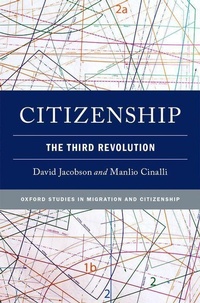
Citizenship
The Third Revolution
Published on 10. November 2023
Book
Hardback
256 pages
978-0-19-766915-0 (ISBN)
Description
The emergence of citizenship, some 4,000 years ago, was a hinge moment in human history. Instead of the reign of blood descent, questions regarding who rules and who belongs were opened up. Yet purportedly primordial categories, such as sex and race, have constrained the emergence of a truly civic polity ever since. Untying this paradox is essential to overcoming the crisis afflicting contemporary democracies. Why does citizenship emerge, historically, and why does it maintain traction, even if in compromised forms? How can citizenship and democracy be revived? Learning from history and building on emerging social and political developments, David Jacobson and Manlio Cinalli provide the foundations for citizenship's third revolution.
Citizenship: The Third Revolution considers three revolutionary periods for citizenship, from the ancient and classical worlds; to the flourishing of guilds and city republics from 1,000 CE; and to the unfinished revolution of human rights from the post-World War II period. Through historical enquiry, this book reveals the underlying principles of citizenship-and its radical promise. Jacobson and Cinalli demonstrate how the effective functioning of citizenship depends on human connections that are relational and non-contractual, not transactional. They illustrate how rights, paradoxically, can undermine as well as reinforce civic society. Looking forward, the book documents the emerging foundations of a "21st century guild" as a basis for repairing our democracies. The outcome of this scholarship is an innovative re-conceptualization of core ideas to engender more authentic civic collectivities.
Citizenship: The Third Revolution considers three revolutionary periods for citizenship, from the ancient and classical worlds; to the flourishing of guilds and city republics from 1,000 CE; and to the unfinished revolution of human rights from the post-World War II period. Through historical enquiry, this book reveals the underlying principles of citizenship-and its radical promise. Jacobson and Cinalli demonstrate how the effective functioning of citizenship depends on human connections that are relational and non-contractual, not transactional. They illustrate how rights, paradoxically, can undermine as well as reinforce civic society. Looking forward, the book documents the emerging foundations of a "21st century guild" as a basis for repairing our democracies. The outcome of this scholarship is an innovative re-conceptualization of core ideas to engender more authentic civic collectivities.
Reviews / Votes
Compelling, original, and thought-provoking, Citizenship: The Third Revolution is a masterful book. Drawing insights from the past and present of citizenship to chart a path toward a more inclusive and democratic future, Jacobson and Cinalli envision seams and multiscalar civic corporations as alternatives to fixed borders and boundaries. Their feverishly erudite approach takes interdisciplinary scholarship to new heights. * Ayelet Shachar, Professor of Law, Political Science & Global Affairs, University of Toronto * Citizenship notions embody internal inconsistencies between the interests of members and the social good; the freedoms of insiders and the exclusion of outsiders; and necessary solidarities and norms of justice. Jacobson and Cinalli masterfully review these issues, and creatively suggest resolutions. Their book is an important contribution. * John W. Meyer, Professor of Sociology, Emeritus, Stanford University * Who is a citizen? What is citizenship? Does it matter for democracy? The authors deliver an intellectual and historical tour de force in responding to these questions. A must-read book for social scientists-and citizens. * Andrea Ruggeri, Professor of Political Science and International Relations, University of Oxford * We are witnessing how ideologies of self-interest and of exclusive identity claims are fracturing contemporary societies. Jacobson and Cinalli develop an intriguing suggestion that corporate guilds can help renew democratic society. It is a book about what holds us together. * Herman Lebovics, New York State Trustees Distinguished Professor, Stonybrook * Citizenship: The Third Revolution is an engaging history of the idea of citizenship and its evolution (or, rather, revolutions) from ancient times to today. But it also compellingly moves beyond the narrative into normative territory, seeking to learn from citizenship's revolutionary past to revive our faltering democracies. * Aakash Singh Rathore, International Fellow, LUISS University, Rome *More details
Series
Language
English
Place of publication
New York
United States
Dimensions
Height: 161 mm
Width: 244 mm
Thickness: 24 mm
Weight
504 gr
ISBN-13
978-0-19-766915-0 (9780197669150)
Copyright in bibliographic data and cover images is held by Nielsen Book Services Limited or by the publishers or by their respective licensors: all rights reserved.
Schweitzer Classification
Other editions
Additional editions
E-Book
09/2023
OUP eBook
€57.99
Available for download
E-Book
09/2023
OUP eBook
€57.99
Available for download
Persons
David Jacobson is Professor of Sociology at the University of South Florida and Professor Emeritus of Global Studies and Sociology at Arizona State University. Jacobson is the author of Rights Across Borders: Immigration and the Decline of Citizenship, Of Virgins and Martyrs: Women and Sexuality in Global Conflict and Place and Belonging in America.
Manlio Cinalli is Professor of Sociology at the University of Milan and Research Fellow at CEVIPOF, Sciences Po Paris. He is the author of Political Integration of Muslims in France and The European Refugee Crisis in the Media: Debating Solidarity Across Borders.
Manlio Cinalli is Professor of Sociology at the University of Milan and Research Fellow at CEVIPOF, Sciences Po Paris. He is the author of Political Integration of Muslims in France and The European Refugee Crisis in the Media: Debating Solidarity Across Borders.
Content
Introduction: Who Rules? Who Belongs? Two Questions, Three Revolutions, Six Propositions
Chapter 2: The First Revolution: The Ancient and Classical Periods
Chapter 3: The Second Revolution: The Medieval Roots of Modern Citizenship
Chapter 4: Practices of Citizenship: From the Enlightenment to the Nation-State
Chapter 5: The Turn to Human Rights, and its Vulnerabilities
Chapter 6: Interests and Identities: Citizenship and the Problem of Collective Action
Chapter 7: From Borders to Seams
Chapter 8: A 21st Century Guild
Chapter 9: Completing the Third Revolution? A Conclusion
Chapter 2: The First Revolution: The Ancient and Classical Periods
Chapter 3: The Second Revolution: The Medieval Roots of Modern Citizenship
Chapter 4: Practices of Citizenship: From the Enlightenment to the Nation-State
Chapter 5: The Turn to Human Rights, and its Vulnerabilities
Chapter 6: Interests and Identities: Citizenship and the Problem of Collective Action
Chapter 7: From Borders to Seams
Chapter 8: A 21st Century Guild
Chapter 9: Completing the Third Revolution? A Conclusion