

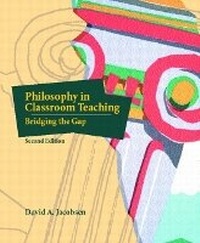
Philosophy in Classroom Teaching
Bridging the Gap
2nd Edition
Published on 9. December 2003
Book
Paperback/Softback
329 pages
978-0-13-042228-6 (ISBN)
Description
For Philosophy of Education courses.
It's an often-asked question: "How do I use educational philosophy in my classroom teaching?" This text is a comprehensive answer. To clearly establish the applicability of philosophy to classroom teaching, this text presents the basics of philosophy; examines all of the major educational philosophies-idealism, realism, pragmatism, existentialism, and post-modernism-and their main proponents; and provides students with a thorough knowledge of each philosophy's fundamental discourse around education. To this theoretical framework are then added real scenarios from real classrooms that demonstrate just how these erudite explorations translate into actual, in-front-of-the-children teaching.
It's an often-asked question: "How do I use educational philosophy in my classroom teaching?" This text is a comprehensive answer. To clearly establish the applicability of philosophy to classroom teaching, this text presents the basics of philosophy; examines all of the major educational philosophies-idealism, realism, pragmatism, existentialism, and post-modernism-and their main proponents; and provides students with a thorough knowledge of each philosophy's fundamental discourse around education. To this theoretical framework are then added real scenarios from real classrooms that demonstrate just how these erudite explorations translate into actual, in-front-of-the-children teaching.
More details
Edition
2nd edition
Language
English
Place of publication
United States
Publishing group
Pearson Education (US)
Target group
Professional and scholarly
Dimensions
Height: 232 mm
Width: 191 mm
Weight
544 gr
ISBN-13
978-0-13-042228-6 (9780130422286)
Copyright in bibliographic data and cover images is held by Nielsen Book Services Limited or by the publishers or by their respective licensors: all rights reserved.
Schweitzer Classification
Other editions
Previous edition

Book
02/1998
Pearson
€53.41
Article exhausted; check for reprint
Content
UNIT 1: PHILOSOPHY AND EDUCATIONAL IDEOLOGIES.
1. Philosophy and Reality.
2. Philosophy and Knowledge.
UNIT 2: PHILOSOPHERS AND CLASSROOM APPLICATIONS.
3. The Ancients: Socrates, Plato, and Aristotle.
4. Challenging the Ancients: Descartes, Bacon, and Locke.
5. Knowledge and the Self: Rousseau and Kant.
6. Logic and Human Behavior: Hegel and Marx.
7. Pedagogy and the Moderns: Pestalozzi, Herbart, and Spencer.
8. Knowledge, Theory, and Action: James and Dewey.
9. Subjectivity and Truth: Kierkegaard and Sartre.
UNIT 3: A NEW MILLENNIUM.
10. Challenging the Moderns.
Glossary of Philosophical Terms.
References.
Index.
1. Philosophy and Reality.
2. Philosophy and Knowledge.
UNIT 2: PHILOSOPHERS AND CLASSROOM APPLICATIONS.
3. The Ancients: Socrates, Plato, and Aristotle.
4. Challenging the Ancients: Descartes, Bacon, and Locke.
5. Knowledge and the Self: Rousseau and Kant.
6. Logic and Human Behavior: Hegel and Marx.
7. Pedagogy and the Moderns: Pestalozzi, Herbart, and Spencer.
8. Knowledge, Theory, and Action: James and Dewey.
9. Subjectivity and Truth: Kierkegaard and Sartre.
UNIT 3: A NEW MILLENNIUM.
10. Challenging the Moderns.
Glossary of Philosophical Terms.
References.
Index.