

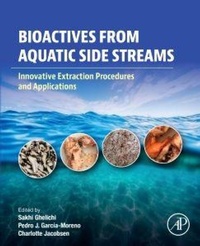
Bioactives from Aquatic Side Streams
Innovative Extraction Procedures and Applications
Will be published approx. on 1. November 2026
Book
Paperback/Softback
350 pages
978-0-443-45519-3 (ISBN)
Description
Bioactives from Aquatic Side Streams: Innovative Extraction Procedures and Applications examines the untapped potential of aquatic resources and byproducts as a rich source of bioactive compounds, including proteins and peptides, omega-3 fatty acids, phenolic compounds, pigments, vitamins, and minerals. With a focus on sustainable practices, this book explores the identification, extraction, characterization, and application of these bioactive compounds across various industries. Early chapters characterize the bioactivity of key compounds, describe the aquatic side streams available for sourcing these compounds, and provide a high-level overview of their extraction techniques.
Central chapters focus on these processes for specific bioactive compounds, including hydrolysates, peptides, omega-3 oil, phospholipids, collagen, gelatin, chitin, chitosan, minerals, pigments, and more. Concluding chapters explore emerging techniques, market hurdles and possible solutions, and regulatory considerations for the sustainable sourcing of bioactive compounds from aquatic side streams. By equipping readers with the knowledge to develop new products that enhance existing ones, this book promotes the innovative use of aquatic byproducts for a more sustainable future.
Central chapters focus on these processes for specific bioactive compounds, including hydrolysates, peptides, omega-3 oil, phospholipids, collagen, gelatin, chitin, chitosan, minerals, pigments, and more. Concluding chapters explore emerging techniques, market hurdles and possible solutions, and regulatory considerations for the sustainable sourcing of bioactive compounds from aquatic side streams. By equipping readers with the knowledge to develop new products that enhance existing ones, this book promotes the innovative use of aquatic byproducts for a more sustainable future.
More details
Language
English
Place of publication
San Diego
United States
Publishing group
Elsevier Science Publishing Co Inc
Target group
Professional and scholarly
Product notice
Paperback (trade)
Unsewn / adhesive bound
Dimensions
Height: 235 mm
Width: 191 mm
Weight
449 gr
ISBN-13
978-0-443-45519-3 (9780443455193)
Copyright in bibliographic data and cover images is held by Nielsen Book Services Limited or by the publishers or by their respective licensors: all rights reserved.
Schweitzer Classification
Persons
Dr. Charlotte Jacobsen is Professor and Group Leader of the Bioactives Analysis and Application Research Group at The National Food Institute, Technical University of Denmark (DTU Food). Her research encompasses the production of antioxidants from natural sources and the oxidative stability of omega-3 delivery systems, including the incorporation of antioxidants into food. Dr. Jacobsen has been appointed by EFSA as an expert in the Fish Oil working group under the Biohazard Panel. She collaborates with numerous international public organizations, including the University of Massachusetts, NTNU (Norway), CSIC/IIM (Spain), Kiel University (Germany), INRA and IFREMER (France), including as President of the European Section of the American Oil Chemists Society and Chair of the Lipid Oxidation Board of the American Oil Chemists Society. She is co-editor of five books on the topic of aquatic bioactives.
Dr. Sakhi Ghelichi is an EU Marie Sklodowska-Curie actions (MSCA)-funded postdoctoral researcher in the Bioactives Analysis and Application Research Group at The National Food Institute, Technical University of Denmark (DTU Food). He obtained his BSc, MSc, and PhD in Seafood Science and Technology from the Gorgan University of Agricultural Sciences and Natural Resources, Iran. His research focuses on the extraction, analysis, and application of bioactive compounds, including protein hydrolysates, omega-3 oils, and antioxidant extracts from discarded, underutilized, and emerging aquatic sources. Dr. Pedro J. Garcia-Moreno is an is an associate professor at the Department of Chemical Engineering at the University of Granada (Spain). He obtained his PhD in 2013 at the University of Granada, and worked from 2015 to 2019 as Marie Curie postdoc and scientist at the National Food Institute, Technical University of Denmark. His research focuses on the upgrading of food byproducts by the obtaining of ingredients with bioactive and/or functional properties. This includes the development of novel strategies to stabilize and deliver bioactive ingredients such as omega-3 fatty acids and peptides. He has received several awards including the Young Lipid Scientist's Award by the European Federation for the Science and Technology of Lipids, the Outstanding Young Researcher Award by the European Section of the American Oil Chemist's society (AOCS) and the PhD Thesis award by the Spanish National Association of Chemists and Chemical Engineers (ANQUE). He serves as associate editor in the Journal of American Oil Chemists' Society (JAOCS) and the Journal of the Science of Food and Agriculture (JSFA).
Dr. Sakhi Ghelichi is an EU Marie Sklodowska-Curie actions (MSCA)-funded postdoctoral researcher in the Bioactives Analysis and Application Research Group at The National Food Institute, Technical University of Denmark (DTU Food). He obtained his BSc, MSc, and PhD in Seafood Science and Technology from the Gorgan University of Agricultural Sciences and Natural Resources, Iran. His research focuses on the extraction, analysis, and application of bioactive compounds, including protein hydrolysates, omega-3 oils, and antioxidant extracts from discarded, underutilized, and emerging aquatic sources. Dr. Pedro J. Garcia-Moreno is an is an associate professor at the Department of Chemical Engineering at the University of Granada (Spain). He obtained his PhD in 2013 at the University of Granada, and worked from 2015 to 2019 as Marie Curie postdoc and scientist at the National Food Institute, Technical University of Denmark. His research focuses on the upgrading of food byproducts by the obtaining of ingredients with bioactive and/or functional properties. This includes the development of novel strategies to stabilize and deliver bioactive ingredients such as omega-3 fatty acids and peptides. He has received several awards including the Young Lipid Scientist's Award by the European Federation for the Science and Technology of Lipids, the Outstanding Young Researcher Award by the European Section of the American Oil Chemist's society (AOCS) and the PhD Thesis award by the Spanish National Association of Chemists and Chemical Engineers (ANQUE). He serves as associate editor in the Journal of American Oil Chemists' Society (JAOCS) and the Journal of the Science of Food and Agriculture (JSFA).
Content
1. Introduction to aquatic side streams and valorisation of bioactive compounds
2. Extraction techniques of bioactives from aquatic side streams
3. Hydrolysates and peptides from marine side streams: Current trends and prospects
4. Aquatic side streams as a source of omega-3 oil and phospholipids
5. Extraction and applications of collagen and gelatin from aquatic byproducts
6. Isolation, characterization, and applications of chitin and chitosan, their oligosaccharides, and glucosamines from byproducts of crabs, shrimps, and squids
7. Recovery and utilization of minerals from aquatic side streams
8. Natural pigments from aquatic side streams: Recovery, stabilization, and applications
9. Recovery of bioactive compounds from the side streams of polysaccharide extraction from seaweed
10. Possibility of recovering bioactives from side streams of omega-3 oil extraction from microalgae
11. Enzymes from aquatic side streams: Extraction, concentraction, purification, and utilization
12. Glycosaminoglycans from fish processing byproducts: recovery, characterization, and potential applications
13. Sensory challenges and solutions in the application of bioactives from aquatic side streams14. Emerging delivery techniques to improve bioavailability and bioaccessibility of bioactives from aquatic side streams
15. Bioinformatics for recovery of bioactives from aquatic byproducts: A top-down approach
16. Market and technological hurdles and regulatory aspects in bioactives from aquatic side streams
2. Extraction techniques of bioactives from aquatic side streams
3. Hydrolysates and peptides from marine side streams: Current trends and prospects
4. Aquatic side streams as a source of omega-3 oil and phospholipids
5. Extraction and applications of collagen and gelatin from aquatic byproducts
6. Isolation, characterization, and applications of chitin and chitosan, their oligosaccharides, and glucosamines from byproducts of crabs, shrimps, and squids
7. Recovery and utilization of minerals from aquatic side streams
8. Natural pigments from aquatic side streams: Recovery, stabilization, and applications
9. Recovery of bioactive compounds from the side streams of polysaccharide extraction from seaweed
10. Possibility of recovering bioactives from side streams of omega-3 oil extraction from microalgae
11. Enzymes from aquatic side streams: Extraction, concentraction, purification, and utilization
12. Glycosaminoglycans from fish processing byproducts: recovery, characterization, and potential applications
13. Sensory challenges and solutions in the application of bioactives from aquatic side streams14. Emerging delivery techniques to improve bioavailability and bioaccessibility of bioactives from aquatic side streams
15. Bioinformatics for recovery of bioactives from aquatic byproducts: A top-down approach
16. Market and technological hurdles and regulatory aspects in bioactives from aquatic side streams