

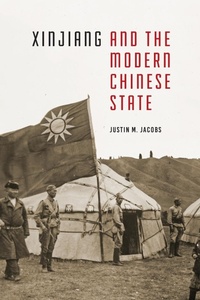
Xinjiang and the Modern Chinese State
Published on 1. September 2017
Book
Paperback/Softback
320 pages
978-0-295-74264-9 (ISBN)
Description
Open-access edition: DOI 10.6069/9780295806570
Xinjiang and the Modern Chinese State views modern Chinese political history from the perspective of Han officials who were tasked with governing Xinjiang. This region, inhabited by Uighurs, Kazaks, Hui, Mongols, Kirgiz, and Tajiks, is also the last significant "colony" of the former Qing empire to remain under continuous Chinese rule throughout the twentieth century. By foregrounding the responses of Chinese and other imperial elites to the growing threat of national determination across Eurasia, Justin Jacobs argues for a reconceptualization of the modern Chinese state as a "national empire." He shows how strategies for administering this region in the late Qing, Republican, and Communist eras were molded by, and shaped in response to, the rival platforms of ethnic difference characterized by Soviet and other geopolitical competitors across Inner and East Asia.
This riveting narrative tracks Xinjiang political history through the Bolshevik revolution, the warlord years, Chinese civil war, and the large-scale Han immigration in the People's Republic of China, as well as the efforts of the exiled Xinjiang government in Taiwan after 1949 to claim the loyalty of Xinjiang refugees.
Xinjiang and the Modern Chinese State views modern Chinese political history from the perspective of Han officials who were tasked with governing Xinjiang. This region, inhabited by Uighurs, Kazaks, Hui, Mongols, Kirgiz, and Tajiks, is also the last significant "colony" of the former Qing empire to remain under continuous Chinese rule throughout the twentieth century. By foregrounding the responses of Chinese and other imperial elites to the growing threat of national determination across Eurasia, Justin Jacobs argues for a reconceptualization of the modern Chinese state as a "national empire." He shows how strategies for administering this region in the late Qing, Republican, and Communist eras were molded by, and shaped in response to, the rival platforms of ethnic difference characterized by Soviet and other geopolitical competitors across Inner and East Asia.
This riveting narrative tracks Xinjiang political history through the Bolshevik revolution, the warlord years, Chinese civil war, and the large-scale Han immigration in the People's Republic of China, as well as the efforts of the exiled Xinjiang government in Taiwan after 1949 to claim the loyalty of Xinjiang refugees.
Reviews / Votes
"This book provides timely and highly valuable research on the long roots of China's relations with Xinjiang, situating today's tension and conflicts within a sweeping historical context. . . . Essential."(Choice) "Jacobs explains better than any other previous scholar how the 'empire of nations' that is the modern PRC emerged from the colonial rule of the Qing dynasty and the politics of accommodation of Republican China on the frontiers."
- Peter C. Perdue (Cross-Currents: East Asian History and Culture Review) "This nicely conceived, thoroughly researched, thoughtful, and well-written book is a must-read for anyone interested in ethnicity in China."
(Journal of Asian Studies)
More details
Series
Language
English
Place of publication
Seattle
United States
Target group
Professional and scholarly
US School Grade: College Graduate Student and over
Product notice
Paperback (trade)
Illustrations
9 illus., 5 maps
Dimensions
Height: 229 mm
Width: 152 mm
Thickness: 19 mm
Weight
518 gr
ISBN-13
978-0-295-74264-9 (9780295742649)
Copyright in bibliographic data and cover images is held by Nielsen Book Services Limited or by the publishers or by their respective licensors: all rights reserved.
Schweitzer Classification
Person
Justin M. Jacobs is associate professor of history at American University in Washington, DC.