

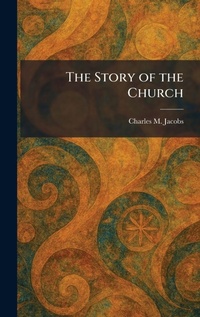
The Story of the Church
Description
"The Story of the Church" by Charles M. Jacobs offers a comprehensive and accessible overview of the historical development of Christianity from its origins to the early 20th century. This work meticulously traces the evolution of the Christian faith, its institutional structures, and its profound impact on the trajectory of global civilization. Jacobs provides readers with a clear, chronological narrative that examines the pivotal events, key figures, and essential theological shifts that have defined the church over two millennia.
Through its detailed exploration, the book delves into the challenges faced by the early church, the complexities of the Middle Ages, the transformative power of the Reformation, and the subsequent expansion of various denominations. Jacobs emphasizes the continuity of the Christian tradition while highlighting how different cultures and eras have shaped and interpreted the faith. Written with both historical rigor and a narrative flow suitable for a general audience, "The Story of the Church" serves as an invaluable resource for students of history, theology, and anyone seeking to understand the foundations of the modern religious landscape.
This work has been selected by scholars as being culturally important, and is part of the knowledge base of civilization as we know it. This work was reproduced from the original artifact, and remains as true to the original work as possible. Therefore, you may see the original copyright references, library stamps (as most of these works have been housed in our most important libraries around the world), and other notations in the work.
This work is in the public domain in the United States of America, and possibly other nations. Within the United States, you may freely copy and distribute this work, as no entity (individual or corporate) has a copyright on the body of the work.
As a reproduction of a historical artifact, this work may contain missing or blurred pages, poor pictures, errant marks, etc. Scholars believe, and we concur, that this work is important enough to be preserved, reproduced, and made generally available to the public. We appreciate your support of the preservation process, and thank you for being an important part of keeping this knowledge alive and relevant.