

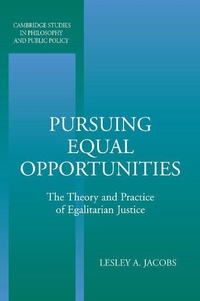
Pursuing Equal Opportunities
The Theory and Practice of Egalitarian Justice
Published on 10. November 2003
Book
Paperback/Softback
296 pages
978-0-521-53021-7 (ISBN)
Description
Pursuing equality is an important challenge for any modern democratic society but this challenge faces two sets of difficulties: the theoretical question of what sort of equality to pursue and for whom; and the practical question concerning which legal and political institutions are the most appropriate vehicles for implementing egalitarian social policy and thus realizing egalitarian justice. This book offers original and innovative contributions to the debate about equality of opportunity. The first part of the book sets out a theory of equality of opportunity that presents equal opportunities as a normative device for the regulation of competition for scarce resources. The second part shifts the focus to the consideration of the practical application by courts or legislatures or public policy makers of policies for addressing racial, class or gender injustices. The author examines standardized tests, affirmative action, workfare, universal health-care, comparable worth, and the economic consequences of divorce.
Reviews / Votes
'... the book is thorough, accessible and clearly written.' Political Studies ReviewMore details
Series
Language
English
Place of publication
Cambridge
United Kingdom
Target group
Professional and scholarly
Product notice
Paperback (trade)
Illustrations
Worked examples or Exercises
Dimensions
Height: 229 mm
Width: 152 mm
Thickness: 18 mm
Weight
484 gr
ISBN-13
978-0-521-53021-7 (9780521530217)
Copyright in bibliographic data and cover images is held by Nielsen Book Services Limited or by the publishers or by their respective licensors: all rights reserved.
Schweitzer Classification
Other editions
Additional editions
E-Book
05/2006
1st Edition
Cambridge University Press
€26.49
Available for download
Book
11/2003
Cambridge University Press
€104.00
Shipment within 15-20 days
Person
Content
1. Introduction; 2. Equal opportunities as a regulative ideal; 3. Equal opportunity without natural inequalities; Part I. Race: 4. Equal opportunities and civil rights: merit, standardized tests, and higher education; 5. Integration, diversity, and affirmative action; Part II. Class: 6. Justifying workfare; 7. Universal access to health care; Part III. Gender: 8. Gender inequalities in the workplace; 9. Equal opportunities after divorce.