

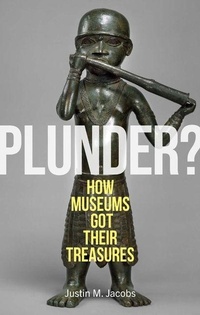
Plunder?
How Museums Got Their Treasures
Published on 1. August 2024
Book
Hardback
216 pages
978-1-78914-948-7 (ISBN)
Description
In this thought-provoking new work, historian Justin M. Jacobs challenges the widely accepted belief that many of Western museums' treasures were acquired by imperialist plunder and theft. His account re-examines the allegedly immoral provenance of Western collections, advocating for a nuanced understanding of how artefacts reached Western shores. Jacobs examines the perspectives of Chinese, Egyptian and other participants in the global antiquities trade over the past two and a half centuries, revealing that Western collectors were often willingly embraced by locals. This collaborative dynamic, largely ignored by contemporary museum critics, unfolds a narrative that may lead to hope and promise for a brighter, more equitable future.
Reviews / Votes
In Plunder? How Museums Got Their Treasures, the historian Justin M. Jacobs sets out to upend this view . . . The strength of Mr. Jacobs's [polemic] is to remind us that the origins of great museum collections cannot be reduced to any one story. -- Hugh Eakin * Wall Street Journal * Jacobs suggests in his lively and provocative Plunder?, not only is the great part of what's in our museums not the spoils of colonialist theft, it's there because at the time that these artefacts made their way into Western collections, through the nineteenth and early twentieth centuries, they did so with the consent of those in charge . . . His non-judgmental unearthing, via contemporary accounts, of how antiquities were once traded and given rather than plundered, is a riposte to those who believe all museum collections to be illegitimately come by. -- JJ Charlesworth * The Daily Telegraph * The book, which covers objects ranging from ancient Egyptian antiquities to the Parthenon marbles, challenges the widely accepted assumption that many western museum treasures were acquired by imperialist plunder and theft, arguing for a nuanced understanding of how they reached western shores. -- Dalya Alberge * The Observer * The ironical question mark of the title of Justin Jacob's Plunder? is a courageous gesture of defiance against the all-pervading backdrop of postcolonial discourse; his book succinctly demolishes the anachronistic concept that museum artefacts are acquisitions of imperial theft. -- Tista Austin * The Critic * Jacobs is a historian of antiquities and archaeology who is fed up with "simplistic bedtime stories" abouthow museums assembled their collections. He objects to the prevailing discourse that regards Western museums as illegitimate repositories of the spoils of empire. In Plunder?, he shows how that notion is historically inaccurate and imposes a modern ideology - of seeing certain ancient artifacts as priceless national treasures - on people in the past who would have found it alien. Plunder? is a scholarly work, but it is the opposite of dry: Jacobs mounts his argument with verve and a relish in dismantling fashionable dogmas. He acknowledges that some objects in Western museums are in fact plunder: They were taken by soldiers during military campaigns. The vast majority of acquisitions, however, came from diplomatic gifts (notably, the Elgin Marbles), via dealers of antiquities, or from archaeological digs. In all these cases, transactions that benefited both sides were conducted openly: Natives who participated were not dupes of imperialists. Only when elites in countries such as Egypt and Turkey became Westernized did they begin to adopt the Western conception of antiquities as priceless art and to put restrictions on their removal. Ironically, in this sense, "Western scholars dug their own archaeological grave". * National Review * During the past century or so, an unfortunate dichotomy has developed which divides archaeologists, museums and collectors into two camps. One views them as heroic explorers who rescued long-neglected antiquities that were going to rack and ruin, while the other sees them as rapacious foreign devils grabbing whatever pelf they could acquire for financial gain or imperialistic glory. In this meticulously researched and carefully illustrated volume, historian Justin M. Jacobs adopts a more balanced, neutral stance which takes a whole panoply of factors into consideration. He convincingly demonstrates that there is no single narrative that can account for the multifarious ways in which archaeological materials ended up in lands other than where they originated, or indeed were destroyed inside the very nations where they were created. Plunder?, rightly posed as a question, provides the reader with a whole range of evidence for complicity from all sides involved in the acquisition. * Victor H. Mair, Professor of Chinese Language and Literature, University of Pennsylvania *
More details
Language
English
Place of publication
London
United Kingdom
Product notice
sewn/stitched
Cloth over boards
Illustrations
49 illustrations
Dimensions
Height: 221 mm
Width: 144 mm
Thickness: 23 mm
Weight
414 gr
ISBN-13
978-1-78914-948-7 (9781789149487)
Copyright in bibliographic data and cover images is held by Nielsen Book Services Limited or by the publishers or by their respective licensors: all rights reserved.
Schweitzer Classification
Person
Justin M. Jacobs is Professor of History at American University, Washington, DC. His books include The Compensations of Plunder: How China Lost Its Treasures (2020).
Content
Introduction
Chapter 1: Presents and Plunder
Chapter 2: Dealers
Chapter 3: Excavations and Expeditions
Conclusion
References
Select Bibliography
Acknowledgements
Photo Acknowledgements
Index
Chapter 1: Presents and Plunder
Chapter 2: Dealers
Chapter 3: Excavations and Expeditions
Conclusion
References
Select Bibliography
Acknowledgements
Photo Acknowledgements
Index