

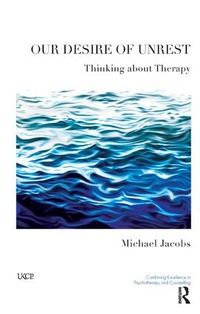
Our Desire of Unrest
Thinking About Therapy
1st Edition
Published on 1. January 2009
Book
Paperback/Softback
208 pages
978-1-85575-489-8 (ISBN)
Description
Knowledge is never static. It is always open to revolutionary thinking or to evolving development. Similarly an individual's knowledge is always moving, and indeed if the ability to think about ideas is lost, an important part of the individual is also lost. In this book, a collection of some of the papers and lectures written by Michael Jacobs over a period of thirty or more years, the author shows his own thinking at work, as he challenges himself to look deeper at some important aspects of his discipline - principally psychodynamic psychotherapy, although always with reference to other forms of discourse such as literature and theology. Here the reader will find the writer behind those popular texts such as The Presenting Past, Psychodynamic Counselling in Action and Shakespeare on the Couch.
Reviews / Votes
'Michael Jacobs is an important, influential, erudite and humane voice within counselling and psychotherapy, urging us to consider what we do not know and to live and work with more complexity.'- Susie Orbach, Psychoanalyst'For more than thirty years, Michael Jacobs has occupied a seminal position in the training and education of psychotherapists and counsellors in Great Britain and beyond. In his latest book... Jacobs takes us on an engrossing intellectual journey as he revisits crucial turning points in his development as both theoretician and practitioner... he helps us to explore a number of often neglected topics, such as fame and fate, the psychology of optimism and pessimism, and the study of the therapist's relationship to the idea of revenge. A beautiful amalgamation of personal and professional vignettes and observations, this book will engage all of us who work in the psychological arena.'- Brett Kahr, Senior Clinical Research Fellow in Psychotherapy and Mental Health at the Centre for Child Mental Health, London'This is a worthwhile read and the use of theological and literary references gives depth and resonance to the read.'- T.B. Broll, New TherapistMore details
Series
Language
English
Place of publication
London
United Kingdom
Publishing group
Taylor & Francis Ltd
Target group
College/higher education
Professional and scholarly
Professional Practice & Development
Dimensions
Height: 229 mm
Width: 146 mm
Weight
320 gr
ISBN-13
978-1-85575-489-8 (9781855754898)
Copyright in bibliographic data and cover images is held by Nielsen Book Services Limited or by the publishers or by their respective licensors: all rights reserved.
Schweitzer Classification
Other editions
Additional editions
Book
09/2019
1st Edition
Routledge
€185.90
Shipment within 15-20 days
E-Book
04/2018
1st Edition
Routledge
€49.99
Available for download
E-Book
04/2018
1st Edition
Routledge
€49.99
Available for download
Person
Michael Jacobs is a Visiting Professor at the Institute of Health and Community Studies, Bournemouth University, and in independent practice in Swanage, Dorset, where he supervises counsellors, sees clients and continues to write and edit. He was, prior to retirement, Director of the Counselling and Psychotherapy programme at the University of Leicester for fifteen years, and prior to that a therapist in the Student Health Service at the same University for twelve years. His books on psychodynamic counselling and therapy are used as key texts on many training courses - notably 'The Presenting Past, Psychodynamic Counselling in Action' and 'Still Small Voice'. Other recent publications include 'The Therapist's Use of Self' (written with John Rowan) and 'Supervision: Questions and Answers for Counsellors and Therapists' (co-written with his wife, Moira Walker).
Content
Preface -- Challenging the stereotype: the psychoanalytic therapist's use of self -- Our desire of unrest -- Naming and labelling -- Optimism and pessimism -- The therapist's revenge: the law of talion as a motive for caring -- Parallel process: confirmation and critique -- Seeing and being seen -- The significance of fame -- Have we lost fate? -- A maturing professional approach