

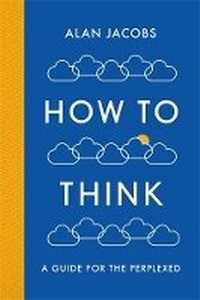
How To Think
A Guide for the Perplexed
Published on 26. October 2017
Book
Hardback
160 pages
978-1-78125-956-6 (ISBN)
Description
How to Think is a contrarian treatise on why we're not as good at thinking as we assume - but how recovering this lost art can rescue our inner lives from the chaos of modern life.
Most of us don't want to think, writes the American essayist Alan Jacobs. Thinking is trouble. It can force us out of familiar, comforting habits, and it can complicate our relationships with like-minded friends. Finally, thinking is slow, and that's a problem when our habits of consuming information (mostly online) leave us lost in the echo chamber of social media, where speed and factionalism trump accuracy and nuance.
In this clever, witty book, Jacobs diagnoses the many forces that prevent thought - forces that have only worsened in the age of Twitter, such as "alternative facts," and information overload. He also dispels the many myths we hold about what it means to think well. (For example: it's impossible to "think for yourself.")
Drawing on sources as far-flung as the novelist Marilynne Robinson, the basketball legend Wilt Chamberlain, the British philosopher John Stuart Mill and the Christian theologian C.S. Lewis, Jacobs digs into the nuts and bolts of the cognitive process, offering hope that each of us can reclaim our mental lives from the whirlpool of what now passes for public debate.
After all, if we can learn to think together, perhaps we can learn to live together.
Most of us don't want to think, writes the American essayist Alan Jacobs. Thinking is trouble. It can force us out of familiar, comforting habits, and it can complicate our relationships with like-minded friends. Finally, thinking is slow, and that's a problem when our habits of consuming information (mostly online) leave us lost in the echo chamber of social media, where speed and factionalism trump accuracy and nuance.
In this clever, witty book, Jacobs diagnoses the many forces that prevent thought - forces that have only worsened in the age of Twitter, such as "alternative facts," and information overload. He also dispels the many myths we hold about what it means to think well. (For example: it's impossible to "think for yourself.")
Drawing on sources as far-flung as the novelist Marilynne Robinson, the basketball legend Wilt Chamberlain, the British philosopher John Stuart Mill and the Christian theologian C.S. Lewis, Jacobs digs into the nuts and bolts of the cognitive process, offering hope that each of us can reclaim our mental lives from the whirlpool of what now passes for public debate.
After all, if we can learn to think together, perhaps we can learn to live together.
Reviews / Votes
Witty, engaging, and ultimately hopeful, Jacobs's guide is sorely needed in a society where partisanship too often trumps the pursuit of knowledge. * Publishers Weekly * As much as this book is a manual, it's also a self-portrait of a particular mind, whose style and skills are ballast against the cognitive turbulence of our time. Reading How to Think feels like riding in a small but sturdy boat, Alan Jacobs your pilot through turbulent waters - and if you're eager to get where he's taking you, you're also grateful for the chance to simply watch him do his thing. -- Robin Sloan, author of 'Mr Penumbra's 24-Hour Bookstore'More details
Edition
Main
Language
English
Place of publication
London
United Kingdom
Product notice
Trade binding
Dimensions
Height: 204 mm
Width: 138 mm
Thickness: 20 mm
Weight
272 gr
ISBN-13
978-1-78125-956-6 (9781781259566)
Copyright in bibliographic data and cover images is held by Nielsen Book Services Limited or by the publishers or by their respective licensors: all rights reserved.
Schweitzer Classification
Other editions
Additional editions
E-Book
10/2017
Profile Books Ltd
€9.49
Available for download
Person
Alan Jacobs is the Distinguished Professor of the Humanities at Baylor University. He has written extensively for The Atlantic, WSJ, The New Atlantis, and Harper's and is the author of several books including a well-received biography of C. S. Lewis and a book on the pleasures of reading.
Find him on twitter.com/ayjay and visit his website at http://blog.ayjay.org/
Find him on twitter.com/ayjay and visit his website at http://blog.ayjay.org/